177 results for: Immigration
Photograph
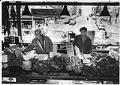
Footong Tsoy Saelee and Choi Saechao selling produce at Pike Place Market, Seattle, July 21, 1982
The Indochinese Farm Project began in 1982 with 18 acres of land along the Sammamish River. Funded in part by King County and the Pike Place Market Preservation and Development Authority (Market PDA), the Indochinese Farm project was a joint project of the Washington State Commission on Asian American Affairs and Bethany Presbyterian church. Through the project, refugees from Laos,…
ID Number:2000.107.151.05.02
Date:1982
Photograph
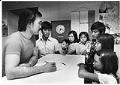
Buntha Nhep counseling Taing family at the Asian Resettlement Center, Bellevue, June 14, 1982
In the aftermath of the Vietnam War, thousands of people from Vietnam, Cambodia, and Laos fled violence and persecution in their home countries and sought refuge in the United States and elsewhere. By 1982, there were 30,000 refugees from Southeast Asia living in Washington. Many spoke little or no English, had very little money, and were unemployed. When they left…
ID Number:2000.107.151.05.03
Date:1982
Photograph
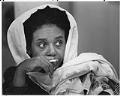
Zaid Tesfaion in a class at the Refugee Women's Alliance, Seattle, January 22, 1991
In the early 1990s, refugees arriving in Washington were coming from more and more diverse places. In the 1980s, most arrived from Southeast Asia, fleeing the ongoing effects of the Vietnam War. By contrast, in 1991 the state estimated that fewer than half of incoming refugees came from Southeast Asia. About 42 percent were Jews or Pentecostalists arriving from the…
ID Number:2000.107.151.05.04
Date:1991
Photograph
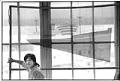
Norie Sato with unfinished artwork, Seattle, June 26, 1991
Norie Sato (b. 1949) was born in northern Japan and moved to the United States at age four with her family. She moved to Seattle in 1972 and studied at the University of Washington, receiving a Master of Fine Arts in printmaking in 1974. Sato’s early work focused on printmaking, and she later incorporated glass and video elements as well.…
ID Number:2000.107.160.17.01
Date:1991
Photograph
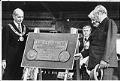
King Olav V unveiling plaque at Bergen Place, Seattle, October 19, 1975
Bergen Place in Seattle's Ballard neighborhood is a park honoring Bergen, Norway, one of Seattle's International Sister Cities. The park is located on the triangular site between Leary Avenue, 22nd Avenue NW, and Market Street. In this image Eilert Eilertsen (1918-2014), left, Lord Mayor of Bergen, an unidentified man, and Wesley C. Uhlman (1935-), Mayor of Seattle, look on as…
ID Number:2000.107.165.09.01
Date:1975
Photograph
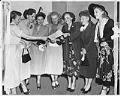
German war brides holding U.S. citizenship papers, Seattle, June 18, 1951
The years after World War II saw an increase in immigration outside of national quotas, primarily for the spouses and children of members of the U. S. Armed Forces, brought about by legislation like the War Brides Act of 1945. This photo shows seven of nine German war brides naturalized in Seattle on June 18, 1951. They are identified from…
ID Number:2000.107.217.22.01
Date:1951
Photograph
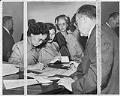
Jung Oy Chinn signing U.S. naturalization papers, Seattle, September 17, 1951
In 1943, the Magnuson Act repealed exclusion of Chinese immigrants and allowed for a small amount of ethnic Chinese immigration to the United States. The act helped lead to additional measures allowing for quotas of other Asian ethnic groups immigrating to the United States, and in 1965 the ending of the National Origins quota system.This photo shows Jung Oy Yee…
ID Number:2000.107.217.22.02
Date:1951
Photograph
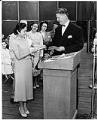
Nina Rivera receiving U.S. naturalization papers, Seattle, July 2, 1952
Each year, the Immigration and Naturalization Service holds ceremonies for new immigrants to become U.S. citizens. Here, John. P. Boyd, district director of the INS, presents citizenship papers to Nina E. Rivera, on July 2, 1952. Caption information derived from captions written by Post-Intelligencer staff and attached to the back of the photograph.
ID Number:2000.107.217.22.03
Date:1952
Photograph
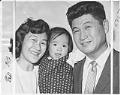
Tamura family posing at U.S. naturalization ceremony, Seattle, November 1, 1965
The Immigration Act of 1965, also called the Hart-Celler Reform Act, removed the national origins quota system of American immigration, effectively ending a system of quotas by racial ethnicity that had been in place since 1924.In this image, Mr. and Mrs. George Tamura are with their 20-month-old daughter Rica at her naturalization ceremony. Caption information source: "Asian American History," Japanese…
ID Number:2000.107.217.23.01
Date:1965
Photograph
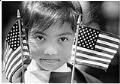
Nyra Sone holding flags at U.S. citizenship ceremony at the Seattle Center, July 4, 1986
Each year, the Immigration and Naturalization Service holds ceremonies for new immigrants to become U.S. citizens. In this image, Nyra Sone, a 9-year-old from Laos, is holding two American flags at her naturalization ceremony on the Fourth of July at the Seattle Center. Caption information derived from captions written by Post-Intelligencer staff and attached to the back of the photograph.
ID Number:2000.107.217.23.02
Date:1986