177 results for: Immigration
Photograph
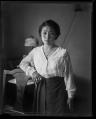
Mrs. E. Nishida, circa 1921
People of Japanese ancestry have lived in Seattle since 1879. By 1900, they had become Seattle's largest minority group. Japanese immigrants were successful farmers, and they operated hotels and small shops. However, they were unable to own property or apply for citizenship due to discriminatory immigration laws. In this photo, taken around 1921, one of Seattle's young Japanese citizens poses…
ID Number:1983.10.1068.2
Date:Circa 1921
Photograph
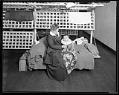
Immigration staff member with Japanese baby, circa 1920
For many years, the United States laws tightly restricted Asian immigration. In the 1920s, Chinese and Japanese wives of Chinese and Japanese citizens of the United States couldn't immigrate to this country, but children could enter if their fathers were legal residents. This meant problems for mothers and children traveling together. The mother might be turned away, but the child…
ID Number:1983.10.1969
Date:Circa 1920
Photograph
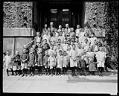
Russian children, circa 1925
In the decade following the 1917 Russian Revolution, nearly a million Russians fled the country. Many refugees took the train across Russia and sailed to the United States from Chinese ports. In 1923 alone, the local Russian Orthodox Cathedral of St. Spiridon helped over 6,000 Russian refugees. Other churches and civic organizations also assisted in the resettlement.This photo, taken sometime…
ID Number:1983.10.2157.2
Date:Circa 1925
Audio recording
Oral history interview with Frank Miyamoto, April 23, 1985
S. Frank Miyamoto was born in 1912 in Seattle to Issei immigrants. He earned his Bachelor of Arts (1936) and Master of Arts (1938) degrees in sociology from the University of Washington. His first faculty appointment was at the University of Washington in 1941 -- an appointment that was terminated when he was forceably removed due to his Japanese heritage.…
ID Number:1985.134.16
Date:1985
Audio recording
Oral history interview with Tomo Shoji, April 10, 1985
Interview with Tomo Shoji about her experiences before and during World War II, conducted by Lorraine McConaghy for the Life on the Homefront Oral History Project, April 10, 1985. She discusses her parents' arrival in the U.S. and their work in a sawmill camp. Her mother later moved to Seattle and set up a midwifery practice for the Japanese community.…
ID Number:1985.134.22
Date:1985
Photograph
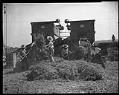
Migrant workers harvesting hay, 1944
The entrance of the United States into World War II created a shortage of farm laborers, as American men left to serve in the war. In the Yakima Valley and western Washington, the labor shortage was exacerbated by the incarceration of Japanese-Americans, many of whom worked on farms. The Braceros program, a series of laws and diplomatic agreements between the…
ID Number:1986.5.2905.1
Date:1944
Photograph
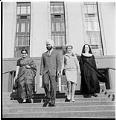
Four people leaving courthouse after naturalization ceremony, March 1, 1965
On Monday, March 1, 1965, 46 people from 15 countries became U.S. citizens in naturalization proceedings held at the United State District Court in Seattle. Among the new citizens were the four individuals pictured here, descending the courthouse steps (left to right): Sheila Gulrajani, Gurnam Singh Sidhu, Leila Aulikki Maattanen, and Sister Catherine G. Rehal.
ID Number:1986.5.15318.1
Date:1965
Photograph
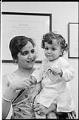
Suman Gupta with her daughter after receiving permanent residency, Seattle, March 1966
Twenty-two-year-old Suman Gupta arrived in the U.S. from India in November 1963 to join her husband, Har Krishan Lal Gupta, in Olympia, Washington. Since she didn't have a visa, Immigration and Naturalization Service placed her in the legal custody of her husband. Her status was upgraded after a 1965 change in immigration law, the Hart-Celler Act, abolished an earlier quota…
ID Number:1986.5.27165.4
Date:1966
Photograph
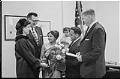
Suman Gupta and family in office after she received permanent residency, March, 1966
Twenty-two-year-old Suman Gupta arrived in the U.S. from India in November 1963 to join her husband, Har Krishan Lal Gupta, in Olympia, Washington. Since she didn't have a visa, Immigration and Naturalization Service placed her in the legal custody of her husband. Her status was upgraded after a 1965 change in immigration law, the Hart-Celler Act, abolished an earlier quota…
ID Number:1986.5.27165.11
Date:1966
Photograph
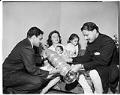
Rajanikant “Raj” and Irene Joshi with their daughters and an unidentified man, February 1965
Rajanikant "Raj" Joshi (1932-2018), originally from Gwailor, India, came to the U.S. in the late 1940s with his family. He attended the University of Washington in the mid-1950s, earning his Master's degree in Urban Planning. He met his wife, Irene, at the UW, and the two married on their shared birthday, October 10, in 1958. Joshi worked as an urban…
ID Number:1986.5.30744.1
Date:1965