584 results for: Alaska
Photograph
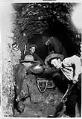
Four men digging tunnel in gold mine at Eldorado, circa 1898
In Alaska and the Yukon, placer gold was found along ancient stream beds, some of which were twelve to forty feet underground at bedrock. The gold was frozen in the dirt or gravel. Miners chopped away at the frozen earth with picks or tried to thaw it with fires or steam machines. They "drifted" all winter, digging tunnels in the…
ID Number:SHS15820
Date:Circa 1898
Photograph
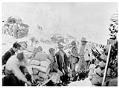
Men with piles of supplies at Chilkoot Pass, circa 1898
At the top of Chilkoot Pass, the gold seekers stockpiled what they had carried up the steep slope and went back for another load. When they had packed everything to the top of the pass, they were ready to cross the border into Canada. During the stampede of 1898, Canada's Northwest Mounted Police checked some 40,000 people through the border.This…
ID Number:SHS15867
Date:Circa 1898
Photograph
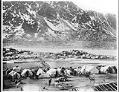
Gold rush tent city, probably Lake Bennett, 1898
In early spring 1898, an estimated 10,000 gold seekers were camped on the shore of Lake Bennett waiting for the ice to clear. They assembled their supplies and built boats and scows to take them down the Yukon River. Until the railroad was completed in 1900, Bennett continued to be a major jumping off spot for the Klondike gold fields.…
ID Number:SHS15876
Date:1898
Photograph
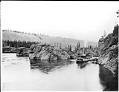
Steamboat "W.K. Merwin" coming up Five Finger Rapids, circa 1898
At Five Finger Rapids, the Yukon River divided into five channels around four islands. This was so tricky to navigate that a permanent cable was anchored in the rocky side of one channel and ships pulled themselves through.This photo, taken around 1898 by Eric Hegg, shows the steamboat "W.K. Merwin" headed upstream. In other versions of this photo, one can…
ID Number:SHS15884
Date:Circa 1898
Photograph
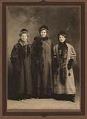
Three women in Skagway, circa 1900
By 1900, American and European women made up 23% of Skagway's population. Some were housewives or nuns. Others were secretaries, taught school, wrote for newspapers, cared for the sick, or ran shops and other businesses.This photo portrait, taken around 1900, shows three Skagway women wearing long warm coats and furs. They are (L to R) Mrs. Daisy Bushell, Lou Doubler,…
ID Number:SHS15931
Date:Circa 1900
Photograph
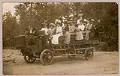
Seattle's first motor-driven sightseeing bus, Seattle, 1907
In 1907, Seattle residents and visitors could climb on the city's first motor-driven sightseeing bus. The vehicle carried passengers to The Meadows racetrack and other destinations. The bus was also used to show visitors the sights at the 1909 Alaska-Yukon-Pacific Exposition (AYPE).
ID Number:SHS16180
Date:1907
Photograph
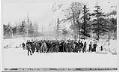
Miners meeting at Sheep Camp, Alaska for trial of camp thieves , circa 1896
At first, miners made and enforced their own laws on the Alaskan frontier. This photo shows a group of miners meeting to decide what to do about camp thieves. It was taken around 1896 at Sheep Camp, Alaska, about 12 miles north of Skagway. James Wickersham, an early Alaskan district judge reported that thieves were given thirty lashes on their…
ID Number:SHS16454
Date:Circa 1896
Photograph
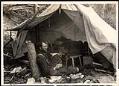
Lucas in tent, 1898
Seattleite Asahel Curtis left for the Klondike in 1897 and stayed two years, taking photos for the Seattle Post-Intelligencer. In 1898, Curtis took this photo of a man named Lucas resting outside his tent. Inside the tent, two pots heat on top of a small woodstove; the chimney of the stove passes up through the roof of the tent. The…
ID Number:SHS16668
Date:1898
Photograph
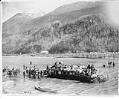
Unloading freight at Skagway, 1898
Gold seekers heading to the Klondike gold fields via the Inland Passage could land at Skagway or Dyea. At first, ships had to anchor offshore and unload their passengers and freight onto barges which carried them ashore. There was usually an extra charge for this.This 1898 photo of the tidal flats at Skagway shows freight being unloaded from a barge.…
ID Number:SHS16696
Date:1898
Photograph
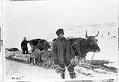
Two men and oxen on Skagway Trail, 1898
In 1897 and 1898, some of the Klondike stampeders used oxen to carry supplies along the White Pass Trail. Others used dogs, horses, mules, and even goats. Once the railroad was completed from Skagway through White Pass, there was less need for these pack animals.In this 1898 photo taken by Asahel Curtis, two men stand in the snow near their…
ID Number:SHS16716
Date:1898