771 results for: Transportation
Ephemera
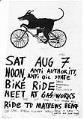
Anti-authority, anti-oil state bike ride flyer, August 7, 1993
In the summer of 1993, Seattle-area bike riders organized several “anti-authority” rides along the Burke-Gilman Trail, starting in Gas Works Park and ending with picnics on Lake Washington.This flyer sports a drawing of a dog pedaling a bicycle and advertises an early August ride to Matthews Beach. The meeting place, route, and date are handwritten below, along with the statements…
ID Number:2002.23.5.70.1
Date:1993
Ephemera
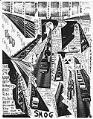
Anti-authority bike ride and picnic flyer, Seattle, July 24, 1993
In the summer of 1993, Seattle-area bike riders organized several “anti-authority” rides along the Burke-Gilman Trail, starting in Gas Works Park and ending with picnics on Lake Washington.This collage-style flyer for a late July ride to Sand Point combines the handwritten names of major national corporations related to cars (e.g., Ford), gasoline (e.g., EXXON), and cigarettes (e.g., Philip Morris), with…
ID Number:2002.23.7.25.1
Date:1993
Poster
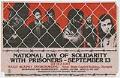
National Day of Solidarity with Prisoners poster, September 13, 1978
The Attica Prison Uprising of 1971 is one of the most well-known flashpoints of the prisoners' rights movement of the 1960s and 1970s. In Seattle, the Uprising was commemorated by marches and other actions on its anniversary over the subsequent several years. On September 6,1978, the newly formed Washington Coalition Against More Prisons asked state officials to immediately release 1000…
ID Number:2002.23.11.12
Date:1978
Postcard
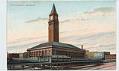
King Street Station, Seattle, circa 1910
Seattle's King Street Station was built between 1904 and 1906 for the Great Northern Railroad. The St. Paul, Minnesota, architectural firm of Reed & Stem designed the station, patterning its tall clock tower after a famous bell tower in Venice, Italy. This mimicry of European architecture added a touch of tradition and heritage to Seattle's growing downtown area. Caption on…
ID Number:2002.48.678
Date:Circa 1910
Postcard
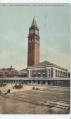
King Street Station, Seattle, circa 1910
Seattle's King Street Station was built between 1904 and 1906 for the Great Northern Railroad. The St. Paul, Minnesota, architectural firm of Reed & Stem designed the station, patterning its tall clock tower after a famous bell tower in Venice, Italy. This mimicry of European architecture added a touch of tradition and heritage to Seattle's growing downtown area. Caption on…
ID Number:2002.48.681
Date:Circa 1910
Postcard
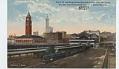
King Street Station, Smith Tower, and Oregon-Washington Station from south, Seattle, circa 1915
These three buildings still remain Seattle landmarks. To the left, the Great Northern and Northern Pacific's King Street Station, with its clock tower, was constructed in 1906. On the right, the Union Pacific completed the Oregon and Washington Station, later known as Union Station, in 1911. In the center is the L. C. Smith Building, later Smith Tower. At the…
ID Number:2002.48.684
Date:Circa 1915
Photograph
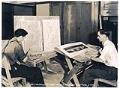
James Fitzgerald and Lloyd Lovegren working on the East Tunnel Portal models for the Lake Washington Floating Bridge, May 9, 1940
Architect Lloyd Lovegren and artist James Fitzgerald designed the East Tunnel Portals, basing a set of sculptural panels on Northwest Coast Native American motifs. Here, Fitzgerald (left) works on a model for one of the panels while Lovegren (right) works with the overall design. Caption on photo: Unit 2. Modeling for precast concrete slabs of east tunnel portal.Photographer's Reference Number:…
ID Number:2003.30.151
Date:1940
Photograph
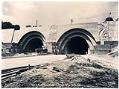
East tunnel portals on the Lake Washington Floating Bridge, June 21, 1940
A decorative concrete facade marked the eastern entrance of the twin-bore tunnel that connected Seattle to the Lake Washington Floating Bridge. Architect Lloyd Lovegren and artist James Fitzgerald designed the portals, basing their sculptural panels on Northwest Coast Native American motifs. In this June 1940 image, two of the three panels have been installed. Caption on photo: Unit 2. East…
ID Number:2003.30.159
Date:1940
Photograph
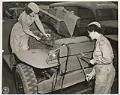
Transportation Corps WACs fixing an Army Jeep, Seattle, July 1944
In 1942, the U.S. Department of War recognized the need for a single manager of Army transportation and created a new branch, the Transportation Corps. The Transportation Corps’ primary function is movement control, and during WWII, the Transportation Corps moved over 30 million Soldiers in the United States and 7 million overseas, along with 126 million tons of cargo.In this…
ID Number:2003.57.6
Date:1944
Photograph
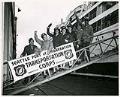
Soldiers waving from gangplank at Port of Embarkation, Seattle, circa 1944
In 1942, the Seattle Port of Embarkation began operations at Pier A (later Pier 36) in Smith Cove, at the northern end of Elliott Bay. Over the next 14 years, the Port of Embarkation will become one of the United States Army's busiest terminals for moving troops and supplies overseas during both World War II and the Korean War. This…
ID Number:2003.57.26
Date:Circa 1944