165 results for: Klondike-Alaska Gold Rush
Photograph
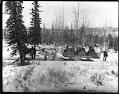
White Pass & Yukon Route sleigh, 1905
Some of the people heading to the Yukon gold fields sailed to Skagway and then packed their equipment and food through White Pass on horses and mules. Conditions along the trail were poor, and thousands of pack animals died. In 1900, the White Pass & Yukon Route railroad was completed between Skagway on the coast and Whitehorse on the Yukon…
ID Number:1983.10.13146
Date:1905
Photograph
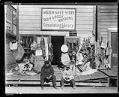
Golden Gate Store and Circulating Library, Alaska, 1905
In Alaska, many general stores still carry a little bit of everything, from thread and canned goods to boots and library books.This 1905 photo, taken during the Nome gold rush, shows an Alaskan Native man and boy sitting on the wooden sidewalk outside the Golden Gate Store. Baskets, furs, dolls, and other souvenirs cover the outside of the building. Even…
ID Number:1983.10.13147
Date:1905
Photograph
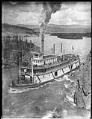
Riverboat "White Horse," circa 1905
The steamer "White Horse," nicknamed "The Old Gray Mare" was one of many Yukon River steamers which carried miners and other travelers to the Klondike gold fields near Dawson. At Five Finger Rapids, the Yukon divided into five channels around four rocky islands. The rapids were so dangerous that a cable was installed and steamboats pulled themselves along through the…
ID Number:1983.10.13153
Date:Circa 1905
Photograph
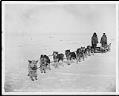
B.T. Dyer and Crosby Keen's dogsled on record trip from Seattle to Nome, April 10, 1906
On April 11, 1906, the Nome Nugget reported that Nome residents B.T. Dyer and Crosby Keen had arrived from Seattle in a record breaking 35 days. They had gone by ship to Valdez and then traveled on to Fairbanks. The men said that if they hadn't run into heavy snow on the trails and storms on the Yukon River, they…
ID Number:1983.10.13156
Date:1906
Photograph
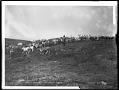
Herd of reindeer at Port Clarence, Alaska, 1900
Beginning in 1892, the United States government brought reindeer from Asia and Europe into Alaska as a new food source for the Native Peoples. The idea was to replace hunting with herding, particularly after newly arrived gold miners had killed so much of the local game.This 1900 photo by Eric Hegg shows a herd of reindeer near Port Clarence, on…
ID Number:1983.10.13163
Date:1900
Photograph
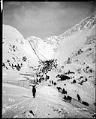
Chilkoot Pass, circa 1898
Some of the people rushing to the Klondike gold fields went by ship to Dyea, Alaska, and continued into Canada on foot by way of Chilkoot Pass. The Canadian government required each person to bring enough food and equipment to last a year. This generally weighed a thousand pounds or more, and it took several trips to carry it over…
ID Number:1983.10.13188
Date:Circa 1898
Cartographic material
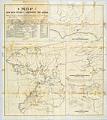
New Gold Fields of North-Western Alaska, 1899
Gold was discovered in the Nome, Alaska, area in 1898, drawing prospectors from the Klondike and other goldfields. More miners poured in when gold was discovered in Nome’s beach sands. To meet the needs of prospectors, D.A. Macdonald used 1897 and 1898 information to publish a map of the new mining districts of northwestern Alaska in 1899.The map includes information…
ID Number:1983.35.7
Date:1899
Book
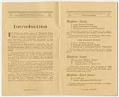
Mapleine Dainties and How to Make Them, circa 1920
The Crescent Manufacturing Company was established in Seattle in 1883 as a small company which specialized in vanilla extract. The company expanded rapidly during the Klondike Gold Rush by selling proprietary spice packets to miners. Crescent Manufacturing grew with their novel creation of an imitation maple flavoring which would not lose flavor over time or with temperature fluctuation. Mapleine debuted…
ID Number:1989.77.a
Date:Circa 1920
Photograph
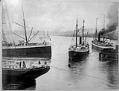
Seattle waterfront, 1899
In 1899, Seattle was still crowded with gold seekers heading to and from the Alaska and Yukon gold fields. Elliott Bay continued to be busy with ships leaving for Skagway, St. Michael and other Alaskan ports.This photo shows a group of ships in Elliott Bay. A crowd waits at the pier (right) for the arrival of the steamer "Al-Ki" (right).…
ID Number:1994.44.15
Date:1899
Photograph
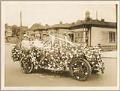
Treat family in car decorated for Golden Potlatch parade, Seattle, 1912
The Tilikums of Elttaes were a fraternal, civic organization composed primarily of influential white Seattle area businessmen who used Native American imagery to promote tourism and the economic development of the city. In July 1911 the Tilikums ("Friends" in Chinook Jargon; Elttaes is Seattle spelled backward) organized the first Golden Potlatch celebration. The Golden Potlatch was a city-wide festival held…
ID Number:2005.19.1
Date:1912