• Visit
    • Museum Accessibility
    • Community Access
    • Group Visits and Tours
    • Programs
      • History Café
      • MOHAI Mercantile Literary Series
      • First Thursday
      • Denny Lecture
      • Al Young Educator of the Year
      • Everyday Heroes
    • MOHAI Mercantile
    • Gourmondo at MOHAI
  • Exhibits
  • Events
  • Collections and Research
    • Collections Search
    • Themed Collections
    • Research Library
    • Image Ordering
    • Donate an Artifact
    • Curator’s Fellowship
  • Support
    • Donate
    • Membership at MOHAI
    • Gift Memberships
    • Corporate Support
  • Education
    • Field Trips
      • Self-Guided School Year Explorations
      • Creating Our Community
      • Cracking the History Code: Salish Stories
      • Cracking the History Code: Settling Around the Sound
      • Hands on History
      • Self-Guided Summer Field Trips
      • Homeschool Group
    • Portable Museum Program
    • Scholarships
    • Education FAQ
    • Primary Source Analysis
    • Online Curricula
    • Teen Programs
    • Idea Lab
    • Discovery Packs
    • Summer Camps
  • About
    • Annual Reports
    • The MOHAI Blog
    • Contact MOHAI
    • Opportunities
    • Leadership
    • Private Events
  • Donate
  • Tickets
  • Membership
HomeCollections and ResearchCollections Search

Collections Search

Explore stories in Northwest history through highlights from MOHAI’s collections. Search by keyword below or browse the entire online collection by entering the asterisk symbol (*). Filter your search by type of materials.

Download lower resolution images directly from an item page. MOHAI offers high-resolution digital reproductions of photographs and other materials from our collections for personal and professional use.

We have many more items in our collections and not everything you see online is on view at the museum. We have additional materials online at the University of Washington’s Digital Collections.

MOHAI Statement on Harmful Content

Search by Collection

Not finding what you are looking for?
Ask the MOHAI Collections Staff

47 results for: Curtis, Asahel
Share:
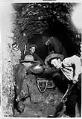
Image of Four men digging tunnel in gold mine at Eldorado, circa 1898
Photograph

Four men digging tunnel in gold mine at Eldorado, circa 1898

In Alaska and the Yukon, placer gold was found along ancient stream beds, some of which were twelve to forty feet underground at bedrock. The gold was frozen in the dirt or gravel. Miners chopped away at the frozen earth with picks or tried to thaw it with fires or steam machines. They "drifted" all winter, digging tunnels in the…
ID Number:SHS15820
Date:Circa 1898
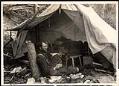
Image of Lucas in tent, 1898
Photograph

Lucas in tent, 1898

Seattleite Asahel Curtis left for the Klondike in 1897 and stayed two years, taking photos for the Seattle Post-Intelligencer. In 1898, Curtis took this photo of a man named Lucas resting outside his tent. Inside the tent, two pots heat on top of a small woodstove; the chimney of the stove passes up through the roof of the tent. The…
ID Number:SHS16668
Date:1898
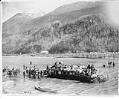
Image of Unloading freight at Skagway, 1898
Photograph

Unloading freight at Skagway, 1898

Gold seekers heading to the Klondike gold fields via the Inland Passage could land at Skagway or Dyea. At first, ships had to anchor offshore and unload their passengers and freight onto barges which carried them ashore. There was usually an extra charge for this.This 1898 photo of the tidal flats at Skagway shows freight being unloaded from a barge.…
ID Number:SHS16696
Date:1898
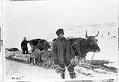
Image of Two men and oxen on Skagway Trail, 1898
Photograph

Two men and oxen on Skagway Trail, 1898

In 1897 and 1898, some of the Klondike stampeders used oxen to carry supplies along the White Pass Trail. Others used dogs, horses, mules, and even goats. Once the railroad was completed from Skagway through White Pass, there was less need for these pack animals.In this 1898 photo taken by Asahel Curtis, two men stand in the snow near their…
ID Number:SHS16716
Date:1898
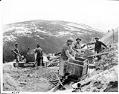
Image of Men using rockers to pan for gold, circa 1898
Photograph

Men using rockers to pan for gold, circa 1898

Many gold miners used rockers (also called cradles) to remove gold from pay dirt. They shoveled the dirt and gravel into a tray at the top of the rocker, and they moved the rocker back and forth as they poured water through the tray. Finer pieces of gold and dirt washed through holes in the tray into the box beneath.…
ID Number:SHS16719
Date:Circa 1898
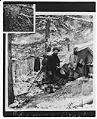
Image of Asahel Curtis and companion on Skagway Trail, circa 1897
Photograph

Asahel Curtis and companion on Skagway Trail, circa 1897

Seattleite Asahel Curtis left for the Klondike in 1897 and stayed two years, taking photos for the Seattle Post-Intelligencer. With today's tiny cameras and one-hour printing, it is easy to forget that he and the other gold rush photographers had to haul hundreds of pounds of glass photographic plates, heavy equipment, and chemicals through the wilderness and find places to…
ID Number:SHS16720
Date:Circa 1897
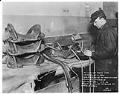
Image of Worker making saddle at Duncan & Sons, Seattle, December 23, 1918
Photograph

Worker making saddle at Duncan & Sons, Seattle, December 23, 1918

Duncan & Sons was a harness and saddle manufacturing business located at 212 Second Avenue South. Their familiar model horse stood above the entrance to the business for many years, only recently to disappear when the company closed. In this photo, a worker rivets coat straps to the body of a cavalry saddle. It is part of a series of…
ID Number:SHS19314
Date:1918
Previous 1 … 3 4 5

Land Acknowledgement

MOHAI stands on the historic and contemporary lands and shores of the Duwamish, Suquamish, Muckleshoot, and other Coast Salish Nations. We acknowledge the forced displacement of Native Communities from this land while honoring the endurance of the Duwamish people who still live here.
Address: 860 Terry Ave N, Seattle WA, 98109
Phone: 206 324 1126
  • Plan a Visit
  • Directions and Parking
  • Accessibility
  • Group Tours
  • About

Sign up to Receive our Newsletter

"*" indicates required fields

This field is for validation purposes and should be left unchanged.

Copyright 2026, Museum of History & Industry. All Rights Reserved