835 results for: Neighborhoods
Photograph
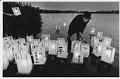
Japanese lantern ceremony at Green Lake, Seattle, August 7, 1991
In this image, a volunteer from Washington Physicians for Social Responsibility helps launch Japanese lanterns to commemorate the U. S. dropping of atomic bombs on Hiroshima and Nagasaki at the end of World War II. The event, held near the Bathhouse Theatre on Green Lake and called "From Hiroshima to Hope," attracted more than 1,000 people. It was patterned after…
ID Number:2000.107.048.01.03
Date:1991
Photograph
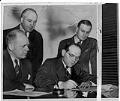
Jesse Epstein signing off on Yesler Terrace project, February 27, 1941
Jesse Epstein (1910-1989) was the first director of the Seattle Housing Authority (SHA) in 1939, having been a primary force in its creation. When the U.S Housing Act of 1937 was passed, subsidizing the construction of low-income housing, Epstein worked for legislation to enable the creation of a local housing authority in Seattle. Two housing bills, the Housing Authorities Law…
ID Number:2000.107.057.02.02
Date:1941
Photograph
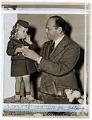
Jesse Epstein receiving cup of punch from child after Yesler Terrace dedication, Seattle, June 16, 1942
Jesse Epstein (1910-1989) was the first director of the Seattle Housing Authority (SHA) in 1939, having been a primary force in its creation. When the U.S Housing Act of 1937 was passed, subsidizing the construction of low-income housing, Epstein worked for legislation to enable the creation of a local housing authority in Seattle. Two housing bills, the Housing Authorities Law…
ID Number:2000.107.057.02.03
Date:1942
Photograph
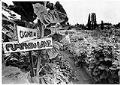
People working in P-Patch garden, Seattle, August 1974
"P-Patch," a term specific to Seattle, refers to a parcel of property used for gardening allotments. The "P" originally stood for "Picardo," after the family that loaned its northeast Seattle farm for a community garden on property first leased and later bought by the city. In 1973 the City of Seattle bought the Picardo Farm property and created a community…
ID Number:2000.107.072.25.04
Date:1974
Photograph
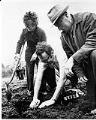
Councilman John Miller planting squash at P-Patch garden, Seattle, May 1974
"P-Patch," a term specific to Seattle, refers to a parcel of property used for gardening allotments. The "P" originally stood for "Picardo," after the family that loaned its northeast Seattle farm for a community garden on property first leased and later bought by the city. In 1973 the City of Seattle bought the Picardo Farm property and created a community…
ID Number:2000.107.072.25.06
Date:1974
Photograph
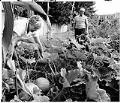
Sylvia Jones and Harold McElhoe working at Pinehurst P-Patch garden, Seattle, September 7, 1986
"P-Patch," a term specific to Seattle, refers to a parcel of property used for gardening allotments. The "P" originally stood for "Picardo," after the family that loaned its northeast Seattle farm for a community garden on property first leased and later bought by the city. In 1973 the City of Seattle bought the Picardo Farm property and created a community…
ID Number:2000.107.072.25.07
Date:1986
Photograph
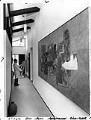
Paul Horiuchi at home, Seattle, August 12, 1967
Painter and collagist Paul Horiuchi (1906-1999) was one of the artists of the "Northwest School," an art movement which combined natural elements of the Puget Sound area with traditional Asian aesthetics to create a novel and distinct regional style.The Horiuchi family's Rainier Beach home, designed by T. Gregory Saito, was filled with natural light and provided ample space to hang…
ID Number:2000.107.091.28.04
Date:1967
Photograph
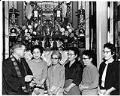
Rev. Kenryu Kumata with Buddhist Women's Federation officers, Seattle, April 20, 1963
The Seattle Buddhist Church (or Seattle Betsuin) at 1427 S Main Street was dedicated in October 1941, and replaced the original church building which was condemned for the development of the Yesler Terrace housing project. The disruption to the Japanese community from that project, and then the relocation of Japanese Americans into incarceration camps the following year destroyed the Japanese…
ID Number:2000.107.098.18.03
Date:1963
Photograph
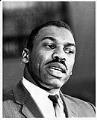
Charles V. Johnson speaking about the need for open housing legislation, Seattle, March 3, 1964
Charles Vernon Johnson (b. 1928) was raised in Arkansas and moved to Seattle in 1954 to attend law school at the University of Washington. Upon graduation, Mr. Johnson went into private practice, and shortly thereafter took on leading roles in both the Seattle Branch of the NAACP and in the Central Area Civil Rights Organization. He was heavily involved in…
ID Number:2000.107.099.31.04
Date:1964
Photograph
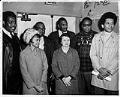
Officers of Citizens Advisory Council for Model Cities posing together, Seattle, January 13, 1969
In response to urban problems of poverty and race in the United States, in November 1966 Congress initiated the Model Cities Program. The program's objectives were to reduce social and economic disadvantages in designated neighborhoods, provide training and employment opportunities, and establish health services for residents. Financial and technical assistance was made available to cities through the Department of Housing…
ID Number:2000.107.099.31.05
Date:1969