835 results for: Neighborhoods
Photograph
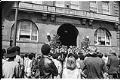
Students protesting outside Seattle Community College, Seattle, May 22, 1969
In 1969, Seattle Community College (SCC) faced boycotts, demonstrations, and rioting in protest of disparities in funding and academic focus between the College's central campus, located near the city's Black residential area, and the north and south campuses, located in predominantly white neighborhoods. Out of $33 million in capital funds for the three campuses, the central campus, located on Capitol…
ID Number:1986.5.50743.4
Date:1969
Photograph
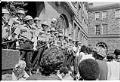
A. Frank Williams addressing protesters outside SCC, Seattle, May 22, 1969
In 1969, Seattle Community College (SCC) faced boycotts, demonstrations, and rioting in protest of disparities in funding and academic focus between the College's central campus, located near the city's Black residential area, and the north and south campuses, located in predominantly white neighborhoods. Out of $33 million in capital funds for the three campuses, the central campus, located on Capitol…
ID Number:1986.5.50743.5
Date:1969
Photograph
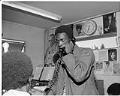
A. Frank Williams and Bob Davis at KYAC radio station, July 24, 1969
KYAC was the first Black-owned radio station in Seattle, broadcasting from 1965 to 1981 with a focus on playing music by Black artists. In addition to music, KYAC broadcast local news relevant to Seattle’s Black population, ran radio contests, hosted live events for listeners, and engaged in activism in the Black community. Initially, KYAC was owned by a white man.…
ID Number:1986.5.50946.1
Date:1969
Photograph
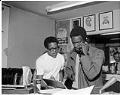
A. Frank Williams and Bob Davis at KYAC radio station, July 24, 1969
KYAC was the first Black-owned radio station in Seattle, broadcasting from 1965 to 1981 with a focus on playing music by Black artists. In addition to music, KYAC broadcast local news relevant to Seattle’s Black population, ran radio contests, hosted live events for listeners, and engaged in activism in the Black community. Initially, KYAC was owned by a white man.…
ID Number:1986.5.50946.2
Date:1969
Photograph
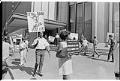
Students protesting outside Western Governors Conference, Seattle, July 31, 1969
In 1969, Seattle Community College (SCC) faced boycotts, demonstrations, and rioting in protest of disparities in funding and academic focus between the College's central campus, located near the city's Black residential area, and the north and south campuses, located in predominantly white neighborhoods. The protests also objected to the lack of African American representation on the Board of Trustees of…
ID Number:1986.5.50972.1
Date:1969
Photograph
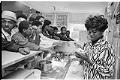
New owners serving customers at the Beanery, Seattle, November 1968
The Beanery was a longtime lunch hangout across the street from Franklin High School in the Mt. Baker neighborhood of Seattle's Rainier Valley. The restaurant closed for about two months in 1968 following a boycott by Black students protesting white ownership of the restaurant. Earlier in the year the students had led the first sit-in held at a Seattle high…
ID Number:1986.5.52276.1
Date:1968
Photograph
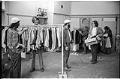
SLF members working in Georgetown Free Store, December 15, 1970
The Georgetown Free Store was a short-lived warehouse in Seattle's Georgetown neighborhood that collected and provided clothing and food to unemployed and poor residents. The store was run by members of the Seattle Liberation Front (SLF), a radical, anti-war organization active in 1970-1971. The Free Store was also one of 18 organizations that presented a list of 16 demands to…
ID Number:1986.5.53485.9
Date:1970
Photograph
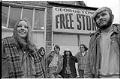
SLF members outside Georgetown Free Store, December 15, 1970
The Georgetown Free Store was a short-lived warehouse in Seattle's Georgetown neighborhood that collected and provided clothing and food to unemployed and poor residents. The store was run by members of the Seattle Liberation Front (SLF), a radical, anti-war organization active in 1970-1971. The Free Store was also one of 18 organizations that presented a list of 16 demands to…
ID Number:1986.5.53485.17
Date:1970
Photograph
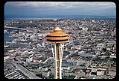
Aerial view, looking northeast, of the top of the Space Needle, Seattle, 1962
Designed by architect John Graham, the Space Needle is easily the most recognizable structure built for the 1962 Century 21 Exposition (Seattle World's Fair). The Space Needle was built in less than one year for 4.5 million dollars by the Howard S. Wright Construction Company. The top of the Needle is 605 feet high, with the main observation deck at…
ID Number:1987.59.131.63
Date:1962
Photograph
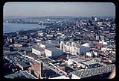
Aerial view, looking northwest, of the U.S. Science Pavilion and the Seattle World's Fair grounds, with Elliott Bay, 1962
The Century 21 Exposition (also known as the Seattle World's Fair) ran from April 21, 1962, to October 21, 1962. Nearly 10 million people attended the fair. As planned, the exposition left behind a fairground and numerous public buildings and public works; some credit it with revitalizing Seattle's economic and cultural life. The site, slightly expanded since the fair, is…
ID Number:1987.59.131.131
Date:1962