57 results for: Cultural Appropriation
Photograph
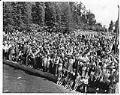
Crowd watching Pow Wow event in Seward Park, Seattle, August 7, 1949
The Rainier District Pow Wow began in the midst of the Great Depression as a day-long community picnic at Seward Park. Between 1934 and 1992, when it ended, pow wow events paralleled what was going on in the rest of the country, celebrating neighborhood commerce in the 1930s, patriotism during World War II, the Baby Boom of the late 1940s…
ID Number:2000.107.185.01.01
Date:1949
Photograph
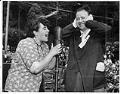
Women in husband-calling contest at Rainier District Pow Wow, Seattle, August 7, 1949
The Rainier District Pow Wow began in the midst of the Great Depression as a day-long community picnic at Seward Park. Between 1934 and 1992, when it ended, pow wow events paralleled what was going on in the rest of the country, celebrating neighborhood commerce in the 1930s, patriotism during World War II, the Baby Boom of the late 1940s…
ID Number:2000.107.185.01.02
Date:1949
Photograph
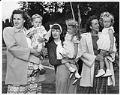
Mothers holding Baby Beauty Contest winners, Seattle, August 7, 1949
The Rainier District Pow Wow began in the midst of the Great Depression as a day-long community picnic at Seward Park. Between 1934 and 1992, when it ended, pow wow events paralleled what was going on in the rest of the country, celebrating neighborhood commerce in the 1930s, patriotism during World War II, the Baby Boom of the late 1940s…
ID Number:2000.107.185.01.03
Date:1949
Photograph
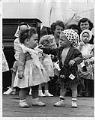
Toddlers in Pow Wow baby beauty contest, Seattle, August 9, 1954
The Rainier District Pow Wow began in the midst of the Great Depression as a day-long community picnic at Seward Park. Between 1934 and 1992, when it ended, pow wow events paralleled what was going on in the rest of the country, celebrating neighborhood commerce in the 1930s, patriotism during World War II, the Baby Boom of the late 1940s…
ID Number:2000.107.185.02.01
Date:1954
Photograph
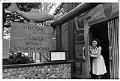
Manager at door of Ivar's Indian Salmon House, Seattle, October 21, 1986
Ivar's Indian Salmon House is one of 31 fish bars and full service-restaurants founded by beloved Seattle showman and restaurateur Ivar Haglund (1905-1985). Mr. Haglund commissioned Seattle architect John W. Adams (1919-2002) to create the Salmon House's interior and exterior, loosely based on a Tlingit longhouse. The restaurant opened in 1969 on NE Northlake Way at the north end of…
ID Number:2000.107.185.21.04
Date:1986
Photograph
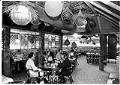
Interior of Trader Vic's restaurant at Washington Plaza Hotel, Seattle, July 6, 1969
Trader Vic's was a Polynesian-themed chain restaurant founded in 1934 by Victor Jules Bergeron, Jr. (1902-1984) in California. The first franchised Trader Vic's opened in Seattle in 1940, and the chain expanded quickly during the Tiki culture fad of the 1950s and 1960s. The Seattle branch moved to the Washington Plaza Hotel (now the Westin) in 1969, however it closed…
ID Number:2000.107.185.26.01
Date:1969
Photograph
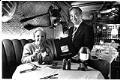
Kayla Skinner and Harry Wong at Trader Vic's restaurant, June 20, 1991
Trader Vic's was a Polynesian-themed chain restaurant founded in 1934 by Victor Jules Bergeron, Jr. (1902-1984) in California. The first franchised Trader Vic's opened in Seattle in 1949, and the chain expanded quickly during the Tiki culture fad of the 1950s and 1960s. The Seattle restaurant moved to the Washington Plaza Hotel (now the Westin) in 1969, and closed in…
ID Number:2000.107.232.27.02
Date:1991
Photograph
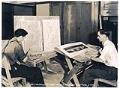
James Fitzgerald and Lloyd Lovegren working on the East Tunnel Portal models for the Lake Washington Floating Bridge, May 9, 1940
Architect Lloyd Lovegren and artist James Fitzgerald designed the East Tunnel Portals, basing a set of sculptural panels on Northwest Coast Native American motifs. Here, Fitzgerald (left) works on a model for one of the panels while Lovegren (right) works with the overall design. Caption on photo: Unit 2. Modeling for precast concrete slabs of east tunnel portal.Photographer's Reference Number:…
ID Number:2003.30.151
Date:1940
Photograph
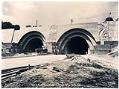
East tunnel portals on the Lake Washington Floating Bridge, June 21, 1940
A decorative concrete facade marked the eastern entrance of the twin-bore tunnel that connected Seattle to the Lake Washington Floating Bridge. Architect Lloyd Lovegren and artist James Fitzgerald designed the portals, basing their sculptural panels on Northwest Coast Native American motifs. In this June 1940 image, two of the three panels have been installed. Caption on photo: Unit 2. East…
ID Number:2003.30.159
Date:1940
Photograph
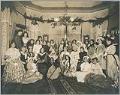
Group of women in costume at Founders' Day Ball, Seattle, November 13, 1911
The first Founders' Day Ball took place on November 13, 1911, on the 60th anniversary of the Denny Party landing at Alki beach. From its inception the event was a historical costume ball, hosted by Emily and Morgan Carkeek at their First Hill mansion. Guests were asked to donate artifacts or documents related to Seattle history, which led to the…
ID Number:2008.3.1.1
Date:1911