57 results for: Cultural Appropriation
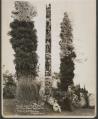
Postcard
J.E. Standley and young girl in front of a totem pole, Seattle, circa 1925
Ohio-born curio collector Joseph Edward "Daddy" Standley (1854-1940) came to Seattle in 1899 and opened Ye Olde Curiosity Shop on Second Avenue and Pike Street. He moved the shop to the Colman Dock on the waterfront in 1904, and since 1988 the shop has been located at Pier 54. Still a family-run business after five generations, the store attracts about…
ID Number:1980.6877.4.85
Date:Circa 1925
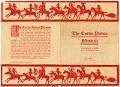
Program
The Curtis Picture Musicale program, circa 1912
From 1911 to 1913, photographer Edward S. Curtis toured the country with a multimedia production, The Curtis Picture Musicale, based on his photographs of Indigenous peoples. At this point, Curtis’s efforts to document Indigenous life had already taken 14 years, and he expected that it would take eight additional years to complete the project. The Musicale, a fund-raising effort, was…
ID Number:1980.7060.1
Date:Circa 1912
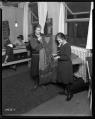
Photograph
Camp Fire Girls in office, circa 1919
The Camp Fire Girls organization was founded in the eastern United States and spread to the Seattle area in 1919. Camp Fire Girls' activities had Native American themes. Each member had an Indian name and made a ceremonial dress with leather trim. She received colored wooden beads for learning new skills, and added them to her dress. The Camp Fire…
ID Number:1983.10.1968.4
Date:Circa 1919
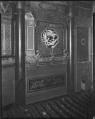
Photograph
Fifth Avenue Theatre interior, Seattle, circa 1926
Audiences were fascinated with the decor of the new Fifth Avenue Theatre. Its brightly-painted woodwork had been inspired by traditional Chinese decorated wood structures in Beijing's Forbidden City. The Asian theme was in keeping with Seattle's position as a gateway for Pacific trade. Handwritten on sleeve: Fifth Ave Theatre Interior DecorationsPhotographer's Reference Number: 120300
ID Number:1983.10.3378.1
Date:Circa 1926
Photograph
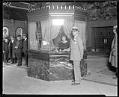
Box office at the new Fifth Avenue Theatre, September 24, 1926
The Fifth Avenue Theatre first opened to an exclusive group of guests on September 23, 1924. All of the detail in its elaborate decor, from the box office to the auditorium ceiling, had a Chinese theme. The Seattle Post-Intelligencer noted that it "cast the mystic spell of a Chinese temple of a thousand years ago."This photo, taken at the 1924…
ID Number:1983.10.3380.4
Date:1926
Photograph
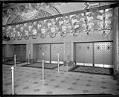
Fifth Avenue Theatre entrance, September 1926
Audiences were fascinated with the decor of the new Fifth Avenue Theatre. Its brightly-painted woodwork had been inspired by traditional Chinese decorated wood structures in Beijing's Forbidden City. The Asian theme was in keeping with Seattle's position as a gateway for Pacific trade. This photo was taken around the time of the 1926 opening of the Fifth Avenue Theatre. It…
ID Number:1983.10.3439
Date:1926
Photograph
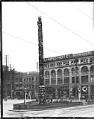
Totem pole in Pioneer Square, Seattle, circa 1905
This Tlingit totem was carved around 1870 to honor a high-ranking tribal woman named Aanséet. The pole was named Naas-shagee-yéil and it was placed in Aanséet's village on Tongass Island on the Alaska coast. In 1899, a group of leading Seattle businessmen on a goodwill tour of southeastern Alaska stole the totem and brought it back to Pioneer Square. The…
ID Number:1983.10.8056.2
Date:Circa 1905
Photograph
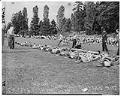
Founders Day, 1914
Handwritten on sleeve: Founders Day, 1914.Webster & Stevens number: 42280
ID Number:1983.10.9904.2
Date:1914
Photograph
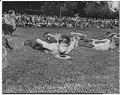
Boys participating in pie eating contest, Seattle, August 3, 1947
The Rainier District Pow Wow began in the midst of the Great Depression as a day-long community picnic at Seward Park. Between 1934 and 1992, when it ended, pow wow events paralleled what was going on in the rest of the country, celebrating neighborhood commerce in the 1930s, patriotism during World War II, the Baby Boom of the late 1940s…
ID Number:1986.5.11290.1
Date:1947
Photograph
Gordon Bradbury in pie eating contest, Seattle, August 3, 1947
The Rainier District Pow Wow began in the midst of the Great Depression as a day-long community picnic at Seward Park. Between 1934 and 1992, when it ended, pow wow events paralleled what was going on in the rest of the country, celebrating neighborhood commerce in the 1930s, patriotism during World War II, the Baby Boom of the late 1940s…
ID Number:1986.5.11290.2
Date:1947