94 results for: Chicano/a Latino/a Culture
Photograph
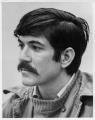
Roberto Trevino discussing the Chicano Movement, Seattle, May 9, 1970
During the summer of 1970, Brown Berets from the University of Washington (UW) led a voter registration drive in the Yakima Valley, and helped push the United States Supreme Court to hear the case against Yakima Valley registrars who refused to permit Spanish-speaking Mexican-Americans to vote. The Brown Berets organized pickets and welfare protests, and interrupted community meetings to promote…
ID Number:2000.107.124.38.08
Date:1970
Photograph
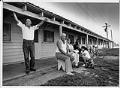
Joe Garza and others outside worker housing at Golding Farms, Yakima Valley, May 1989
The Braceros program during World War II brought Mexican workers to the Yakima Valley to ease labor shortages, and even after the program ended in 1948, Mexicans and Mexican Americans continued to provide a substantial part of the Valley’s agricultural workforce. By the 1980s, the Yakima Valley was home to large communities of Mexican immigrant workers, as well as their…
ID Number:2000.107.124.38.10
Date:1989
Photograph
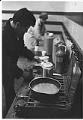
Isidoro Gonzales working in kitchen during occupation of Beacon Hill School, October 18, 1972
Seattle had a growing Latino population in the late 1960s, and activists had been pressing the city for a building in which to establish a Chicano community center. Tired of having their requests ignored, in October 1972 they took over the abandoned Beacon Hill School on 16th Avenue South and renamed it El Centro de la Raza. After a 75-day…
ID Number:2000.107.124.39.01
Date:1972
Photograph
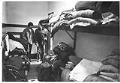
Men in makeshift dormitory in occupied Beacon Hill School, October 18, 1972
Seattle had a growing Latino population in the late 1960s, and activists had been pressing the city for a building in which to establish a Chicano community center. Tired of having their requests ignored, in October 1972 they took over the abandoned Beacon Hill School on 16th Avenue South and renamed it El Centro de la Raza. After a 75-day…
ID Number:2000.107.124.39.02
Date:1972
Photograph
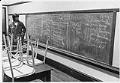
Alfonso Simiano in classroom during occupation of Beacon Hill School, October 18, 1972
Seattle had a growing Latino population in the late 1960s, and activists had been pressing the city for a building in which to establish a Chicano community center. Tired of having their requests ignored, in October 1972 they took over the abandoned Beacon Hill School on 16th Avenue South and renamed it El Centro de la Raza. After a 75-day…
ID Number:2000.107.124.39.03
Date:1972
Photograph
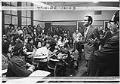
Councilman John Miller speaking to group occupying Beacon Hill School, October 12, 1972
Seattle had a growing Latino population in the late 1960s, and activists had been pressing the city for a building in which to establish a Chicano community center. Tired of having their requests ignored, in October 1972 they took over the abandoned Beacon Hill School on 16th Avenue South and renamed it El Centro de la Raza. After a 75-day…
ID Number:2000.107.124.39.04
Date:1972
Photograph
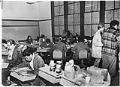
Group in classroom at occupied Beacon Hill School, October 11, 1972
Seattle had a growing Latino population in the late 1960s, and activists had been pressing the city for a building in which to establish a Chicano community center. Tired of having their requests ignored, in October 1972 they took over the abandoned Beacon Hill School on 16th Avenue South and renamed it El Centro de la Raza. After a 75-day…
ID Number:2000.107.124.39.05
Date:1972
Photograph
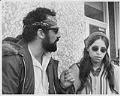
Roberto Maestas and Celia Cantri during occupation of Beacon Hill School, October 1972
Seattle had a growing Latino population in the late 1960s, and activists had been pressing the city for a building in which to establish a Chicano community center. Tired of having their requests ignored, in October 1972 they took over the abandoned Beacon Hill School on 16th Avenue South and renamed it El Centro de la Raza. After a 75-day…
ID Number:2000.107.124.39.06
Date:1972
Photograph
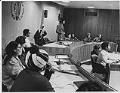
Protesters taking over City Council meeting, November 10, 1972
Seattle had a growing Latino population in the late 1960s, and activists had been pressing the city for a building in which to establish a Chicano community center. Tired of having their requests ignored, in October 1972 they took over the abandoned Beacon Hill School on 16th Avenue South and renamed it El Centro de la Raza. After a 75-day…
ID Number:2000.107.124.39.07
Date:1972
Photograph
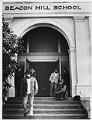
Protesters outside Beacon Hill School, October 11, 1972
Seattle had a growing Latino population in the late 1960s, and activists had been pressing the city for a building in which to establish a Chicano community center. Tired of having their requests ignored, in October 1972 they took over the abandoned Beacon Hill School on 16th Avenue South and renamed it El Centro de la Raza. After a 75-day…
ID Number:2000.107.124.39.08
Date:1972