450 results for: Military
Photograph
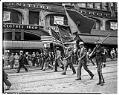
Spanish-American War veterans in Memorial Day parade, Seattle, May 30, 1940
On May 30, 1940, Seattle area veterans of the Civil War, Spanish American War, and World War I held ceremonies of remembrance and marched in the Memorial Day parade. They gathered on Second Avenue at Virginia Street, moved down Second Avenue to Yesler Way and then marched back north on Fourth Avenue. National guard units, cadet corps, patriotic groups, Red…
ID Number:PI23376
Date:1940
Photograph
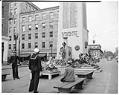
War memorial in Victory Square, Seattle, 1946
Memorial reads: We here highly resolve that these dead shall not have died in vain. -Lincoln.Handwritten on negative: Victory Square.Handwritten on sleeve: Memorial Day - Victory Square.Date photograph was filed at the Seattle Post-Intelligencer (date of photograph and file date may differ by a month or more): May 31, 1946.
ID Number:PI23390
Date:1946
Photograph
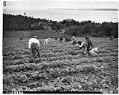
Indigenous berry pickers on Vashon Island, June 1943
The United States' entry into World War II in December 1941 created labor shortages as many men left civilian jobs to join the military. On the West Coast, the shortage was exacerbated by the forced removal of Japanese Americans, many of whom were farmers. In the summer of 1943, the Vashon Island Packing Company hired 80 First Nations people from…
ID Number:PI23856
Date:1943
Photograph
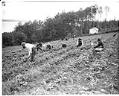
Indigenous workers in a strawberry field, Vashon Island, June 1943
The United States' entry into World War II in December 1941 created labor shortages as many men left civilian jobs to join the military. On the West Coast, the shortage was exacerbated by the forced removal of Japanese Americans, many of whom were farmers.In the summer of 1943, the Vashon Island Packing Company hired 80 First Nations people from British…
ID Number:PI23857
Date:1943
Photograph
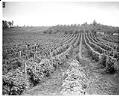
Indigenous workers in berry field, Vashon Island, June 1943
The United States' entry into World War II in December 1941 created labor shortages as many men left civilian jobs to join the military. On the West Coast, the shortage was exacerbated by the forced removal of Japanese Americans, many of whom were farmers.In the summer of 1943, the Vashon Island Packing Company hired 80 First Nations people from British…
ID Number:PI23858
Date:1943
Photograph
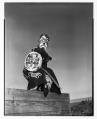
Charlie Swan, Makah cultural leader, Neah Bay, August 1945
The Makah people of the northwest tip of the Olympic Peninsula refer to themselves as Kwih-dich-chuh-ahtx, which translates roughly to "the people who live by the rocks and seagulls." The early Makah were skilled mariners, using several types of canoes which they carved from western red cedar for various purposes - war, whaling, fishing, sealing, carrying cargo, and long voyages.…
ID Number:PI23865
Date:1945
Photograph
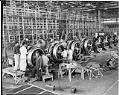
Men working on B-17 engines at the Boeing plant, November 1940
In 1940, some 7,500 Boeing Aircraft Company employees worked 24 hours per day to build B-17 Flying Fortress bombers for the British and American military. These long-range propeller-driven planes were capable of attacking an enemy fleet more than 1,000 miles offshore and conducting bombing raids on Germany from England. At this time, the United States had not yet entered World…
ID Number:PI23926
Date:1940
Photograph
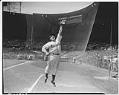
Seattle Rainiers outfielder Bill Matheson jumping to catch a ball, Seattle, 1944
Just after the United States entered World War II, President Franklin Roosevelt decided that it would be good for the nation's morale if professional baseball games continued. Some players from the Seattle Rainiers joined the military, but the team continued to play throughout the war. In addition to their regular games, the team also played exhibition games against service ball…
ID Number:PI26702
Date:1944
Photograph
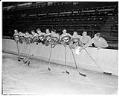
Boeing Bombers hockey team, Seattle, 1943
In 1943, the Northwest International Hockey League (NIHL) operated in the Pacific Northwest. The NIHL consisted of five teams, mostly backed by local companies. The Boeing Bombers and Isaacson Iron Workers played in Seattle, the Warcos and the Oilers played in Portland, and the Maple Leafs represented Vancouver, BC, but did not have a home arena and only played away…
ID Number:PI26798
Date:1943
Photograph
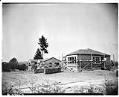
Houses under construction in Bellevue, May 1946
At the end of World War II, the United States Congress passed the Servicemen's Readjustment Act of 1944, called the G.I. Bill of Rights. The G.I. Bill provided $13 billion to returning military personnel for medical treatment, education and vocational training, and other needs. The bill offered home buyers government-guarantied, low-interest loans on new homes, with no down payment. New…
ID Number:PI27850
Date:1946