450 results for: Military
Photograph
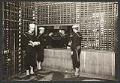
Navy personnel at station commissary, Seattle, circa 1918
During World War I a temporary Naval Training Station was set up on the University of Washington campus, near where the university's health sciences center is now located. The training camp was active from 1917-1919, during which time over 5,000 mostly college students were trained for both naval and naval aviation units. This image of U. S. Navy Training Station…
ID Number:Lib1993.35.3.53
Date:Circa 1918
Photograph
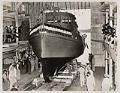
Launching of boat Warden Johnston at McNeil Island Penitentiary, Washington, May 1945
During World War II, the McNeil Island prisoners built a number of boats for military and civilian use. The 65-foot passenger boat Warden Johnston was launched on McNeil Island in May 1945. The vessel was designed by L.H. Coolidge, a Seattle naval architect. The officials supervising construction were Henri Andersen, V.E. Smith and Evert Soldin. Prisoners were paid 15 cents…
ID Number:Lib1996.11.15
Date:1945
Manuscript
Henry A. Smith's recollection of 1856 "Battle of Seattle," circa 1900
On the morning of January 26, 1856, the "Battle of Seattle" began when Native Americans raided the settlement of Seattle. Previously warned of the attack, most settlers had barricaded themselves in a blockhouse. The attackers were driven off by artillery fire and by Marines from the U.S. Navy sloop-of-war Decatur, anchored in Elliott Bay. Although there were relatively few casualties…
ID Number:MS.COLL.204
Date:Circa 1900
Program
Swedish Hospital Training School for Nurses commencement program, Seattle, May 18, 1921
The Swedish Hospital Training School for Nurses was founded in 1910 at the hospital's first location on Belmont Avenue in Seattle's Capitol Hill neighborhood. Applicants to the nursing school had to be female, aged 18-35, and high school graduates. Students had to outfit themselves with four gingham dresses, 12 aprons, six collars, and two pairs of "high black leather shoes…
ID Number:MS.COLL.1046
Date:1921
Serial
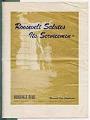
Roosevelt High School News Memorial Day supplement, Seattle, May 28, 1945
In September 1922, Roosevelt High School opened in the then-outer limits of the Seattle School District, serving 1,300 students and 47 teachers, led by Principal V. K. Froula. A dedication ceremony took place on October 27, the birthday of President Theodore Roosevelt, for whom the school was named.This image is of a Memorial Day supplement to Roosevelt High School's student…
ID Number:MS.COLL.1124
Date:1945
Photograph
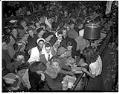
Shoppers buying stockings at Frederick & Nelson, November 3, 1945
In the early 1940s, during World War II, the military needed silk to make parachutes. Silk was rationed, and there was hardly any left over to make underwear, stockings or other everyday products. Women found that rayon stockings bagged and leg makeup smeared or cracked. When the war was over, women jumped at the chance to buy the new sheer…
ID Number:PI21052
Date:1945
Photograph
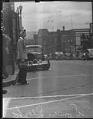
Woman in work clothes waiting to cross street, Seattle, 1942
During World War II, many women were trained to fill the jobs left by men serving in the military. Women did auto repair, aircraft assembly and other jobs once considered men's work. Handwritten on image: Women slacks.Handwritten on sleeve: Fashions - slacks - women's.Date photograph was filed at the Seattle Post-Intelligencer (date of photograph and file date may differ by…
ID Number:PI21377
Date:1942
Photograph
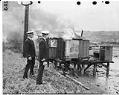
Naval officers watching Hooverville shack burn, June 6, 1942
During the Great Depression of the 1930s, many unemployed and homeless people throughout the United States built shantytowns on vacant lots. The settlements were called Hoovervilles, after President Herbert Hoover whom many blamed for the depression. In Seattle, shantytowns grew in the waterfront areas south of downtown Seattle and north near Smith Cove. When the United States entered World War…
ID Number:PI22395
Date:1942
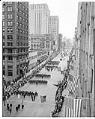
Photograph
Independence Day parade on Second Avenue, Seattle, July 4, 1938
Over 6,000 people marched in Seattle's 1938 Independence Day parade. Military units and civic groups marched down Second Avenue to Yesler Way, then up to Fourth Avenue and back to Virginia Street. The Seattle Post-Intelligencer estimated that tens of thousands of spectators crowded the downtown area, standing 10 to 20 deep along the parade route.Here, American flags hang from the…
ID Number:PI23277
Date:1938
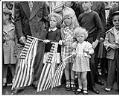
Photograph
Children watching Independence Day parade, July 4, 1947
Seattle's 1947 July 4th holiday began with a military parade and a flyover of B-29 bombers and naval planes. The Seattle Post-Intelligencer estimated that the crowd of spectators numbered in the tens of thousands as the parade wound its way south along Second Avenue and north again on Third Avenue. The 1947 holiday also celebrated the new independence of the…
ID Number:PI23314
Date:1947