365 results for: Homes and Housing
Photograph
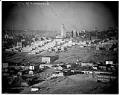
Yesler Terrace housing project, Seattle, 1941
Opened in 1940, Yesler Terrace was Seattle's first public housing project. The project had an integrated housing policy, which was somewhat unusual at that time. Handwritten on negative: Yesler housing.Handwritten on sleeve: Seattle - housing projects - Yesler.Date photograph was filed at the Seattle Post-Intelligencer (date of photograph and file date may differ by a month or more): December 27,…
ID Number:PI23736
Date:1941
Photograph
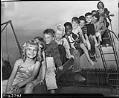
Children on slide at Yesler Terrace playground, Seattle, 1942
Yesler Terrace had an integrated housing policy from its beginnings, and today is an extremely diverse community. Handwritten on negative: Yesler project playfield.Handwritten on sleeve: Seattle - playfields - Yesler project.Date photograph was filed at the Seattle Post-Intelligencer (date of photograph and file date may differ by a month or more): June 22, 1942.
ID Number:PI23743
Date:1942
Photograph
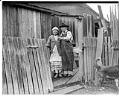
George and Mary Adams standing outside their home, Port Gamble Reservation, February 1939
In February 1939, the representatives of the Port Gamble band of the Clallam (now S’Klallam) people invited a Seattle Post-Intelligencer reporter and photographer to come to their village south of Hansville on the Olympic Peninsula. Chairman of the tribe’s governing committee Benny George, along with his aid Jackson and Rev. Karl Leonard of Bremerton, had been in contact with the…
ID Number:PI23825
Date:1939
Photograph
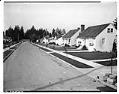
Residential street in Wedgwood, September 8, 1949
Home building boomed in many areas of the United States after World War II. In the Seattle area, some 27,805 houses were built between August 1945 and September 1949. This September 1949 photo, taken as part of National Home Week, shows some of the new homes in Seattle's Wedgwood area. The view is to the north from East 82nd Street…
ID Number:PI27772
Date:1949
Photograph
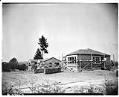
Houses under construction in Bellevue, May 1946
At the end of World War II, the United States Congress passed the Servicemen's Readjustment Act of 1944, called the G.I. Bill of Rights. The G.I. Bill provided $13 billion to returning military personnel for medical treatment, education and vocational training, and other needs. The bill offered home buyers government-guarantied, low-interest loans on new homes, with no down payment. New…
ID Number:PI27850
Date:1946
Photograph
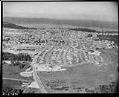
Aerial view of Lake Hills, Bellevue, 1959
In the 1950s, Lake Hills and other housing developments were built for families moving to the east side of Lake Washington. The developers of Lake Hills built 4,000 homes on 1,000 rural acres near Bellevue. They advertised the new development as the first major planned community in the Pacific Northwest, calling it "a fine residential area in a relaxing country…
ID Number:PI27874
Date:1959
Photograph
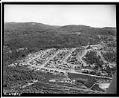
Aerial of Eastgate looking south, 1959
In the 1950s, several housing developments were built for families moving to the east side of Lake Washington. Eastgate is located just south of Interstate 90, which was known as the Sunset Highway when this photo was taken. Title from original inventory (incorrect identification of Eastlake as Lake Hills): Aerial view of Lake Hills residential district, with Lake Sammamish in…
ID Number:PI27875
Date:1959
Photograph
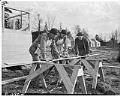
Servicemen building cabins at Jefferson Park, Seattle, March 1942
During World War II, thousands of service men and women served in or passed through Seattle. Jefferson Park Golf Course on Beacon Hill was requisitioned by the U. S. Army for a anti-aircraft batteries. The Army also took over the rest of the park west of Beacon Avenue for a G.I. center. Built by the Civilian Conservation Corps (CCC), community…
ID Number:PI28215
Date:1942
Photograph
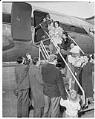
War brides and children disembarking from plane, probably in Seattle, 1950
Handwritten on sleeve: World War II - War brides, with Mrs. Ruby Starr, Mrs. John Ross, Mrs. Raymond Trotter, Mrs. Irving Deshwier, Mrs. Roy Spencer.Date photograph was filed at the Seattle Post-Intelligencer (date of photograph and file date may differ by a month or more): February 20, 1950.
ID Number:PI28316
Date:1950
Photograph
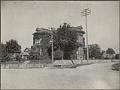
Exterior of Minor-Collins home on First Hill, Seattle, circa 1900
Situated on the northeast corner of Minor Avenue and Cherry Street, the Minor-Collins Home was built in 1887 by Sarah and Dr. Thomas T. Minor (1844-1889), one of the earliest grand homes built on First Hill. In 1891 when Angela and John Collins (1835-1903) became the new residents, it was still addressed 702 12th Avenue, but the street was soon renamed…
ID Number:SHS166
Date:Circa 1900