390 results for: Manufacturing
Photograph
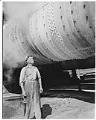
Oscar Lindgren at Pacific Coast Cement Company, Seattle, circa 1953
The Pacific Coast Cement Company was located on a 20-acre site along the East Duwamish waterway near Charleston Street from 1928-1947. The plant was designed to be easily accessible by highway, railroad, and ship along a private 460-foot wharf. At its peak, the Pacific Coast Cement Company was capable of producing 3,400 barrels of cement a day. Cement is mixed…
ID Number:2016.92.3
Date:Circa 1953
Photograph
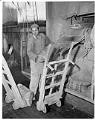
Dallas Graham, cement packer at Pacific Coast Cement Company, Seattle, circa 1953
The Pacific Coast Cement Company was located on a 20-acre site along the East Duwamish waterway near Charleston Street from 1928-1947. The plant was designed to be easily accessible by highway, railroad, and ship along a private 460-foot wharf. At its peak, the Pacific Coast Cement Company was capable of producing 3,400 barrels of cement a day. Cement is mixed…
ID Number:2016.92.16
Date:Circa 1953
Photograph
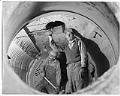
A. Koch and John Grim at Pacific Coast Cement Company, Seattle, December 12, 1952
The Pacific Coast Cement Company was located on a 20-acre site along the East Duwamish waterway near Charleston Street from 1928-1947. The plant was designed to be easily accessible by highway, railroad, and ship along a private 460-foot wharf. At its peak, the Pacific Coast Cement Company was capable of producing 3,400 barrels of cement a day. Cement is mixed…
ID Number:2016.92.24
Date:1952
Photograph
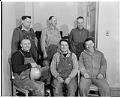
Plant foremen at Pacific Coast Cement Company, Seattle, 1952
The Pacific Coast Cement Company was located on a 20-acre site along the East Duwamish waterway near Charleston Street from 1928-1947. The plant was designed to be easily accessible by highway, railroad, and ship along a private 460-foot wharf. At its peak, the Pacific Coast Cement Company was capable of producing 3,400 barrels of cement a day. Cement is mixed…
ID Number:2016.92.39
Date:1952
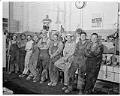
Photograph
Shop group at Pacific Coast Cement Company, Seattle, 1955
The Pacific Coast Cement Company was located on a 20-acre site along the East Duwamish waterway near Charleston Street from 1928-1947. The plant was designed to be easily accessible by highway, railroad, and ship along a private 460-foot wharf. At its peak, the Pacific Coast Cement Company was capable of producing 3,400 barrels of cement a day. Cement is mixed…
ID Number:2016.92.40
Date:1955
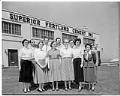
Photograph
Office personnel at Pacific Coast Cement Company, Seattle, May 19, 1955
The Pacific Coast Cement Company was located on a 20-acre site along the East Duwamish waterway near Charleston Street from 1928-1947. The plant was designed to be easily accessible by highway, railroad, and ship along a private 460-foot wharf. At its peak, the Pacific Coast Cement Company was capable of producing 3,400 barrels of cement a day. Cement is mixed…
ID Number:2016.92.42
Date:1955
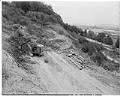
Photograph
Shovel at the Superior Clay Pit, Seattle, August 13, 1952
The Pacific Coast Cement Company was located on a 20-acre site along the East Duwamish waterway near Charleston Street from 1928-1947. The plant was designed to be easily accessible by highway, railroad, and ship along a private 460-foot wharf. At its peak, the Pacific Coast Cement Company was capable of producing 3,400 barrels of cement a day. Cement is mixed…
ID Number:2016.92.110
Date:1952
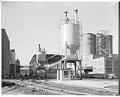
Photograph
Diamond Cement bulk loading tanks at Pacific Coast Cement Company, Seattle, December 10, 1952
The Pacific Coast Cement Company was located on a 20-acre site along the East Duwamish waterway near Charleston Street from 1928-1947. The plant was designed to be easily accessible by highway, railroad, and ship along a private 460-foot wharf. At its peak, the Pacific Coast Cement Company was capable of producing 3,400 barrels of cement a day. Cement is mixed…
ID Number:2016.92.123
Date:1952
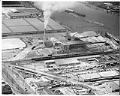
Photograph
Aerial view of Pacific Coast Cement Company, Seattle, May, 1953
The Pacific Coast Cement Company was located on a 20-acre site along the East Duwamish waterway near Charleston Street from 1928-1947. The plant was designed to be easily accessible by highway, railroad, and ship along a private 460-foot wharf. At its peak, the Pacific Coast Cement Company was capable of producing 3,400 barrels of cement a day. Cement is mixed…
ID Number:2016.92.135
Date:1953
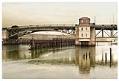
Photograph
View of old South Park Bridge, Seattle, 2008
The 14th Avenue South Bridge, later renamed the South Park Bridge, connected Seattle with the nearby South Park neighborhood. Spanning the Duwamish River, it was a double-leaf bascule bridge, meaning that the two halves of the road deck opened from the middle. The bridge, shown here, opened in 1931, and by 2009 carried some 20,000 vehicles per day. It was…
ID Number:2017.14.1
Date:2008