390 results for: Manufacturing
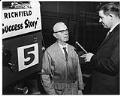
Photograph
Frank Law interviewed by Bill Neilson at the Currin-Greene Shoe Manufacturing Company, Seattle, 1959
On October 13, 1959, Seattle's KING 5 TV aired "Richfield Success Story" a 30-minute television documentary about the Currin-Greene Shoe Manufacturing Company. The film featured the boot making process and included interviews with long-time employees. Here, employee Frank Law is being interviewed by emcee Bill Neilson inside the factory. Stamped on verso: RICHFIELD SUCCESS STORY. PICTURE # 91013 13. SHOW…
ID Number:2013.114.16
Date:1959
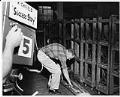
Photograph
Ben Peterson at work during KING-TV filming at the Currin-Greene Shoe Manufacturing Company, Seattle, 1959
On October 13, 1959, Seattle's KING 5 TV aired "Richfield Success Story" a 30-minute television documentary about the Currin-Greene Shoe Manufacturing Company. The film featured the boot making process and included interviews with long-time employees. Here, Ben Peterson is being filmed while working inside the factory. Stamped on verso: RICHFIELD SUCCESS STORY. PICTURE # 91013 22. SHOW DATE 10 13…
ID Number:2013.114.17
Date:1959
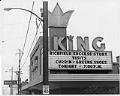
Photograph
KING TV marquee promoting Richfield Success Story featuring Currin-Greene Shoe Company, 1959
On October 13, 1959, Seattle's KING 5 TV aired "Richfield Success Story" a 30-minute television documentary about the Currin-Greene Shoe Manufacturing Company. The film featured the boot making process and included interviews with long-time employees. Here, the KING television marquee promotes the Richfield Success Story featuring Currin-Greene Shoe Company. The King Broadcasting building was located at this time in a…
ID Number:2013.114.18
Date:1959
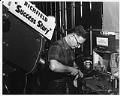
Photograph
Tony Russo at work during KING-TV filming at the Currin-Greene Shoe Manufacturing Company, Seattle, 1959
On October 13, 1959, Seattle's KING 5 TV aired "Richfield Success Story" a 30-minute television documentary about the Currin-Greene Shoe Manufacturing Company. The film featured the boot making process and included interviews with long-time employees. Here, Tony Russo is being filmed while working on a pair of boots inside the factory. Stamped on verso: RICHFIELD SUCCESS STORY. PICTURE # 91013…
ID Number:2013.114.19
Date:1959
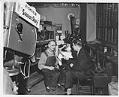
Photograph
Worker being interviewed for a documentary at the Currin-Greene Shoe Manufacturing Company, Seattle, 1959
On October 13, 1959, Seattle's KING 5 TV aired "Richfield Success Story," a 30-minute television documentary about the Currin-Greene Shoe Manufacturing Company. The film featured the boot making process and included interviews with long-time employees. Here, the show's emcee Bill Nielson interviews expert hand-sewer Julius Brandt. A selection of the company's boots and shoes can be seen in the background.
ID Number:2013.114.20
Date:1959
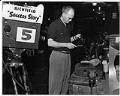
Photograph
Gordon Matheson at work during KING-TV filming at the Currin-Greene Shoe Manufacturing Company, Seattle, 1959
On October 13, 1959, Seattle's KING 5 TV aired "Richfield Success Story" a 30-minute television documentary about the Currin-Greene Shoe Manufacturing Company. The film featured the boot making process and included interviews with long-time employees. Here, Gordon Matheson is being filmed while working on a pair of boots inside the factory. Stamped on verso: RICHFIELD SUCCESS STORY. PICTURE # 91013…
ID Number:2013.114.21
Date:1959
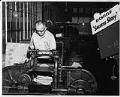
Photograph
Bob Burki at work during KING-TV filming at the Currin-Greene Shoe Manufacturing Company, Seattle, 1959
On October 13, 1959, Seattle's KING 5 TV aired "Richfield Success Story" a 30-minute television documentary about the Currin-Greene Shoe Manufacturing Company. The film featured the boot making process and included interviews with long-time employees. Here, Bob Burki is being filmed while working on a pair of boots inside the factory. Stamped on verso: RICHFIELD SUCCESS STORY. PICTURE # 91013…
ID Number:2013.114.22
Date:1959
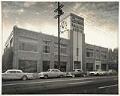
Photograph
Currin's Rainier Shoes building, Seattle, 1955
Hugh Currin and Warren Greene founded the Currin-Greene Shoe Manufacturing Company in 1908. They built their first plant on Seattle’s Eastlake Avenue and moved in 1920 to a new plant on Western Avenue. The company specialized in specialty and heavy-duty work boots and shoes, which they sold throughout the Pacific Northwest and Alaska. The company later acquired the Rainier shoe…
ID Number:2013.114.23
Date:1955
Photograph
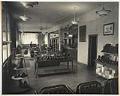
Currin-Greene Shoe manufacturing employees, Seattle, 1955
Hugh Currin and Warren Greene founded the Currin-Greene Shoe Manufacturing Company in 1908. They built their first plant on Seattle’s Eastlake Avenue and moved in 1920 to a new plant on Western Avenue. The company specialized in specialty and heavy-duty work boots and shoes, which they sold throughout the Pacific Northwest and Alaska. The company later acquired the Rainier shoe…
ID Number:2013.114.24
Date:1955
Book
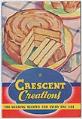
Crescent Creations, 180 Alluring Recipes for Every Day Use, 1935
Featuring a richly colored illustration of a classic yellow layer cake with chocolate icing, this cookbook offers ideas for using Crescent baking powder to leaven many sweet and savory baked goods. The book also describes "Hurricake," a new method for cake baking utilizing only three steps and requiring the use of the Crescent Baking Powder. Originally located at 122 S.…
ID Number:2014.3.2.10
Date:1935