525 results for: Government and Public Services
Photograph
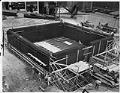
Federal Reserve Bank branch under construction, Seattle, July 21, 1949
The Federal Reserve Bank of San Francisco opened a branch in Seattle in 1917. After some years in leased space, the Seattle Branch moved into its own, purpose-built building on Second Avenue and Madison Street in 1951. The new bank had a two-story vault with 30-inch steel-reinforced concrete walls and an inner steel shell. This 1949 image shows the bank…
ID Number:2000.107.165.11.04
Date:1949
Photograph
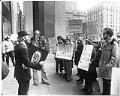
Seattle City Light rate protest outside SeaFirst building, January 9, 1979
In this image taken outside the Seattle First National Bank building in downtown Seattle, demonstrators gathered to protest a new building code allowing commercial and industrial firms to pay less as they use larger amounts of electricity. By contrast, residential users paid more as they used more under Seattle City Light's rate structures. Jim Wurzer, left, dressed as SeaFirst Bank…
ID Number:2000.107.165.16.01
Date:1979
Photograph
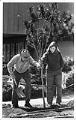
Planting cherry trees on Capitol Hill, Seattle, April 13, 1982
In the spring of 1982, residents of Seattle's Capitol Hill neighborhood turned out to plant some 250 cherry trees paid for by federal block grant money. Residents chose Bing cherries for their food value and because their foliage matched the area's brick gutters.Here, landscape contractor Henry Zinser helps Capitol Hill resident Carol Baldwin plant a Bing cherry tree on East…
ID Number:2000.107.168.11.05
Date:1982
Photograph
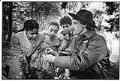
Ranger leading nature walk at Camp Long, Seattle, March 7, 1985
Named for Seattle Juvenile Court Judge William George Long (1894-1974), Camp Long was built in 1937 as a place for organized scouting groups to learn camping skills. In 1984, park officials made the 68 acre park more accessible to the general public, allowing visitors to enjoy nature, hike in the forest, camp overnight in rustic cabins, rock climb, and learn…
ID Number:2000.107.168.11.06
Date:1985
Photograph
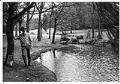
Ranger standing at Polliwog Pond, Camp Long, Seattle, March 7, 1985
Named for Seattle Juvenile Court Judge William George Long (1894-1974), Camp Long was built in 1937 as a place for organized scouting groups to learn camping skills. In 1984, park officials made the 68 acre park more accessible to the general public, allowing visitors to enjoy nature, hike in the forest, camp overnight in rustic cabins, rock climb, and learn…
ID Number:2000.107.168.11.07
Date:1985
Photograph
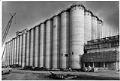
Exterior of Pier 86 grain terminal, Seattle, January 6, 1970
In 1970 the Port of Seattle spent millions of dollars finishing and upgrading container terminals, airport projects, and new property acquisitions to support what is a major contributor to regional economic growth. Seattle's grain exports were moved at the time to the $15 million Pier 86 Grain Facility in the Interbay neighborhood. This property replaced the Port’s Hanford Street Grain…
ID Number:2000.107.171.37.01
Date:1970
Photograph
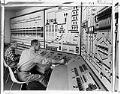
Employees operating Pier 86 grain terminal control panel, Seattle, October 28, 1970
In 1970 the Port of Seattle spent millions of dollars finishing and upgrading container terminals, airport projects, and new property acquisitions to support what is a major contributor to regional economic growth. Seattle's grain exports were moved at the time to the $15 million Pier 86 Grain Facility in the Interbay neighborhood. This property replaced the Port’s Hanford Street Grain…
ID Number:2000.107.171.37.02
Date:1970
Photograph
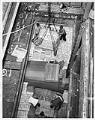
Employees loading bags of bulgur at Fisher Flouring Mills, Seattle, July 24, 1961
In different administrative and organizational forms, the Food for Peace program of the United States has provided food assistance around the world since President Dwight D. Eisenhower signed the Agricultural Trade Development and Assistance Act, or Public Law (P.L.) 480, in 1954. Initially a means to donate surplus U.S. commodities, the U.S. government now purchases food from American farmers through…
ID Number:2000.107.172.34.06
Date:1961
Photograph
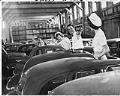
Employees with imported cars at Foreign Trade Zone, Seattle, April 20, 1950
Foreign-Trade Zones (FTZs) are duty-free, quota-free, secured areas in a designated customs “port of entry,” considered outside U. S. Customs territory and exempt from customs tariffs. The FTZ program was established in 1934 to stimulate economic growth and development in the United States by lowering the cost of international trade.In this image, from left, Robert Edwards, Rose Schnoberger, Bruce Williams,…
ID Number:2000.107.173.01.04
Date:1950
Photograph
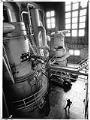
Interior of Georgetown steam plant, Seattle, October 1985
The Georgetown Steam Plant, located near Boeing Field in Seattle's Georgetown neighborhood, was originally constructed in 1906 for the Seattle Electric Company. The plant's overall contributions to electricity production were minor but the innovative methods and materials used to build it, the intact early-twentieth-century steam-generating equipment it houses, and the involvement of pioneering efficiency expert Frank Bunker Gilbreth, Sr. (1868-1924),…
ID Number:2000.107.173.07.02
Date:1985