525 results for: Government and Public Services
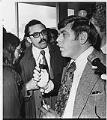
Photograph
Keo Capastany and Robert Gogerty at Mayor's office sit-in, April 5, 1973
Seattle had a growing Latino population in the late 1960s, and activists had been pressing the city for a building in which to establish a Chicano community center. Tired of having their requests ignored, in October 1972 they took over the abandoned Beacon Hill School on 16th Avenue South and renamed it El Centro de la Raza. After a 75-day…
ID Number:2000.107.124.39.13
Date:1973
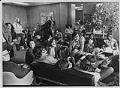
Photograph
Sit-in at mayor's office, Seattle, April 5, 1973
Seattle’s Latino community was rapidly growing in the late 1960s and community activists pushed for the building of a Chicano community center, which they named El Centro de la Raza. After Chicano activists occupied the abandoned Beacon Hill School in late 1972, the city agreed to lease them the building for $1 per year. However, Seattle mayor Wes Uhlman refused…
ID Number:2000.107.124.39.20
Date:1973
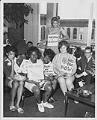
Photograph
Sit-in at Mayor Gordon Clinton's office, Seattle, July 1963
On July 1, 1963, after a demonstration of about 400 people on the City Hall plaza, 35 individuals from the Central District Youth Club began a sit-in at Mayor Gordon Clinton's office to protest Clinton's lack of action on an open housing ordinance. This photo shows some of the group of young women and men in the reception area of…
ID Number:2000.107.131.21.15
Date:1963
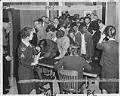
Photograph
Crowd at City Hall for housing ordinance hearing, October 25, 1963
The Seattle Human Rights Commission drafted an open housing ordinance in 1963 and presented it to the City Council for approval. The Council held public hearings on the ordinance, but declined to pass it outright as the Commission recommended. Instead, the issue was put on the ballot in March 1964, where it was turned down by voters.In this photo, a…
ID Number:2000.107.131.21.17
Date:1963
Photograph
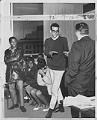
Central Area youth with Ed Devine at Mayor's office, August 19, 1965
On August 19 and 20th, 1965, a group of nine youths from the Central Area Youth Action Council occupied the reception area outside Mayor Dorm Braman's office in attempt to speak with the mayor. On both days, the mayor's administrative assistant, Ed Devine, told the group the mayor was expected to be out all day. The group made several requests…
ID Number:2000.107.131.21.24
Date:1965
Photograph
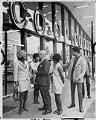
Central Area Cooperative supermarket at 23rd and Madison, Seattle, March 29, 1969
The first Central Area Cooperative supermarket opened in Seattle on Empire Way South (now Martin Luther King Jr. Way) near South Dearborn Street. Formerly a chain store, the market opened on September 7, 1968 as a cooperative. The private corporation sold stock to the public for $5 a share, with each member having one vote. A large percentage of the…
ID Number:2000.107.131.21.25
Date:1969
Photograph
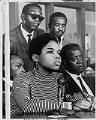
Infanta Spence and other Central Area activists at press conference, August 11, 1967
On August 2, 1967, Governor Dan Evans visited the Central Area of Seattle and listened to members of the Black community, meeting first with community leaders at the Sorrento Hotel, and later with the youth community at the Y.M.C.A. Some of the young people present agreed to develop proposals for action, and in the following days formed a group called…
ID Number:2000.107.131.22.07
Date:1967
Photograph
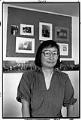
Chizuko Omori at home in front of incarceration camp photos, Seattle, August 10, 1988
Chizuko May Omori (b. 1930), a young Nisei girl, was living with her family in Oceanside, California when World War II broke out. After the bombing of Pearl Harbor, Omori and her family were incarcerated in Poston concentration camp (known officially as the Colorado River Relocation Center) in Yuma County, Arizona. After release from the camp, Omori lived for a…
ID Number:2000.107.136.07.01
Date:1988
Photograph
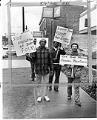
Picketers protesting discriminatory loan practices at Liberty Bank, Seattle, February 15, 1972
In response to urban problems of poverty and race in the United States, in November 1966 Congress initiated the Model Cities Program. The program's objectives were to reduce social and economic disadvantages in designated neighborhoods, provide training and employment opportunities, and establish health services for residents. Financial and technical assistance was made available to cities through the Department of Housing…
ID Number:2000.107.141.14.01
Date:1972
Photograph
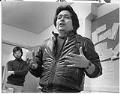
Michael Ramos and Rafael at the Salvadoran-Guatemalan Refugee Program, Seattle, February 28, 1985
This photo was taken at the Salvadoran-Guatemalan Refugee Program office in Seattle. The program supported refugees from El Salvador and Guatemala with legal aid, assistance with getting political asylum, and paying bail bonds for refugees who were arrested. If bail was not posted within a specified time period, refugees were sent to camps in California or Arizona. On the occasion…
ID Number:2000.107.151.03.01
Date:1985