3246 results for: Seattle Post-Intelligencer, The
Photograph
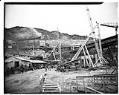
Change of shift at dam construction site, circa 1937
Work started on the Grand Coulee Dam in the fall of 1933 and was finished ten years later. Workers used a system of cranes, trestles, and conveyor belts to move the concrete and other construction materials into place. The men labored in shifts around the clock in winter and summer to build the dam on the Columbia River.This photo, taken…
ID Number:PI22031
Date:Circa 1937
Photograph
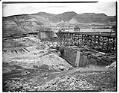
Trestles and traveling cranes at dam construction site, circa 1937
Large concrete dams, like Grand Coulee Dam, are actually built as a series of immense blocks, not as one solid structure. At Grand Coulee, workers poured concrete five feet at a time into wooden forms at the top of each column. A system of trestles and traveling cranes moved the workers and building materials to where they were needed.This photo,…
ID Number:PI22037
Date:Circa 1937
Photograph
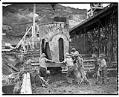
Men emptying cement into form at dam construction site, circa 1937
After much research, the United States Bureau of Reclamation and its contractor, the MWAK Company, developed a very strong type of concrete for the Grand Coulee Dam. Two concrete mixing plants built at the dam site supplied 640 cubic yards of concrete per hour, breaking all earlier records. Traveling cranes moved the concrete to the building site in huge buckets.This…
ID Number:PI22043
Date:Circa 1937
Photograph
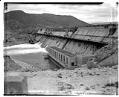
West side of Grand Coulee Dam showing powerhouse, March 1941
The Columbia Basin Project, including Grand Coulee Dam, was designed to supply irrigation water from the Columbia River to the dry lands of eastern Washington state. The dam also harnessed the power of the river to supply electricity to the Pacific Northwest. Irrigation and cheap hydroelectric power stimulated the growth of both agriculture and industry throughout the region.This photo, taken…
ID Number:PI22057
Date:1941
Photograph
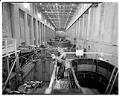
Inside a powerhouse at Grand Coulee Dam, August 1941
When Grand Coulee Dam was completed in 1943, its huge generators were the largest in the world, and the dam itself was one of the world's largest power plants. During World War II, the cheap electric power from Grand Coulee and Bonneville Dams stimulated the growth of the Pacific Northwest's aluminum, aircraft and shipbuilding industries and lit the homes of…
ID Number:PI22065
Date:1941
Photograph
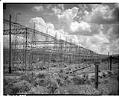
Power lines from Grand Coulee Dam, July 1942
From the start, Grand Coulee Dam was controversial. Private electric companies opposed such a huge government involvement in the power industry. Many taxpayers didn't want to pay for a dam they believed would generate more electricity than the country needed. By the end of World War II in 1945, the availability of cheap hydroelectric power had spurred the growth of…
ID Number:PI22078
Date:1942
Photograph
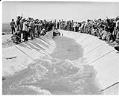
Irrigation canal near Pasco, May 15, 1948
Although the Columbia River carries a huge volume of water through eastern Washington, rainfall in the area is low and the land is very dry. Columbia River Project planners dreamed of a system of dams and channels which would give farmers a steady supply of water to grow wheat, sugar beets and other crops. After the completion of the Grand…
ID Number:PI22145
Date:1948
Photograph
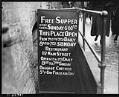
Sign outside Millionair Club offering free Sunday supper, Seattle, circa 1925
In 1921, Seattle businessman Martin G. Johanson founded The Millionair Club to help the city's unemployed help themselves. Johanson managed the organization which provided nourishing meals and acted as a clearinghouse for temporary jobs. He gave the organization its name because he said that helping others made him feel like a millionaire. He dropped the "e" in the organization's name…
ID Number:PI22381
Date:Circa 1925
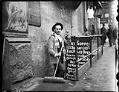
Photograph
Martin Johanson sweeping steps at The Millionair Club, circa 1925
In 1921, Seattle businessman Martin G. Johanson founded The Millionair Club to help the city's unemployed help themselves. Johanson managed the organization which provided nourishing meals and acted as a clearinghouse for temporary jobs. The Millionair Club still serves Seattle's unemployed with meals, clothing, job training, temporary jobs and medical referrals.This photo, taken in the 1920s, shows Martin Johanson sweeping…
ID Number:PI22382
Date:Circa 1925
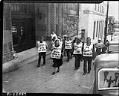
Photograph
Demonstrators with signs outside Seattle Chamber of Commerce during WPA strike, Seattle, 1937
In 1936, the federal Works Progress Administration hired some 9,000 unemployed King County residents on 271 different projects ranging from improving roads and parks to serving school lunches. Congress reduced funding for the WPA in 1937, causing nationwide layoffs. In Seattle, some workers stormed the WPA offices to protest the layoffs. Others staged sitdown strikes or picketed on downtown sidewalks.This…
ID Number:PI22387
Date:1937