3246 results for: Seattle Post-Intelligencer, The
Photograph
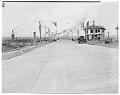
Decorating Ballard Bridge for reopening celebration, Seattle, May 1940
The Ballard Bridge, also known as the 15th Avenue Bridge, is a double-leaf bascule bridge in Seattle which connects Ballard to the Magnolia and Queen Anne neighborhoods. Opened in 1917 and spanning the Lake Washington Ship Canal, the Bridge originally had wooden approaches intended to last only ten years. The bridge was closed for repairs in 1939 and the approaches…
ID Number:PI20464
Date:1940
Photograph
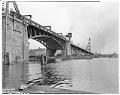
Ballard Bridge crossing Salmon Bay, Seattle, May 1940
The Ballard Bridge, also known as the 15th Avenue Bridge, is a double-leaf bascule bridge in Seattle which connects Ballard to the Magnolia and Queen Anne neighborhoods. Opened in 1917 and spanning the Lake Washington Ship Canal, the Bridge originally had wooden approaches intended to last only ten years. The bridge was closed for repairs in 1939 and the approaches…
ID Number:PI20465
Date:1940
Photograph
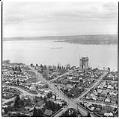
Aerial of Evergreen Point Bridge under construction from southwest, Seattle, 1963
Washington's Evergreen Point Floating Bridge carries State Route 520 across Lake Washington, connecting Seattle with the growing area east of the lake. When it opened, the bridge's 7,578 foot floating span was the longest in the world. This was the second floating bridge to cross Lake Washington, and both bridges are overcrowded daily with commuters in their automobiles.This photo shows…
ID Number:PI20474
Date:1963
Photograph
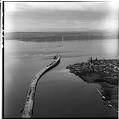
Aerial view of Evergreen Point Floating Bridge, March 1963
Washington's Evergreen Point Floating Bridge carries State Route 520 across Lake Washington, connecting Seattle with the growing area east of the lake. When it opened, the bridge's 7,578 foot floating span was the longest in the world. This was the second floating bridge to cross Lake Washington, and both bridges are overcrowded daily with commuters in their automobiles.//This photo shows…
ID Number:PI20478
Date:1963
Photograph
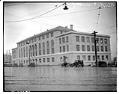
United States Immigration Station and Assay Office, Seattle, 1932
The federal immigration station building opened in 1932 at on Airport Way South near Maynard Avenue South. In 2004, the US Department of Homeland Security opened a new facility in Tacoma, and closed immigration services at this location. Handwritten on image: U.S. Immigration.Handwritten on sleeve: U.S. Immigration Station - Seattle.Date photograph was filed at the Seattle Post-Intelligencer (date of photograph…
ID Number:PI20985
Date:1932
Photograph
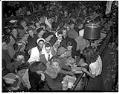
Shoppers buying stockings at Frederick & Nelson, November 3, 1945
In the early 1940s, during World War II, the military needed silk to make parachutes. Silk was rationed, and there was hardly any left over to make underwear, stockings or other everyday products. Women found that rayon stockings bagged and leg makeup smeared or cracked. When the war was over, women jumped at the chance to buy the new sheer…
ID Number:PI21052
Date:1945
Photograph
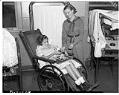
Virginia Harris and Vera Danilchik building a camp fire model, November 1937
Girl Scouting started in Seattle in 1921. By 2013, the area's Girl Scout Council was serving nearly 26,000 girls in Western Washington. Troops of girls meet regularly to learn about health and handicrafts as well as science and technology, careers, and leadership. The program is open to all girls, regardless of their abilities.This 1937 photo shows Girl Scout Virginia Harris…
ID Number:PI21219
Date:1937
Photograph
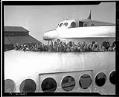
Girl Scouts on the ferry "Kalakala," August 1938
Girl Scouting started in Seattle in 1921. By 1997, the area's Girl Scout Council was serving nearly 17,000 members in ten western Washington counties. Troops of girls meet regularly to learn about health and handicrafts as well as science and technology, careers and leadership. During the summer, many of the scouts attend camp or go on outdoor field trips.This August…
ID Number:PI21221
Date:1938
Photograph
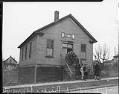
Parishioners exiting Bethany Friends Community Church, Seattle, 1939
Bethany Friends Community Church was located at Atlantic Street and 24th Avenue South in Seattle. It was demolished for the construction of the Lake Washington Floating Bridge. Sign on building reads: Bethany Friends Community Church.Handwritten on image: Lake Wash Bridge expropriates.Handwritten on sleeve: Seattle - churches - Bethany Friends.Date photograph was filed at the Seattle Post-Intelligencer (date of photograph and…
ID Number:PI21247
Date:1939
Photograph
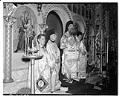
Clergy at St. Demetrios, August 1940
Members of Seattle's Greek Orthodox community built St. Demetrios Church in 1920 on Yale Avenue at the northeast corner of Thomas Street. In the 1960s, the congregation left the old church and moved to a new building in the Montlake neighborhood. In the 1990s, the old St. Demetrios, a landmark at the time, was demolished to make room for REI's…
ID Number:PI21283
Date:1940