31 results for: Hegg, Eric A.
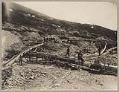
Photograph
Miners and sluices on Bonanza Creek, circa 1898
Miners used water running through sluice boxes to wash the gold out of the pay dirt. Lumber for the sluice boxes was cut from the surrounding hills and finished in a nearby sawmill. As the hills were cleared, lumber became even more expensive. By the time this photo was taken, large mining companies had begun to replace small scale mining…
ID Number:SHS7300
Date:Circa 1898
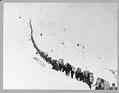
Photograph
Packers ascending summit of Chilkoot Pass, circa 1898
The Chilkoot Pass had been used as a Indigenous trade route for generations before the Klondike stampede. When the 1897 gold rush started, the Chilkat, Tlingit, and other Native people hired themselves out as packers for the incoming gold seekers, charging $1.00 a pound to carry goods over Chilkoot Pass. The following year, a tramway put many of the Native…
ID Number:SHS8258
Date:Circa 1898
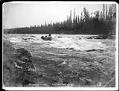
Photograph
Klondikers shooting White Horse Rapids, 1898
Two miles below Miles Canyon, gold seekers on the Yukon River had to navigate through White Horse Rapids. Those who could afford it hired a pilot or portaged their goods around the rapids and used ropes to guide their empty boats through the dangerous rapids. Some boats broke up among the rocks and whirlpools; some took on so much water…
ID Number:SHS8332
Date:1898
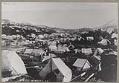
Photograph
Tent city at Lake Bennett, 1898
In early spring 1898, roughly 10,000 gold seekers were camped on the shore of Lake Bennett waiting for the ice to clear. They assembled their supplies and built boats and scows to take them down the Yukon River. Until the railroad was completed in 1900, Bennett continued to be a major jumping off spot for the Klondike gold fields.This 1898…
ID Number:SHS8352
Date:1898
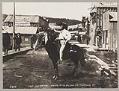
Photograph
Capt. Jack Cawford on horseback, Dawson, Yukon Territory, July 4, 1899
Most of the people who poured into Dawson starting in 1897 were Americans. As a result, the Fourth of July was a big holiday.This photo, taken by Eric Hegg on July 4, 1899, shows Captain Jack Cawford on his horse in Dawson. Cawford was an American and a veteran of both the Civil War and the Indian Wars of the…
ID Number:SHS9539
Date:1899
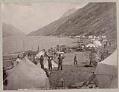
Photograph
Klondikers sailing down Lake Bennett, May 30, 1898
In the spring of 1898, the air at Bennett was filled with the sound of hammering and sawing as gold seekers cut trees and built boats to head downstream. The ice on Lake Bennett broke up on May 29, 1898. Within a week, over 1,000 boats started across the lake and down the Yukon River to the Klondike gold fields.This…
ID Number:SHS9906
Date:1898
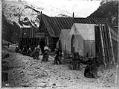
Photograph
The favorite dog team of Sheep Camp, circa 1898
Gold seekers who landed at Dyea, Alaska, carried their supplies to Sheep Camp and then to the foot of Chilkoot Pass. Some people in Dyea and Sheep Camp made a living carrying the stampeders' goods along the trail by dog team. This photo by Eric Hegg, taken around 1898, shows a dog team considered the favorite in Sheep Camp.
ID Number:SHS10426
Date:Circa 1898
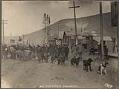
Photograph
Dog team pulling a cart, Dawson City, circa 1898
After the snow melted in the spring, dog teams didn't rest. They continued to work, pulling carts instead of sleds. This photo shows a team of six dogs pulling a cart loaded with a trunk and other supplies, possibly belonging to the woman standing near the cart (left center). Eric Hegg took this photo in Dawson City sometime around 1898.…
ID Number:SHS10428
Date:Circa 1898
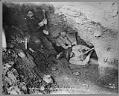
Photograph
Underground mining at Gold Hill, circa 1898
In Alaska and the Yukon, placer gold was found along ancient stream beds, some of which were twelve to forty feet underground at bedrock. The gold was frozen in the dirt or gravel. Miners chopped away at the frozen earth with picks or tried to thaw it with fires or steam machines. They "drifted" all winter, digging in the direction…
ID Number:SHS12491
Date:1900
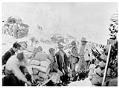
Photograph
Men with piles of supplies at Chilkoot Pass, circa 1898
At the top of Chilkoot Pass, the gold seekers stockpiled what they had carried up the steep slope and went back for another load. When they had packed everything to the top of the pass, they were ready to cross the border into Canada. During the stampede of 1898, Canada's Northwest Mounted Police checked some 40,000 people through the border.This…
ID Number:SHS15867
Date:Circa 1898