31 results for: Hegg, Eric A.
Photograph
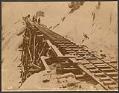
Icy tracks on the White Pass & Yukon Route, circa 1899
Winter snow in the coastal mountains was a constant problem for the White Pass and Yukon Route railway. Subzero temperatures, icy conditions, and snowfalls of several feet were common. The railroad's snowplows couldn't always get through, and sometimes passengers had to help clear the tracks.This photo by Eric Hegg shows workers clearing ice from the tracks of the White Pass…
ID Number:SHS42
Date:Circa 1899
Photograph
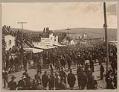
July fourth, Dawson, Yukon Territory, July 4, 1899
In 1898 and 1899, most of the people who poured into Dawson were Americans. The Fourth of July was a big holiday in this Canadian city.This photo, probably taken in 1899 by Eric Hegg, shows the crowds enjoying the Independence Day celebration in Dawson, Yukon Territory. Some spectators have climbed on the roofs of the buildings to watch the festivities.…
ID Number:SHS47
Date:1899
Photograph
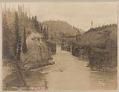
Miles Canyon, circa 1898
Miles Canyon was one of the most dangerous parts of the Yukon River between Lake Bennett and Dawson. It was only 100 feet wide, with steep cliffs, a whirlpool midway, and a large rock at the lower end. The gold rush stampeders could pay professional guides to take them through the canyon, but many couldn't afford the expense.This E. A.…
ID Number:SHS48
Date:1898
Photograph
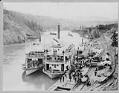
Three steamboats at the Miles Canyon tramway, circa 1898
Miles Canyon and White Horse Rapids were among the most dangerous parts of the Yukon River between Lake Bennett and Dawson. In 1898, a five-mile tramway was built around these two obstacles, and travelers could ride around them in safety. The tramway operators charged 25 cents a pound to haul gold seekers' goods on horse-drawn flat bed cars. Many miners…
ID Number:SHS49
Date:Circa 1898
Photograph
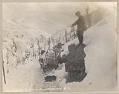
Man with two loaded sleds on Dyea trail above Lindeman, April 10, 1899
The trail from Dyea led across Chilkoot Pass to Lake Lindeman (sometimes spelled Linderman) and Lake Bennett in British Columbia. Many of the gold seekers who crossed Chilkoot Pass in the winter from 1897 to 1899 camped by Lake Lindeman waiting for the ice to thaw. Others hiked further to Lake Bennett.This photo, taken by Eric Hegg in April 1899,…
ID Number:SHS50
Date:1899
Photograph
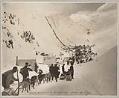
Scales and summit of Chilkoot Pass, 1898
The gold seekers packed their supplies from Sheep Camp to just below Chilkoot Pass. At this point, they assembled their goods, weighed them, and, if they could afford it, arranged have their supplies carried to the top of the pass by packers or tramway. Packers charged more to carry the load up the steep slope than along the trail from…
ID Number:SHS412
Date:1898
Photograph
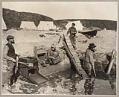
Group of miners using conveyor and rockers, circa 1899
Around 1898, gold was found in inland creekbeds near what would become Nome. It wasn't until early 1899, when word leaked out that gold had been discovered in beach sand, that the Nome gold rush truly began. Extracting gold from beach sand called for different methods. Conveyors and rockers worked more efficiently than sluices and panning.This 1899 or 1900 photo…
ID Number:SHS414
Date:Circa 1899
Photograph
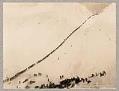
Packers ascending summit of Chilkoot Pass, 1898
The gold seekers climbed over 1,200 steps to reach the top of Chilkoot Pass where they crossed the border into Canada. The angle of climb was about 30 degrees, and the line could only move as fast as the slowest climber. Anyone who stopped to rest might wait hours to get back in line. The Northwest Mounted Police required that…
ID Number:SHS2246
Date:1898
Photograph
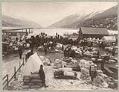
Freight yard at Dyea, circa 1898
By the fall of 1897, over 3,000 people had poured into the tiny settlement of Dyea, heading for the Klondike gold fields. At first, ships had to anchor well offshore. The harbor was narrow and had a twenty-foot tide. Klondike stampeders had paid to get to Dyea, but their passage didn't include unloading their supplies and taking them ashore.This photo…
ID Number:SHS2365
Date:Circa 1898
Photograph
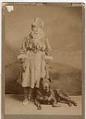
Mrs. Minerva Hose, governess in Skagway, circa 1900
In 1896, Tagish Indian Skookum Jim Mason and two other men made the first big gold strike on Rabbit (Bonanza) Creek, setting off the Klondike gold rush. Mason later employed Mrs. Minerva Hose to teach and take care of his daughter Daisy. Mrs. Hose was an early shopkeeper in Dyea, Alaska.This photo of Mrs. Minerva Hose was taken at the…
ID Number:SHS6370
Date:Circa 1900