154 results for: Fish and Fishing
Photograph
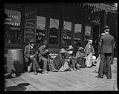
Group of Suquamish people waiting at Colman Dock, Seattle, circa 1911
The Suquamish tribe lived on Bainbridge Island and fished in the waters of Puget Sound long before Seattle was founded. The Suquamish carved dugout canoes and used them to travel to fishing and hunting grounds across Puget Sound. Fishing, especially for salmon, was of central importance to the Suquamish for both subsistence and culture. Suquamish fishers used subtle environmental clues…
ID Number:1983.10.7723
Date:1911
Photograph
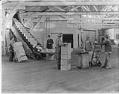
Interior of the Virginia Street Dock warehouse, circa 1911
Northwest Fisheries caught and canned red salmon in Alaska. The cans were packed into wooden crates and shipped to Seattle. The crates were then stored in warehouses until they could be sent to buyers in the United States and other countries.This photo was taken around 1911. It shows men loading crates of Northwest Fisheries' canned red Alaska salmon onto a…
ID Number:1983.10.7984
Date:Circa 1911
Photograph
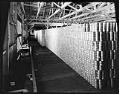
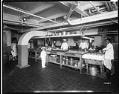
Storeroom at Pacific American Fisheries salmon canning factory, 1910
Bellingham Bay's first commercial salmon cannery opened in Fairhaven, Washington in 1895. By 1901, Whatcom County was home to twelve of the nineteen canneries on Puget Sound. That year, the county's 5,500 cannery workers packed 935,000 cases of salmon. At 48 one-pound cans per case, that's 44,880,000 cans.This 1910 photo, taken at the Pacific American Fisheries salmon cannery on Bellingham…
ID Number:1983.10.8341
Date:1910
Photograph
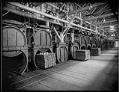
Retorts at Pacific American Fisheries salmon canning factory, 1910
Pacific American Fisheries, in Bellingham, Washington, was one of the largest salmon canning companies in the Pacific Northwest. During each salmon run, PAF fishers caught tons of fresh salmon for the cannery. Cannery workers gutted and cleaned the fish and then packed the meat into cans. The cans were then heated in huge steam retorts to cook and preserve the…
ID Number:1983.10.8342
Date:1910
Photograph
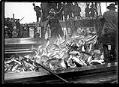
Emptying a salmon trap, circa 1910
The waters of Puget Sound are home to an abundance of salmon and salmon fishermen. In this photo, visitors watch as tons of live salmon are dumped from a trap into a barge somewhere in northern Puget Sound. Webster & Stevens number: 10964
ID Number:1983.10.8405.2
Date:Circa 1910
Photograph
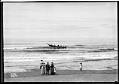
Quinault canoe and sightseers, Moclips, Washington, 1914
The Quinault are a Coast Salish people whose historic territory was the southwestern Olympic Peninsula. The current Quinault Indian Nation (QIN) has a reservation covering part of their historic lands. In addition to Quinault people, the QIN includes people from several neighboring tribes: Queets, Quileutes, Hohs, Chehalis, Chinook, and Cowlitz. Fishing, especially for salmon, is an important part of Quinault…
ID Number:1983.10.8687
Date:1914
Photograph
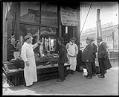
Fish market near the Seattle waterfront, circa 1917
Even in the 1910s, at least one Seattle fish market promoted its shipping services. In this photo, taken at a market next to Colman Dock around 1917, two salesmen show their fresh fish to several prospective buyers. The market has salmon for sale, and crabs for 20 cents each. The sign above the door says that fish can be shipped…
ID Number:1983.10.10556
Date:Circa 1917
Photograph
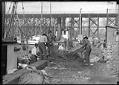
Fishermen checking nets at Fisherman's Terminal, Seattle, circa 1918
For many years, commercial fishermen have kept their boats at Fishermen's Terminal, in Salmon Bay, just west of the Ballard Bridge. This sheltered area of the Lake Washington Ship Canal gives easy access to Puget Sound. In this photo, taken in about 1918, fishermen are checking and mending their gill nets. Handwritten on sleeve: Fisherman's DockWebster & Stevens number: 90660
ID Number:1983.10.10941.2
Date:Circa 1918
Photograph
Fishing boat Ida Mae, Seattle, April 16, 1940
Handwritten on sleeve: Fish Boat Ida Mae 4/16/40Webster & Stevens number: 145992
ID Number:1983.10.13176.2
Date:1940
Photograph
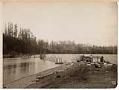
Salmon trap, circa 1911
For many years, Native Americans and others trapped migrating salmon by building wire mesh and net barriers across waterways. The fish were funneled into a trap and couldn't escape. Canneries ran traps too. Their boats regularly emptied the salmon traps and delivered the fish to the cannery. This method caught so many fish that salmon runs began to disappear. Salmon…
ID Number:1983.10.PA11.79
Date:Circa 1911