844 results for: Puget Sound
Videorecording
Oral history interview with Norton Clapp, June 12, 1985
Norton Clapp (1906-1995) was a Seattle businessman and philanthropist. Clapp started working for the Weyerhaeuser Timber Company part-time in 1938, and returned to the company after serving in the Navy, replacing his father as director after his death. In 1960, he became president of Weyerhaeuser, serving in that position until 1966, and as Board member until 1970, before leaving to…
ID Number:1985.135.5
Date:1985
Videorecording
Oral history interview with Kenneth Fisher, April 23, 1985
Kenneth Robinson Fisher (1906-1999) was the grandson of O.W. (Oliver Williams) Fisher, founder and owner of Seattle’s Fisher Flour Mill. Fisher built his mill, the largest in the west, on the newly constructed Harbor Island in Elliott Bay at the mouth of the Duwamish waterway, one of the first industrial businesses to open on the island. Fisher ran the business…
ID Number:1985.135.10
Date:1985
Videorecording
Oral history interview with H. Dewayne Kreager, October 17, 1985
H. (Henry) Dewayne Kreager (1912 – 2001) was a banker and businessman, a Washington state native who attended college at Washington State University, Duke, and Harvard. Kreager started his professional career in Washington, D.C., working with the federal Foreign Economic Administration from 1941 to 1946, with the State Department as assistant director of the Foreign Service Institute in 1946 -1947,…
ID Number:1985.135.14
Date:1985
Videorecording
Oral history interview with Horace W. McCurdy, January 18, 1985
Horace Winslow (“H.W.”) McCurdy (1899-1989) was a maritime construction executive, civic leader, and avid supporter of maritime research in the Pacific Northwest. A Washington native, McCurdy was born and raised in Port Townsend, and attended University of Washington in Seattle and the Massachusetts Institute of Technology (MIT). After graduating in 1922, he got a job at the Puget Sound Bridge…
ID Number:1985.135.17
Date:1985
Videorecording
Oral history interview with George Nickum, September 1985
George C. Nickum (1910-1990), internationally recognized naval architect and longtime Northwest resident, headed the naval architectural firms of W.C. Nickum & Sons, and later Nickum & Spaulding Associates, before his retirement in 1986. Nickum apprenticed in the practice of naval architecture with his father, W.C. Nickum, during the Depression years. His father had designed early Seattle fireboats, including the fireboat…
ID Number:1985.135.18
Date:1985
Videorecording
Oral history interview with Alfred Schweppe, April 1985, January 1986
Alfred J. Schweppe (1895-1988) came to Seattle from Minnesota as a young lawyer. At age 31, he became dean of the University of Washington School of Law, and three years later, opened a private practice. In 1933 Schweppe, who was instrumental in drafting the State Bar Act, served as the first executive secretary of the newly formed Washington State Bar…
ID Number:1985.135.24
Date:1985
Videorecording
Oral history interview with Holt W. Webster, 1985
Holt Webster (1919-1992) was a pioneer in the freight industry, and one of the founders of Airborne Express, where he also served as chairman and chief executive officer. During World War II, Webster was a captain in the military Air Transport Command from 1942 through 1946. After the war, he worked for Northwest Airlines in Seattle from 1946 to 1951…
ID Number:1985.135.28
Date:1985
Photograph
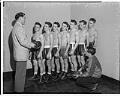
Greenwood Boys' Club boxing team, December 1949
The Greenwood Boys' Club was founded in the spring of 1943 to give unsupervised neighborhood teen boys a safe place to hang out. The organizers rented an old empty nightspot at 8537 Greenwood Ave. for $1 a year to start the club, which had a pool table and ping pong, and a playground at Fremont Avenue north of 85th Street…
ID Number:1986.5.1195.1
Date:1949
Photograph
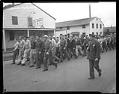
German prisoners at Fort Lawton, Seattle, 1945
In 1897, the city of Seattle donated land on Magnolia Bluff to the US government to build a new Army post as part of a defense system for Puget Sound; this was designated as Fort Lawton in 1900. During most of its active service, the fort served as an embarkation station where troops gathered before being sent to duty in…
ID Number:1986.5.3533.1
Date:1945
Photograph
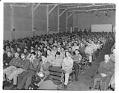
German prisoners viewing atrocity newsreels at Fort Lawton, Seattle, 1945
In 1897, the city of Seattle donated land on Magnolia Bluff to the US government to build a new Army post as part of a defense system for Puget Sound; this was designated as Fort Lawton in 1900. During most of its active service, the fort served as an embarkation station where troops gathered before being sent to duty in…
ID Number:1986.5.3533.2
Date:1945