389 results for: A. D.
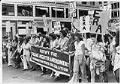
Photograph
Demonstrators marching with signs supporting the ERA, Seattle, July 8, 1978
The Equal Rights Amendment (ERA) was introduced in the U.S. Congress for the first time in 1921 and has prompted conversations about the meaning of equality for women and men ever since. With the rise of the women's movement in the 1960s, the ERA garnered increasing support, was reintroduced to Congress in 1972, and was submitted to the state legislatures…
ID Number:2000.107.232.26.01
Date:1978
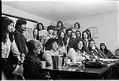
Photograph
Jim Robideau and others at BIA protest, Seattle, November 6, 1972
On November 2nd, 1972, several hundred Indigenous people occupied the headquarters of the Bureau of Indian Affairs (BIA) in Washington, DC. They presented 20 demands for better conditions for Indigenous peoples in the United States, including reform of the BIA, enforcement of existing treaties, protection of Indigenous lands, and improved treaty procedures. Over the following days, BIA offices in other…
ID Number:2000.107.19721106.1.24
Date:1972
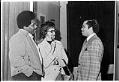
Photograph
People at preview of Black Arts/West production of "Black Girl," Seattle, March 22, 1973
Black Arts/West was Seattle's first Black theater and functioned as a three component program: theater, dance, and an art gallery displaying the work of local and national artists. Founded by Douglas Q. Barnett (1931-2019) in 1969, Black Arts/West evolved out of the Civil Rights movement of the 1960s. As a division of the Central Area Motivation Program (CAMP), an anti-poverty…
ID Number:2000.107.19730322.2.15A
Date:1973
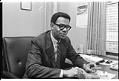
Photograph
Alfred E. Cowles at his desk, Seattle, March 30, 1973
Alfred E. Cowles was appointed to the Seattle School Board in May 1969 representing a new district covering the Central Area. Later that year he was elected to keep his seat, becoming the first Black man elected to the Board. He served on the Board until 1973, when he moved to Washington, D.C. to lead the Center for Dispute Settlement,…
ID Number:2000.107.19730330.1.14
Date:1973
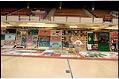
Photograph
NAMES Project AIDS Memorial Quilt displayed at University of Washington, Seattle, May 1997
The idea for the NAMES Project AIDS Memorial Quilt was conceived in 1985 in San Francisco, and the Quilt was first displayed in 1987 on the National Mall in Washington, D.C. The Quilt consists of sewn and embroidered cloth panels made to commemorate loved ones who died of AIDS-related illness. When first unveiled, the Quilt was larger than a football…
ID Number:2000.107.19970514.6.08
Date:1997
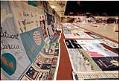
Photograph
NAMES Project AIDS Memorial Quilt displayed at UW, 1997
The idea for the NAMES Project AIDS Memorial Quilt was conceived in 1985 in San Francisco, and the Quilt was first displayed in 1987 on the National Mall in Washington, D.C. The Quilt consists of sewn and embroidered cloth panels made to commemorate loved ones who died of AIDS-related illness. When first unveiled, the Quilt was larger than a football…
ID Number:2000.107.19970514.7.12
Date:1997

Photograph
Abdinasir Ali Nur at the Maka Mini Mart, Seattle, July 16, 2002
Three small South Seattle groceries owned by Somali immigrants were caught up in the wake of the September 11 terror attacks. In late 2001, federal agents raided Maka Mini Mart and Halal Meat, owned by Abdinasir Ali Nur, during a raid on a neighboring money-wiring business with alleged links to terrorism. Although unrelated to that neighboring business, the agents confiscated…
ID Number:2000.107.20020716.CD02.03.001
Date:2002

Photograph
Mike Evans (Snohomish) wearing a traditional cedar hat, Redondo Beach, August 2002
Seattle celebrated the sesquicentennial of its 1852 founding in 2002. On August 31, the commemoration ended with The Spirit Returns, a group of 15 tribal canoes from Washington and British Columbia that paddled along West Seattle starting at Seacrest Boathouse. Their destination, Terminal 107 Park, was the location of Chief Seattle’s childhood home and the proposed site of the Duwamish…
ID Number:2000.107.20020822.CD01.01.001
Date:2002

Photograph
Long Tall (Chippewa) paddling a traditional cedar canoe, Redondo Beach, August 2002
Seattle celebrated the sesquicentennial of its 1852 founding in 2002. On August 31, the commemoration ended with The Spirit Returns, a group of 15 tribal canoes from Washington and British Columbia that paddled along West Seattle starting at Seacrest Boathouse. Their destination, Terminal 107 Park, was the location of Chief Seattle’s childhood home and the proposed site of the Duwamish…
ID Number:2000.107.20020822.CD01.03.001
Date:2002

Photograph
Young girl paddling in a cedar canoe, Redondo Beach, August 2002
Seattle celebrated the sesquicentennial of its 1852 founding in 2002. On August 31, the commemoration ended with The Spirit Returns, a group of 15 tribal canoes from Washington and British Columbia that paddled along West Seattle starting at Seacrest Boathouse. Their destination, Terminal 107 Park, was the location of Chief Seattle’s childhood home and the proposed site of the Duwamish…
ID Number:2000.107.20020822.CD01.03.002
Date:2002