705 results for: KING - TV
Videorecording
Oral history interview with Holt W. Webster, 1985
Holt Webster (1919-1992) was a pioneer in the freight industry, and one of the founders of Airborne Express, where he also served as chairman and chief executive officer. During World War II, Webster was a captain in the military Air Transport Command from 1942 through 1946. After the war, he worked for Northwest Airlines in Seattle from 1946 to 1951…
ID Number:1985.135.28
Date:1985
Videorecording
Oral history interview with Kate Webster, March 30, 1988
Kate Belcher Webster (1924-2017) was a longtime Washington State University (WSU) regent and a leader at Seattle Children’s Hospital. Born and raised in New York City, Webster moved to Seattle some time after her marriage to Holt Webster, founder of the Airborne Express delivery company. She described herself as a “professional volunteer.” In Seattle, Webster first became involved with the…
ID Number:1985.135.32
Date:1988
Photograph
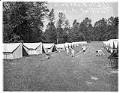
Youth farm workers' camp near Auburn, June 28, 1943
World War II caused a shortage of farm labor. Some workers left to serve in the military. Japanese Americans, many of whom farmed in King County, Washington, were forcibly removed to inland incarceration camps. In late June 1943, a call went out asking Seattle and area residents to pick peas, berries, and other crops or work in canning plants. Several…
ID Number:1986.5.2904.1
Date:1943
Photograph
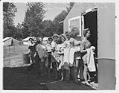
Young women farm volunteers waiting for the shower, June 28, 1943
World War II caused a shortage of farm labor. Some workers had left to serve in the military. Japanese Americans, many of whom farmed in King County, Washington, had been forcibly removed to inland incarceration camps. In late June 1943, a call went out asking Seattle and area residents to pick peas, berries, and other crops or work in canning…
ID Number:1986.5.2904.2
Date:1943
Photograph
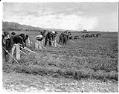
Teenage farm workers in Puyallup Valley, May 1942
World War II caused a shortage of farm labor in Washington state. Some workers had left to serve in the military. Japanese Americans, many of whom farmed on Bainbridge Island or in eastern King County, had been forcibly removed to inland incarceration camps.This May 1942 photo shows a row of high school students working as farm hands in a field…
ID Number:1986.5.2909.1
Date:1942
Photograph
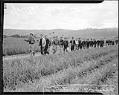
Teenage farm workers returning from the fields, June 1942
World War II caused a shortage of farm labor in Washington state. Some workers had left to serve in the military. Japanese Americans, many of whom farmed in King County, had been forcibly removed to inland incarceration camps. Governor Arthur B. Langlie declared the first week of June 1942 as "Farm Labor Week," and called for volunteers to help harvest…
ID Number:1986.5.2909.2
Date:1942
Photograph
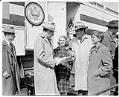
Girl being interviewed in front of the Freedom Train at King Street Station, Seattle, 1948
In 1947, the National Archives created a traveling museum called the Freedom Train, which stopped at 319 cities between 1947 and 1949. As part of an effort to underscore American freedoms in the post-war country, the display inside the rail cars included copies of the Magna Carta, the Mayflower Compact, a draft of the Declaration of Independence penned by Thomas…
ID Number:1986.5.3591.1
Date:1948
Photograph
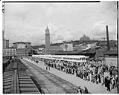
Crowds meeting Freedom Train at King Street Station, Seattle, 1948
In 1947, the National Archives created a traveling museum called the Freedom Train, which stopped at 319 cities between 1947 and 1949. As part of an effort to underscore American freedoms in the post-war country, the display inside the rail cars included copies of the Magna Carta, the Mayflower Compact, a draft of the Declaration of Independence penned by Thomas…
ID Number:1986.5.3595.1
Date:1948
Photograph
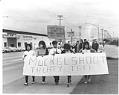
Muckleshoot Treaty Trek in support of tribal fishing rights, 1966
In the 1960s, Native Americans and their supporters began protesting Washington State laws restricting Native American fishing rights that had been granted in a series of treaties with the United States between 1854 and 1855. The Survival of the American Indian Society (SAIA), the NAACP, and the National Indian Youth Council (NIYC), coordinated a series of protests and peaceful demonstrations…
ID Number:1986.5.4450.2
Date:1966
Photograph
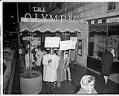
Civil rights marchers in front of Olympic Hotel, Seattle, 1964
Proponents of an open housing ordinance demonstrate in front of the world-class Olympic Hotel at 411 University Street. Despite efforts to end racial discrimination in home sales and rentals, on March 10, 1964, Seattle voters rejected the ordinance 112,448 to 53,453. The ordinance, drafted by Seattle's Human Rights Commission, would have made housing discrimination a misdemeanor. Opponents, mostly in the…
ID Number:1986.5.5952.1
Date:1964