3251 results for: Seattle Post-Intelligencer, The
Photograph
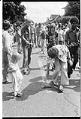
Central Area residents painting a red line down the middle of Roy Street to protest red-lining bank policies, August 17, 1975
In the mid-20th century, protesters began challenging long-established inequitable practices in housing. Racially restrictive housing covenants and discriminatory lending (“redlining”) excluded people of color from buying or renting housing in most of Seattle’s neighborhoods. Seattle passed an open housing law in 1968, making redlining illegal, but it often continued in secret and its effects have continued for decades. This photo,…
ID Number:2000.107.19750817.2.21A
Date:1975
Photograph
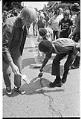
Central Area residents painting a red line down the middle of Roy Street to protest red-lining bank policies, August 17, 1975
In the mid-20th century, protesters began challenging long-established inequitable practices in housing. Racially restrictive housing covenants and discriminatory lending (“redlining”) excluded people of color from buying or renting housing in most of Seattle’s neighborhoods. Seattle passed an open housing law in 1968, making redlining illegal, but it often continued in secret and its effects have continued for decades. This photo,…
ID Number:2000.107.19750817.2.22A
Date:1975
Photograph
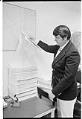
King County Det. Capt. Nick Mackie with computer printouts related to "Ted" investigation, October 1975
Joseph Neilan “Nick” Mackie (1934-2019) was a longtime Washington law enforcement officer known for his role in the investigation of serial killer Ted Bundy during the 1970s. Born on Whidbey Island, Nick Mackie attended Lincoln High School and University of Washington, and served in the U.S. Marine Corps before joining the King County Sheriff’s Department, where he rose to the…
ID Number:2000.107.19751000.8.17
Date:1975
Photograph
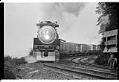
American Freedom Train coming into Seattle, October 30, 1975
The American Freedom Train was an exhibit that traveled across the United States from 1975 through 1976 as part of the country's bicentennial celebrations. It was a follow up to the first Freedom Train, which toured the US in the late 1940s. The American Freedom Train consisted of 10 train cars filled with artifacts from across US history including documents…
ID Number:2000.107.19751030.1.08
Date:1975
Photograph
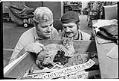
Cat with six kittens in a foreman's desk drawer at Stetson-Ross Machine Co., November 1975
In November 1975, the feline mascot of the Stetson Ross Machine Company's production room gave birth to six kttens in foreman Earl Lee's desk drawer. Stetson Ross welders Phil Aamont and Larry Bucks had been taking care of the cat since it moved into the company's assembly shop about six months prior. Here, Ross and Bucks admire the new family…
ID Number:2000.107.19751100.1.20
Date:1975
Photograph
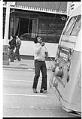
Curtis Robinson checking the power poles of his Metro trolley bus, Seattle, November 1975
In December 1975, the Seattle Post-Intelligencer published what it jokingly referred to as a “report on the anthropology and sociology of bus riders.” The research was based on an interview with four-year Metro employee Curtis Robinson, driver of the 19th Avenue trolley bus. Robinson reported on the different communication styles of passengers: the talkers, who sit in front directly across…
ID Number:2000.107.19751100.4.4A
Date:1975
Photograph
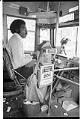
Curtis Robinson at wheel of Metro trolley bus, Seattle, November 1975
In December 1975, the Seattle Post-Intelligencer published what it jokingly referred to as a “report on the anthropology and sociology of bus riders.” The research was based on an interview with four-year Metro employee Curtis Robinson, driver of the 19th Avenue trolley bus. Robinson reported on the different communication styles of passengers: the talkers, who sit in front directly across…
ID Number:2000.107.19751100.4.12A
Date:1975
Photograph
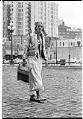
Jacket designed by a "Friends of the Rag" artist, Seattle, December 11, 1975
In the early 1970s, a group of Seattle textile and fabric artists formed Friends of the Rag, dedicating themselves to pushing the boundaries of what women and men might wear. In the 1970s and 1980s, the growing group appeared at events around Seattle, from art openings to philanthropic benefits. One outfit might be made from rubber and window screening, and…
ID Number:2000.107.19751200.2.12
Date:1975
Photograph
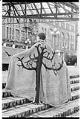
Cape designed by a "Friends of the Rag" artist, Seattle, December 1975
In the early 1970s, a group of Seattle textile and fabric artists formed Friends of the Rag, dedicating themselves to pushing the boundaries of what women and men might wear. In the 1970s and 1980s, the growing group appeared at events around Seattle, from art openings to philanthropic benefits. One outfit might be made from rubber and window screening, and…
ID Number:2000.107.19751200.2.18
Date:1975
Photograph
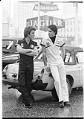
Two men modeling jumpsuits, Seattle, December 1975
Jumpsuits were invented in 1919 for parachutists to wear while jumping from planes, but they evolved beyond these origins. By the 1970s they had become part of the fashion landscape: worn on stage by Cher and Elvis, designs available from many high fashion houses, and popular both as sportswear and leisure garments. This image shows two men modeling jumpsuits decorated…
ID Number:2000.107.19751200.5.09
Date:1975