233 results for: Animals
Photograph
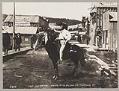
Capt. Jack Cawford on horseback, Dawson, Yukon Territory, July 4, 1899
Most of the people who poured into Dawson starting in 1897 were Americans. As a result, the Fourth of July was a big holiday.This photo, taken by Eric Hegg on July 4, 1899, shows Captain Jack Cawford on his horse in Dawson. Cawford was an American and a veteran of both the Civil War and the Indian Wars of the…
ID Number:SHS9539
Date:1899
Photograph
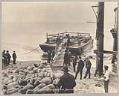
Landing sheep at Nome for Carstens Brothers & Dashley, circa 1900
There is no harbor at Nome, Alaska, and when the Nome gold rush started in 1899, there wasn't even a city. It was a challenge for ships to bring in passengers and supply the new town with food and fuel. Vessels anchored in deep water and barges brought freight and passengers to the shore through the shallows. Each year, supplies…
ID Number:SHS9552
Date:1900
Photograph
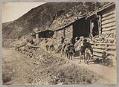
Mule train moving by the side of the Klondike River, circa 1904
Even after the opening of railroad and steamboat routes along the Yukon River and its tributaries, mules and other pack animals still carried some of the supplies to the Klondike gold fields. This was hard work, and good packtrain owners knew to pack their animals carefully and feed them well.In this photo, taken by Larss & Duclos around 1904, a…
ID Number:SHS9581
Date:Circa 1904
Photograph
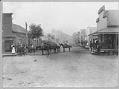
Horse pack train in North Bend, 1906
North Bend, Washington, was named for a sharp curve in the Snoqualmie River, near where it flows over Snoqualmie Falls. The area was first homesteaded in 1865. By 1900, the hops and lumber industries had attracted more settlers. A trail led eastward across the Cascade Mountains through Snoqualmie Pass. The trail was used for pack horses and cattle drives but…
ID Number:SHS9756
Date:1906
Photograph
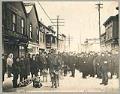
Ned Darling posing with dog sled team before departure for Seattle, Nome, Alaska, February 2, 1906
The world's record for the fastest time of a midwinter "mush" from Nome to Seattle via Valdez was set by Charles Edward "Ned" Darling (1871-1923) at 42 days, beating the previous record by four days. Born in Ireland, at the time of this image Ned was a hardware merchant in Nome, Alaska. He moved to Berkeley, California, before 1920 with…
ID Number:SHS9888
Date:1906
Photograph
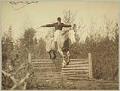
Harry Whitney Treat on horse, Seattle, circa 1920
Seattle businessman Harry Whitney Treat (1865-1922) and his family arrived in Seattle around 1904. Active in real estate, he bought hundreds of acres in Ballard, where he developed the Loyal Heights area and Golden Gardens Park, originally called Loyal Beach. Both were named for his younger daughter Loyal Graef (Treat) Nichols. The Treats owned a mansion on Queen Anne Hill,…
ID Number:SHS10234
Date:Circa 1920
Photograph
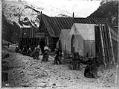
The favorite dog team of Sheep Camp, circa 1898
Gold seekers who landed at Dyea, Alaska, carried their supplies to Sheep Camp and then to the foot of Chilkoot Pass. Some people in Dyea and Sheep Camp made a living carrying the stampeders' goods along the trail by dog team. This photo by Eric Hegg, taken around 1898, shows a dog team considered the favorite in Sheep Camp.
ID Number:SHS10426
Date:Circa 1898
Photograph
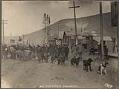
Dog team pulling a cart, Dawson City, circa 1898
After the snow melted in the spring, dog teams didn't rest. They continued to work, pulling carts instead of sleds. This photo shows a team of six dogs pulling a cart loaded with a trunk and other supplies, possibly belonging to the woman standing near the cart (left center). Eric Hegg took this photo in Dawson City sometime around 1898.…
ID Number:SHS10428
Date:Circa 1898
Photograph
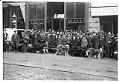
Dog team in front of Seattle Times offices, circa 1898
The gold rush heated up competition between Seattle's newspapers. Each paper published special guides to the Yukon with maps and information for would-be gold seekers. The Seattle Times and many other American and foreign newspapers sent correspondents to the Klondike to write first hand accounts of the gold rush--and maybe to make a fortune. The papers made it all sound…
ID Number:SHS11037
Date:Circa 1898
Photograph
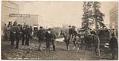
Men on the street of Atlin, British Columbia, May 24, 1899
The Klondike was not the only gold mining area. In the late 1890s, gold was also found Atlin, British Columbia, to the east of White Pass. Many gold seekers left Dawson to try their luck in Atlin.//This photo, taken by Anton Vogee, shows a group of men in the street at Atlin, B.C. Three men ride a single horse (center…
ID Number:SHS11958
Date:1899