417 results for: Indigenous Peoples
Photograph
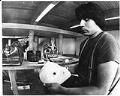
Alex Williams carving mask at Daybreak Star Cultural Center, Seattle, April 13, 1978
Here, Nez-Perce carver Alex Williams shapes a piece of alder wood into a totem mask during a workshop at the Daybreak Star Cultural Center in Discovery Park. Indigenous artists taught painting, carving, and drawing at the Center to anyone who was interested, free of charge. Native Americans from throughout the Northwest were welcomed as participating artists at the center. The…
ID Number:2000.107.178.14.02
Date:1978
Photograph
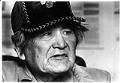
David Sohappy at Geiger Corrections Center, Spokane, November 22, 1987
David Sohappy (1925-1991) was a Wanapum fisher and activist for Indigenous fishing rights. In the mid-1960s, Sohappy and his family moved to Cook’s Landing in Skamania County at the mouth of the Little White Salmon River. There, Sohappy became a fisher full-time and took only as many fish as needed for his community, in line with traditional Wanapum beliefs and…
ID Number:2000.107.202.10.01
Date:1987
Photograph
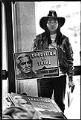
Andy Sohappy protesting at the Federal Building, Seattle, November 24, 1987
Andy Sohappy is the son of David Sohappy (1925-1991), a Wanapum fisher and activist for Indigenous fishing rights. In the mid-1960s, David Sohappy and his family moved to Cook’s Landing in Skamania County at the mouth of the Little White Salmon River. There, Sohappy became a fisher full-time and took only as many fish as needed for his community, in…
ID Number:2000.107.202.10.02
Date:1987
Photograph
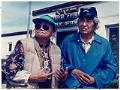
Myra and David Sohappy outside Yakama Tribal Court, June 13, 1990
David Sohappy (1925-1991) was a Wanapum fisher and activist for Indigenous fishing rights. In the mid-1960s, Sohappy and his family moved to Cook’s Landing in Skamania County at the mouth of the Little White Salmon River. There, he became a fisher full-time and took only as many fish as needed for his community, in line with traditional Wanapum beliefs and…
ID Number:2000.107.202.10.03
Date:1990
Photograph
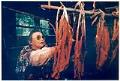
Myra Sohappy, Cook's Landing, June 12, 1990
Myra Sohappy (1926-2005) was the wife of David Sohappy (1925-1991), a Wanapum fisher and activist for Indigenous fishing rights. In the mid-1960s, the Sohappy family moved to Cook’s Landing in Skamania County at the mouth of the Little White Salmon River. There, David became a fisher full-time and took only as many fish as needed for his community, in line…
ID Number:2000.107.202.11.01
Date:1990
Photograph
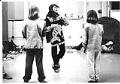
Terry Tafoya teaching a dance to students at the Pacific Science Center, Seattle, March 2, 1983
In this photo, Terry Tafoya of the Northwest Institute for Indian Education (NINE) leads a traditional dance with 5th grade students at an overnight camp at the Pacific Science Center. Tafoya was one of three educators with NINE who taught Native history to teachers and students at schools, workshops, and camps. Caption information source: "Kids learn about Indians from Indians"…
ID Number:2000.107.210.01.01
Date:1983
Photograph
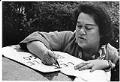
Grace Thorpe making sign for protest at courthouse, Seattle, March 16, 1970
On March 8, 1970, about 100 members and sympathizers of United Indian People's Council (later United Indians of All Tribes Foundation, or UIATF) occupied Fort Lawton, a 1,100-acre army post in Seattle's Magnolia neighborhood. They were inspired by the passage of a bill signed by President Richard Nixon, which granted non-federal entities the ability to obtain surplus federal lands for…
ID Number:2000.107.212.01.01
Date:1970
Photograph
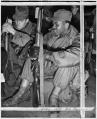
Two soldiers at Fort Lawton before transfer to Korea, November 29, 1950
In 1897, the city of Seattle donated land on Magnolia Bluff to the US government to build a new Army post as part of a defense system for Puget Sound; this was designated as Fort Lawton in 1900. During most of its active service, the fort served as an embarkation station where troops gathered before being sent to duty in…
ID Number:2000.107.216.24.01
Date:1950
Photograph
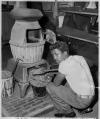
Sgt. Melvin Boykin cleaning ashes from stove, Fort Lawton, July 1952
In 1897, the city of Seattle donated land on Magnolia Bluff to the US government to build a new Army post as part of a defense system for Puget Sound; this was designated as Fort Lawton in 1900. During most of its active service, the fort served as an embarkation station where troops gathered before being sent to duty in…
ID Number:2000.107.216.24.03
Date:1952
Photograph
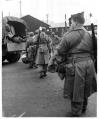
Servicemen at Fort Lawton preparing to leave for Korea, November 29, 1950
In 1897, the city of Seattle donated land on Magnolia Bluff to the US government to build a new Army post as part of a defense system for Puget Sound; this was designated as Fort Lawton in 1900. During most of its active service, the fort served as an embarkation station where troops gathered before being sent to duty in…
ID Number:2000.107.216.24.04
Date:1950