234 results for: Northwest Coast Native Peoples
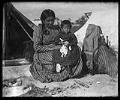
Photograph
Makah woman and child with puppy, Port Townsend, circa 1900
The Makah people of the northwest tip of the Olympic Peninsula refer to themselves as Kwih-dich-chuh-ahtx, which translates roughly to "the people who live by the rocks and seagulls." The early Makah were skilled mariners, using several types of canoes which they carved from western red cedar for various purposes - war, whaling, fishing, sealing, carrying cargo, and long voyages.…
ID Number:1955.970.470.26
Date:Circa 1900
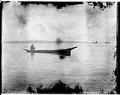
Photograph
Coast Salish canoe in Port Townsend Bay, circa 1900
The Coast Salish style canoe was designed for use in the calm waters of Puget Sound and its many small bays and inlets. Both the prow and the stern curve upwards from a rounded bottom. Salish canoes were often painted black with brightly colored figures near the prow and stern. The Coast Salish style of canoe was more lightly constructed…
ID Number:1955.970.470.512
Date:Circa 1900
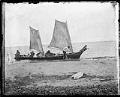
Photograph
West Coast style canoe with two sails, circa 1900
By the turn of the 20th century, Indigenous seafarers adapted cloth sails, usually of the sprit-rig type seen in this image. Traditional sails of woven mats and wood slats had been used prior to the arrival of Europeans, but they were replaced by cloth once the Native peoples began trading with the settlers. This photograph was probably taken in Port…
ID Number:1955.970.470.513
Date:Circa 1900
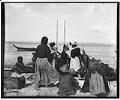
Photograph
Women shopping for baskets on the beach, Port Townsend, circa 1895
The Makah people of the northwest tip of the Olympic Peninsula refer to themselves as Kwih-dich-chuh-ahtx, which translates roughly to "the people who live by the rocks and seagulls." The early Makah were skilled mariners, using several types of canoes which they carved from western red cedar for various purposes - war, whaling, fishing, sealing, carrying cargo, and long voyages.…
ID Number:1955.970.470.546
Date:Circa 1895
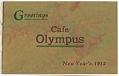
Ephemera
Café Olympus New Year's booklet, 1912
The Olympus Café opened about 1898 at 112 1st Avenue South, "Situated right in the business district of Seattle ... Just South of the Totem Pole." This small booklet, printed with New Year's greetings, includes promotional text and a photo of the cafe's "Venetian Room."On each left-hand page is the emblem of the Golden Potlatch "Bug," which advertised the summer…
ID Number:1976.6296.7
Date:1912
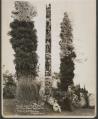
Postcard
J.E. Standley and young girl in front of a totem pole, Seattle, circa 1925
Ohio-born curio collector Joseph Edward "Daddy" Standley (1854-1940) came to Seattle in 1899 and opened Ye Olde Curiosity Shop on Second Avenue and Pike Street. He moved the shop to the Colman Dock on the waterfront in 1904, and since 1988 the shop has been located at Pier 54. Still a family-run business after five generations, the store attracts about…
ID Number:1980.6877.4.85
Date:Circa 1925
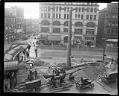
Photograph
Moving the totem pole, Pioneer Square, Seattle, circa 1923
This Tlingit totem was carved around 1870 to honor a high-ranking tribal woman named Aanséet. The pole was named Naas-shagee-yéil and it was placed in Aanséet's village on Tongass Island on the Alaska coast. In 1899, a group of leading Seattle businessmen on a goodwill tour of southeastern Alaska stole the totem and brought it back to Pioneer Square. The…
ID Number:1983.10.2537.1
Date:circa 1923
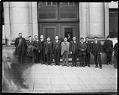
Photograph
Group of Native American men at courthouse, circa 1920
Sometime between 1915 and 1923, Jerry Kanim, chief of the Snoqualmie Tribe, and a group of other men visited the King County Courthouse in Seattle. A photographer from the firm of Webster & Stevens snapped a photograph of the group but left no notes on the occasion. Kanim, chief since 1914, was active in pursuing land claims and fishing rights,…
ID Number:1983.10.2545
Date:Circa 1920
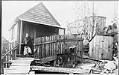
Photograph
Kikisoblu (Princess Angeline) at her house, circa 1893
Kikisoblu was the eldest daughter of Chief Si'ahl (Chief Seattle). By the time this photo was taken, probably in the 1890s, her Suquamish and Duwamish people had been exiled to the Port Madison Reservation. White settlers renamed her Princess or Queen Angeline and built her a new home. Her house was located on Western Avenue near what is now Pike…
ID Number:1983.10.6086
Date:Circa 1893
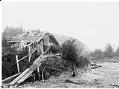
Photograph
Hwehlchtid's house at low tide, Shilshole, circa 1903
Hwehlchtid (called Salmon Bay Charlie by the settlers) of the Shilshole people lived on the southern shore of Salmon Bay, near present-day Ballard, which was then outside of Seattle. Hwehlchtid and his wife Chilohleet'sa (Madeline) remained in their traditional homeland long after others of their tribe had moved away. This photograph showing Hwehlchtid and Chilohleet’sa’s home, later made into a…
ID Number:1983.10.6567
Date:Circa 1903