436 results for: Urban Planning
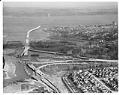
Photograph
Aerial of Evergreen Point Bridge under construction from west, Seattle, 1963
Washington's Evergreen Point Floating Bridge carries State Route 520 across Lake Washington, connecting Seattle with the growing area east of the lake. When it opened, the bridge's 7,578 foot floating span was the longest in the world. This was the second floating bridge to cross Lake Washington, and both bridges are overcrowded daily with commuters in their automobiles. This photo…
ID Number:1986.5.7595.4
Date:1963
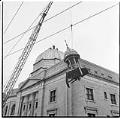
Photograph
Crane removing cupola of First Presbyterian Church, July 13, 1962
The third First Presbyterian Church building at 7th Avenue and Spring Street was erected in 1907, during the ministry of Rev. Dr. Mark A. Mathews, a Southerner from Jackson, TN, who led the congregation from 1902-1940. In 1962, a new Chapel and Christian Education Building dedicated to Matthews were built, and in 1968 the church shown here was demolished and…
ID Number:1986.5.7932.1
Date:1962
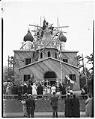
Photograph
St. Nicholas Russian Orthodox church during construction, Seattle, 1937
St. Nicholas Russian Orthodox Church is located at 1714 13th Avenue East in Seattle's Capitol Hill neighborhood. It features the onion domes common to Russian church architecture. One of the oldest Russian Orthodox parishes in the U.S., it was founded in 1932 by Russian immigrants. The church building shown here was consecrated in December 1937 and dedicated to the 4th…
ID Number:1986.5.8213.1
Date:1937
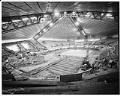
Photograph
Seattle Center Coliseum during renovation, March 1964
The Washington State Pavilion was built by the state to house the World of Tomorrow exhibit for the 1962 World's Fair (also Century 21 Exposition). After the fair closed, the city of Seattle bought the Pavilion, renamed it the Seattle Coliseum, and converted it into a convention, sports, and entertainment facility. After an extensive remodel in 1995, the building was…
ID Number:1986.5.8802.1
Date:1964
Photograph
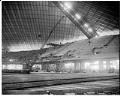
Seattle Center Coliseum during renovation, April 1964
The Washington State Pavilion was built by the state to house the World of Tomorrow exhibit for the 1962 World's Fair (also Century 21 Exposition). After the fair closed, the city of Seattle bought the Pavilion, renamed it the Seattle Coliseum, and converted it into a convention, sports, and entertainment facility. After an extensive remodel in 1995, the building was…
ID Number:1986.5.8803.1
Date:1964
Photograph
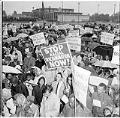
Open housing demonstration at Garfield playfield, Seattle, October 20, 1963
In the mid-20th century, protesters began challenging long-established inequitable practices in housing. Racially restrictive housing covenants and discriminatory lending (“redlining”) excluded people of color from buying or renting housing in most of Seattle’s neighborhoods. In 1963, the Seattle Human Rights Commission drafted an open housing ordinance and presented it to the City Council for approval. The Council held public hearings…
ID Number:1986.5.9653.7
Date:1963
Photograph
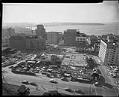
Aerial of Seattle Public Library under construction from northeast, Seattle, 1959
Since 1906 Seattle Public Library's central branch has been located at 1000 Fourth Avenue. The original Carnegie building was demolished after 50 years of service to make way for the second Central Library. This southwest view over Fifth Avenue shows the early construction stages of the new library that opened in 1960. Handwritten on sleeve: SEATTLE PUBLIC LIBRARY, New, construction.Date…
ID Number:1986.5.11240.1
Date:1959
Photograph
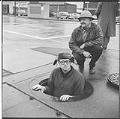
Battery Street Tunnel tenders at manhole, February 2, 1960
Groundhogs, also known as woodchucks, are not native to Washington State, so on Groundhog Day in 1960, a reporter for the Seattle PI checked in with a different sort of subterranean creature. Shown here are Seattle Engineering Department employees George Gregory and Bruce Gordon, who briefly emerged from the underground control chamber in the Battery Street tunnel to speak to…
ID Number:1986.5.26496.2
Date:1960
Photograph
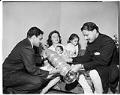
Rajanikant “Raj” and Irene Joshi with their daughters and an unidentified man, February 1965
Rajanikant "Raj" Joshi (1932-2018), originally from Gwailor, India, came to the U.S. in the late 1940s with his family. He attended the University of Washington in the mid-1950s, earning his Master's degree in Urban Planning. He met his wife, Irene, at the UW, and the two married on their shared birthday, October 10, in 1958. Joshi worked as an urban…
ID Number:1986.5.30744.1
Date:1965
Photograph
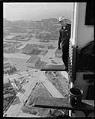
Ironworker Ray Lind on the Space Needle, Seattle, October 1961
Hundreds of feet above the site of the Seattle World's Fair grounds, ironworker Ray Lind inspects the work of his construction crew on the Space Needle. He stands on a wood platform attached to the outside of one of the 500-foot high "legs" of the structure. Lind is excited that he and his fellow ironworkers are among a relatively small…
ID Number:1986.5.33157.1
Date:1961