162 results for: Port of Seattle
Photograph
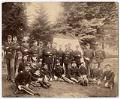
National Guard of Washington officers posing after the fire, Seattle, June 1889
The Great Fire of June 6, 1889 was a significant turning point in Seattle's history and changed both the physical and political landscapes of the City. 100 acres of Seattle's business district and waterfront were destroyed. The burned areas were guarded and patrolled by members of the Washington National Guard from Seattle, Tacoma, and Port Townsend until June 11, 1889.…
ID Number:SHS685
Date:1889
Photograph
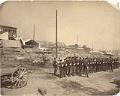
Members of the Washington National Guard in Seattle, June 1889
The Great Fire of June 6, 1889 was a significant turning point in Seattle's history and changed both the physical and political landscapes of the City. One hundred acres of Seattle's business district and waterfront were destroyed. The burned areas were guarded and patrolled by members of the Washington National Guard from Seattle, Tacoma, and Port Townsend until June 11,…
ID Number:SHS710
Date:1889
Photograph
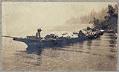
Chesheeahud and others in a canoe on Lake Union, Seattle, circa 1885
Chesheeahud (also spelled Cheshiahud) was a Duwamish chief and guide to the lakes and rivers around what is now Seattle, living between the mid-19th and early 20th centuries. He led a village called hehs-KWEE-kweel (meaning Skate), at the south edge of the mouth of Union Bay onto Lake Washington. hehs-KWEE-kweel was near a vital portage used by the Duwamish between…
ID Number:SHS2228
Date:Circa 1885
Photograph
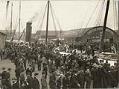
Crowd with steamship "Australia" at Seattle pier, circa 1898
Gold seekers streamed to Seattle by the thousands, eager to board ships bound for the Klondike gold fields. Seattle's shipping industry and waterfront businesses boomed during the gold rush. In March 1897, before the news of the Klondike gold finds reached Seattle, port records show that only 18 ships sailed to or from Seattle. In March 1898, with the gold…
ID Number:SHS2504
Date:Circa 1898
Photograph
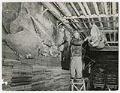
Man with display at the Frozen Fish Museum, Seattle, 1950
From 1926-1956 the Port of Seattle operated the Frozen Fish Museum on the Port’s Spokane Street wharf (now Terminal 30). Strange fish would be presented to the museum, where it could be viewed by the public. In this image taken at the museum, a man poses with a fish hanging from the ceiling. Caption information source: http://www.portseattle.org/About/History/Pages/1950-1959.aspxCaption information source: The…
ID Number:SHS6176
Date:1950
Photograph
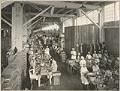
Women cleaning strawberries at Spokane Street terminal, Seattle, circa 1921
In 1921 the Port of Seattle completed the Spokane Street Terminal, with nearly 200,000 square feet of space and state-of-the-art cold storage facilities used for freezing, handling, and storing fish from Alaska and local produce until they were exported or sent to local markets. That same year, Puget Sound berry growers harvested 3,160 acres of strawberries, mainly for the processing…
ID Number:SHS7309
Date:Circa 1921
Photograph
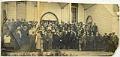
Members of the Seattle Chamber of Commerce, circa 1904
The Seattle Metropolitan Chamber of Commerce was founded on April 17, 1882, by a group of 26 business and community leaders, to devise a way to win a $12,000 annual mail route to Alaska over a competing San Francisco steamship company. The Chamber's first decade was dominated by the fight to obtain a railroad for Seattle. Chamber founders Thomas Burke,…
ID Number:SHS9796
Date:Circa 1904
Photograph
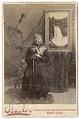
Kikisoblu (Princess Angeline) with painting of Snoqualmie Falls, Seattle, 1890
Kikisoblu was the eldest daughter of Chief Si'ahl (Chief Seattle). During her long life, she saw the coming of white settlers, the exile of her Duwamish and Suquamish people from their traditional lands, and the growth of the new city named for her father. She didn't move to the Port Madison Reservation with the rest of her people, but stayed…
ID Number:SHS10127
Date:1890
Photograph
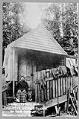
Kikisoblu (Princess Angeline) at her home, circa 1890
Kikisoblu or Kick-is-on-lo Cud was the eldest daughter of Chief Seattle. During her long life, she saw the coming of white settlers, the exile of her Duwamish and Suquamish people from their traditional lands, and the growth of the new city named for her father. She didn't move to the Port Madison Reservation with the rest of her people, but…
ID Number:SHS10965
Date:Circa 1890
Photograph
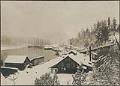
Port Blakely planing mill in snow, January 1880
In January 1880, five feet of snow fell in the Seattle area. At Port Blakely, on Bainbridge Island, the lumber mill opened late each day so that workmen could clear the snow off the roofs in town. The weather was so cold that the snow stayed on the ground for several weeks.This photo shows the planing mill and waterfront at…
ID Number:SHS11500
Date:1880