162 results for: Port of Seattle
Ephemera
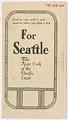
For Seattle: The New York of the Pacific Coast, 1906
The Seattle Commercial Club was incorporated on July 11, 1906, by a group of businessmen in order to "stimulate the civic spirit and patriotism of the citizens of Seattle; to procure a market for the produce of this vicinity; to encourage commerce and enterprise in all mercantile lines; to support all local industries and manufacturers; and to collect and impart…
ID Number:1947.25.22
Date:1906
Cartographic material
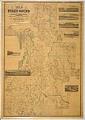
Map of Puget-Sound, Washington Territory, 1875
In 1800, the United States Congress created local Land Offices to facilitate the selling of land to settlers. Each office had a Register to handle sales and documentation, a Receiver to oversee the money, and a Surveyor General who provided plat maps, one of which was logged in the Land Office. In 1852, over one year after the Washington Territory…
ID Number:1952.986.57.1
Date:1875
Photograph
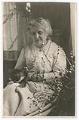
Portrait of Mary Hadley Fletcher, mother of Harriet Foster Beecher, circa 1910
Mary Hadley Fletcher (1834-1922) was the mother of artist Harriet Foster Beecher and lived with Harriet and her family in Port Townsend. This photo of Fletcher, with a cat on her lap, was taken sometime before her daughter's death in 1915, as a corresponding photo of Harriet in the same location and pose, published in the book cited below, was…
ID Number:1953.303.b
Date:Circa 1910
Ephemera
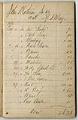
Account book, 1875
This account book lists debits and credits for February 1875 through October 1877. The first page of the notebook lists two names -- John Mathison and G. A. Meigs. The ledger is probably connected with George Anson Meigs (1816-1896), a lumber merchant from San Francisco who built a saw mill at Port Madison on Bainbridge Island in 1854. Mr. Meigs…
ID Number:1953.641.1a
Date:1875
Scrapbook
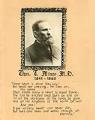
Dedication to Thomas Taylor Minor in "Memoirs of Minor Hospital Alumnae" scrapbook, circa 1950
Minor Private Hospital was founded in January 1906, and a two-story, brick hospital building constructed at 1420 Spring Street in Seattle’s First Hill neighborhood. In September 1906, a school for nurses was established at Minor Hospital, with a three-year course of training. Minor Private Hospital closed in 1928, and the last nursing school class graduated in 1930. The nurses later…
ID Number:1954.683.4
Date:Circa 1950
Photograph
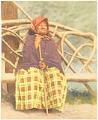
Kikisoblu (Princess Angeline) seated at Madrona Park, Seattle, circa 1892
Kick-is-on-lo Cud, or Kikisoblu (circa 1816-1896), was the eldest daughter of Chief Seattle (Si'ahl), the leader of the Suquamish and Duwamish tribes. During her lifetime, she saw the coming of white settlers, the exile of her people from their traditional lands, and the growth of the new city named for her father. She didn't move to the Port Madison Reservation…
ID Number:1954.812.1
Date:Circa 1892
Photograph
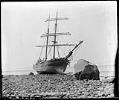
Brig "Tanner," 1902
The "Tanner" was one of the earliest vessels to make regular trips between San Francisco and Puget Sound. In 1866, the vessel arrived in Seattle carrying some of the Mercer Girls on the last leg of their voyage from the east coast. By 1900, the days of sailing ships had passed. The "Tanner" ended its days in 1902, beached and…
ID Number:1955.970.627
Date:1902
Photograph
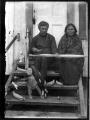
Young Doctor and his wife Lizzie, Neah Bay, circa 1900
The Makah people of the northwest tip of the Olympic Peninsula refer to themselves as Kwih-dich-chuh-ahtx, which translates roughly to "the people who live by the rocks and seagulls." The early Makah were skilled mariners, using several types of canoes which they carved from western red cedar for various purposes - war, whaling, fishing, sealing, carrying cargo, and long voyages.…
ID Number:1955.970.470.1
Date:Circa 1900
Photograph
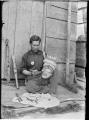
Atlieu, Nuu-cha-nulth carver, Neah Bay, circa 1900
The Nuu-chah-nulth are a group of 14 First Nations peoples living on the west side of Vancouver Island: Ditidaht, Huu-ay-aht, Hupacasath, Tse-shaht, Uchucklesaht, Ahousaht, Hesquiaht, Tla-o-qui-aht, Toquaht, Ucluelet, Ehattesaht, Kyuqout/Checlesaht, Mowachat/Muchalaht, and Nuchatlaht. They share cultural traditions and language but remain distinct nations, each with a hereditary chief. The Nuu-chah-nulth peoples were previously called the Nootka after European colonizers misunderstood…
ID Number:1955.970.470.2
Date:Circa 1900
Photograph
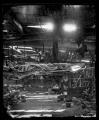
Interior of a longhouse, Neah Bay, circa 1900
The Makah people of the northwest tip of the Olympic Peninsula refer to themselves as Kwih-dich-chuh-ahtx, which translates roughly to "the people who live by the rocks and seagulls." The early Makah were skilled mariners, using several types of canoes which they carved from western red cedar for various purposes - war, whaling, fishing, sealing, carrying cargo, and long voyages.…
ID Number:1955.970.470.10
Date:Circa 1900