1669 results for: Webster
Photograph
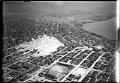
Aerial view of Denny regrade area, Seattle, 1931
Seattle's present-day Denny Triangle neighborhood was created between 1897-1930 by removing Denny Hill in stages. The neighborhood is located in the triangle formed by Denny Way on the north, Third Avenue on the southwest, and Olive Way on the southeast. This aerial view of the newly cleared neighborhood faces south towards downtown Seattle. It was taken after completion of the…
ID Number:1983.10.17948
Date:1931
Photograph
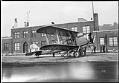
Air mail plane at Boeing Field, Seattle, circa 1933
In the 1920s, King County voters passed a bond issue to buy land for a commercial airport south of Seattle. Low lying land was graded with fill dredged from the Duwamish Waterway. The new airport, Boeing Field, was dedicated in July 1928. By 1938, the field served three major airlines, passenger planes and airborne freight carriers. Boeing Field is also…
ID Number:1983.10.17984.8
Date:Circa 1933
Photograph
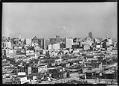
Downtown and Mount Rainier, Seattle, July 21, 1939
Handwritten on sleeve: City view looking south 7/21/39Webster & Stevens number: 220
ID Number:1983.10.18023
Date:1939
Photograph
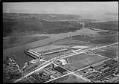
Aerial of Ford Motor Plant from southeast, Seattle, 1932
Photographer Charles Laidlaw made this view of the second Ford factory from about 800 feet above the Duwamish industrial area. Seattle's newest producer of Fords built only a few thousand cars before the Great Depression stopped the assembly line. The building was later used as a sales and service facility; in 1942 it was sold to the federal government. Caption…
ID Number:1983.10.18041.2
Date:1932
Photograph
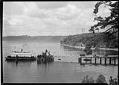
Ferry at dock, Vashon Island, circa 1941
Vashon Island, like many other islands in Puget Sound, is served by ferries. In this photo, probably taken in 1941, the ferry "Fox Island" nears the dock at Tahlequah. The "Fox Island" was built in Tacoma for service to Day and Fox Islands, but was used as a standby ferry on other runs.
ID Number:1983.10.18083.4
Date:Circa 1941
Photograph
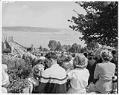
Crowd watching Seafair hydroplane races from above Lake Washington floating bridge, Seattle, 1952
Handwritten on sleeve: '52 Seafair from Lake Washington Floating Bridge.Webster & Stevens number: 52-0119
ID Number:1983.10.18197.1
Date:1952
Photograph
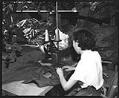
Woman sewing in garment factory, Seattle, 1954
Title from inventory: Union Special Machine Co. - Sewing in Garment FactoryHandwritten on sleeve: Sewing in Garment Factory.Webster & Stevens number: 54-5140
ID Number:1983.10.18245.5
Date:1954
Photograph
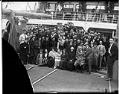
Group portrait of Russian immigrants arriving on President Jackson, Seattle, July 7, 1923
By early 1924, there were about 5000 Russians living in Seattle, most of whom arrived as refugees fleeing the Russian Revolution and Civil War of 1917-1922. Many were well-educated, including professionals, former government and military officers, or former aristocrats. The Russian community in Seattle centered on the Orthodox church on Lakeview Boulevard, which hosted classes on citizenship and the English…
ID Number:1983.10.18266
Date:1923
Photograph
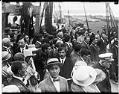
Russian immigrants arriving on President Jackson, Seattle, July 7, 1923
By early 1924, there were about 5000 Russians living in Seattle, most of whom arrived as refugees fleeing the Russian Revolution and Civil War of 1917-1922. Many were well-educated, including professionals, former government and military officers, or former aristocrats. The Russian community in Seattle centered on the Orthodox church on Lakeview Boulevard, which hosted classes on citizenship and the English…
ID Number:1983.10.18348
Date:1923
Photograph
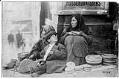
Indigenous family selling baskets in downtown Seattle, circa 1912
At the turn of 19th to 20th centuries, Indigenous artists in the Pacific Northwest were making baskets and carvings specifically for the tourist trade and were experimenting with form and design. Making baskets for sale became an important income source for many Indigenous families. In this photo, two women and a boy sit by their baskets on Second Avenue, outside…
ID Number:1983.10.PA2.1
Date:Circa 1912