1580 results for: City of Seattle
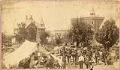
Photograph
Seattleites posing with goods salvaged from the fire, June 1889
The Great Fire of June 6, 1889 was a significant turning point in Seattle's history and changed both the physical and political landscapes of the City, destroying 100 acres of Seattle's business district and waterfront. The city didn't take much time to mourn; most businesses decided to rebuild where they had been, and rebuilding began almost immediately. Relief bureaus were…
ID Number:SHS2150
Date:1889
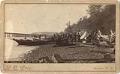
Photograph
Native camp on the beach, Seattle, circa 1885
In 1865 the Board of Trustees of Seattle passed Ordinance No. 5 banning Indigenous people from living in the city unless they worked for a non-Indigenous resident and lived on their employer’s property. Despite this attempt to enforce separation between Indigenous people and the settlers, Seattle depended on Indigenous people. Settlers relied on Native people for domestic work and for…
ID Number:SHS2174
Date:Circa 1885
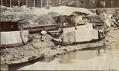
Photograph
Indigenous encampment at the Seattle waterfront, circa 1895
In 1865 the Board of Trustees of Seattle passed Ordinance No. 5 banning Indigenous people from living in the city unless they worked for a non-Indigenous resident and lived on their employer’s property. Despite this attempt to enforce separation between Indigenous people and the settlers, Seattle depended on Indigenous people. Settlers relied on Native people for domestic work and for…
ID Number:SHS2210
Date:Circa 1895
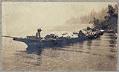
Photograph
Chesheeahud and others in a canoe on Lake Union, Seattle, circa 1885
Chesheeahud (also spelled Cheshiahud) was a Duwamish chief and guide to the lakes and rivers around what is now Seattle, living between the mid-19th and early 20th centuries. He led a village called hehs-KWEE-kweel (meaning Skate), at the south edge of the mouth of Union Bay onto Lake Washington. hehs-KWEE-kweel was near a vital portage used by the Duwamish between…
ID Number:SHS2228
Date:Circa 1885
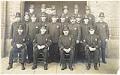
Photograph
Members of Seattle Police Department, Ballard Station, April, 1913
Ballard was an independent city from its incorporation in 1890, until a vote to annex to Seattle passed 996 to 874 on November 6, 1906. On May 29, 1907, the City of Ballard officially became simply Ballard, a neighborhood of Seattle.In the 1910s, Seattle had neighborhood police headquarters in Ballard, West Seattle, Columbia City, Densmore (now Wallingford), and Georgetown. This…
ID Number:SHS2273
Date:1913
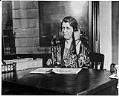
Photograph
Mayor Bertha K. Landes at her desk, Seattle, circa 1927
In 1926, Bertha Knight Landes was the first woman to be elected mayor of a major American city when she became mayor of Seattle. She vowed to clean up city government, running on the platform of "municipal housekeeping." She served only one term as mayor but remained a civic leader in such organizations as the Women's University Club, the Women's…
ID Number:SHS2344
Date:Circa 1927
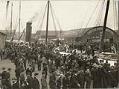
Photograph
Crowd with steamship "Australia" at Seattle pier, circa 1898
Gold seekers streamed to Seattle by the thousands, eager to board ships bound for the Klondike gold fields. Seattle's shipping industry and waterfront businesses boomed during the gold rush. In March 1897, before the news of the Klondike gold finds reached Seattle, port records show that only 18 ships sailed to or from Seattle. In March 1898, with the gold…
ID Number:SHS2504
Date:Circa 1898
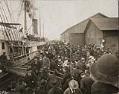
Photograph
Steamship "Australia" loading at Seattle pier, circa 1898
The United States was in the grip of a nationwide economic depression in the 1890s. When the steamer "Portland" arrived in Seattle in July 1897 with more than a ton of Klondike gold, the city's depression ended. Pacific Northwest shipping companies were eager to profit from the gold rush. They scrambled to provide passenger and freight service to the Alaskan…
ID Number:SHS2506
Date:Circa 1898
Photograph
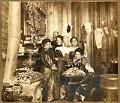
Theodore Wernecke and employees inside fur store, Seattle, circa 1898
An estimated 100,000 prospectors migrated to the Klondike region of the Yukon in north-western Canada between 1896 and 1899. Most of them stopped in Seattle to purchase supplies, greatly contributing to the city's economic success. Ohio-born Charles Theodore Wernecke (1852-1922) came to Seattle around 1897 and operated at least one store catering to miners headed to Alaska during the Klondike…
ID Number:SHS2508
Date:Circa 1898
Photograph
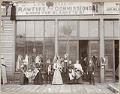
Exterior of C.T. Wernecke fur store, Seattle, circa 1897
Fur trading in the Pacific Northwest dates back to the 1700s. The first raw fur auction in the United States was organized in Seattle in 1898, coinciding with the Klondike Gold Rush, which had started in 1896. Ohio-born Charles Theodore Wernecke had come to Seattle in 1897 and ran a store that bought raw furs, manufactured fur clothing, and catered…
ID Number:SHS2525
Date:Circa 1897