154 results for: Fish and Fishing
Photograph
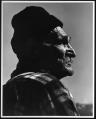
Fisherman Nick Cayafas, Seattle, 1978
Photographer Josef Scaylea (1913-2004) worked for 35 years as chief photographer for the Seattle Times, winning over 1000 awards for his photographs highlighting the scenery and people in the Pacific Northwest. He donated a collection of his photographs and photography equipment to MOHAI in 1993.Scaylea took this photo of Greek fisherman Nick Cayafas at Salmon Bay Terminal in 1978. Handwritten…
ID Number:Lib1993.20.218
Date:1978
Photograph
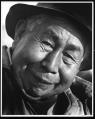
Sherman Dominick, 1970
In the 1960s, Native Americans and their supporters began protesting Washington State laws restricting Native American fishing rights that had been granted in a series of treaties with the United States between 1854 and 1855. The Survival of the American Indian Society (SAIA), the NAACP, and the National Indian Youth Council (NIYC), coordinated a series of protests and peaceful demonstrations…
ID Number:Lib1993.20.240
Date:1970
Photograph
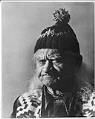
William Frank, Sr., 1980
William Frank, Sr. (1879-1983) was a Nisqually elder, early tribal government official, and leader in the struggle for Indigenous fishing rights. His name at birth was Qu Lash Qud, and he was renamed Frank while at boarding school, after a white homesteader for whom his father worked. In 1917, the US Army took most of the Nisqually Reservation to expand…
ID Number:Lib1993.20.249
Date:1980
Photograph
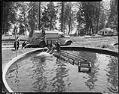
Trout rearing ponds at Seward Park, Seattle, 1948
In 1935, during the Great Depression, a Washington Emergency Relief Act work crew built fish rearing ponds at Seattle's Seward Park. The Washington State Department of Game supervised the fish hatchery and, in May 1948, delivered 250,000 young rainbow trout to the Cedar River and other area streams. Handwritten on image: Seward Park Rearing ponds.Handwritten on sleeve: Fish - Trout…
ID Number:PI23041
Date:1948
Photograph
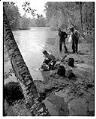
Man dumping fish into stream, May 1948
In 1935, during the Great Depression, a Washington Emergency Relief Act work crew built fish rearing ponds at Seattle's Seward Park. The Washington State Department of Game supervised the fish hatchery and, in May 1948, delivered 250,000 young rainbow trout to the Cedar River and other area streams.In this photo, taken around May 21, 1948, Washington State Department of Game…
ID Number:PI23045
Date:1948
Photograph
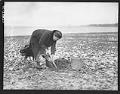
Josie Anderson digging clams, Port Gamble Reservation, February 1939
In February 1939, the representatives of the Port Gamble band of the Clallam (now S’Klallam) people invited a Seattle Post-Intelligencer reporter and photographer to come to their village south of Hansville on the Olympic Peninsula. Chairman of the tribe’s governing committee Benny George, along with his aid Jackson and Rev. Karl Leonard of Bremerton, had been in contact with the…
ID Number:PI23827
Date:1939
Photograph
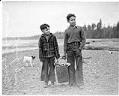
Skip George and Benny Anderson carrying clams at Point Julia, February 1939
In February 1939, the representatives of the Port Gamble band of the Clallam (now S’Klallam) people invited a Seattle Post-Intelligencer reporter and photographer to come to their village south of Hansville on the Olympic Peninsula. Chairman of the tribe’s governing committee Benny George, along with his aid Jackson and Rev. Karl Leonard of Bremerton, had been in contact with the…
ID Number:PI23828
Date:1939
Photograph
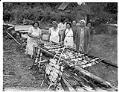
Women cooking salmon, Muckleshoot Reservation, circa 1950
The Muckleshoot Indian Tribe is made up of descendants of the Duwamish and Upper Puyallup peoples who lived near Puget Sound and its associated waterways since time immemorial. Muckleshoot ancestors lived in villages that were tied together by marriage bonds, trade, shared ceremonies, and use of the same land. This network of interconnected villages extended far beyond the Upper Puyallup…
ID Number:PI23907
Date:Circa 1950
Photograph
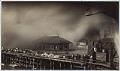
Great Seattle Fire burning at waterfront, June 6, 1889
The Great Fire of June 6, 1889 was a significant turning point in Seattle's history and changed both the physical and political landscapes of the City. The fire started at 2:30 p.m. in a paint and woodwork shop at Front and Madison and over the course of the next 18 hours swept a southward across 100 acres of Seattle's business…
ID Number:SHS708A
Date:1889
Photograph
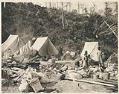
Camp of Auke Natives, Alaska, circa 1896
The Tlingit people have lived on the coast and islands of what is now southeastern Alaska since time immemorial. Tlingit society is organized into clans, which follow maternal descent. Fishing, gathering, and hunting were central to historic Tlingit lifeways - they used salmon, shellfish, seals, berries, deer, and other food sources. They used every part for different purposes, not wasting…
ID Number:SHS1772
Date:Circa 1896