1580 results for: City of Seattle
Photograph
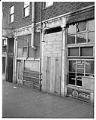
Boarded up storefronts in Chinatown - International District after forced removal of Japanese Americans, Seattle, June 1942
The exclusion of Seattle's Japanese families by the federal government during World War II changed the city in numerous ways. Among the more obvious signs were the shuttered and boarded up Japanese businesses along Main, Jackson and upper King Streets. Many of the families who managed or worked in the stores and shops never returned to the city after they…
ID Number:PI28074
Date:1942
Photograph
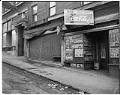
Closed businesses on S. Main St. after forced removal of Japanese Americans, Seattle, June 1942
The exclusion of Seattle's Japanese families by the federal government during World War II changed the city in numerous ways. Among the more obvious signs were the shuttered and boarded up Japanese businesses along Main, Jackson and upper King Streets. Many of the families who managed or worked in the stores and shops never returned to the city after they…
ID Number:PI28075
Date:1942
Photograph
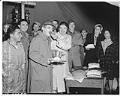
Woman feeding cake to serviceman, Seattle, December 1941
During World War II, thousands of service men and women served in or passed through Seattle. A number of recreation and temporary stay facilities provided entertainment and services for military personnel visiting the city, such as the large USO facility in the remodeled Rialto Building, opened in 1943. In this image, Sergeant Charles Damm is fed a slice of cake…
ID Number:PI28207
Date:1941
Photograph
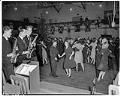
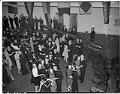
Women and servicemen dancing at the Naval Reserve Armory, Seattle, December 1942
Built on the former site of a Duwamish village, the Naval Reserve Armory was announced in 1937 but trouble with funding delayed completion of the project for several years. The Armory was designed by B. Marcus Priteca, a well-known theater architect, and William R. Grant. The Works Progress Administration, one of the New Deal agencies, constructed the building. Groundbreaking occurred…
ID Number:PI28212
Date:1942
Photograph
Women and servicemen dancing at the Naval Reserve Armory, Seattle, December 1942
Built on the former site of a Duwamish village, the Naval Reserve Armory was announced in 1937 but trouble with funding delayed completion of the project for several years. The Armory was designed by B. Marcus Priteca, a well-known theater architect, and William R. Grant. The Works Progress Administration, one of the New Deal agencies, constructed the building. Groundbreaking occurred…
ID Number:PI28213
Date:1942
Photograph
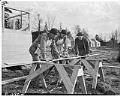
Servicemen building cabins at Jefferson Park, Seattle, March 1942
During World War II, thousands of service men and women served in or passed through Seattle. Jefferson Park Golf Course on Beacon Hill was requisitioned by the U. S. Army for a anti-aircraft batteries. The Army also took over the rest of the park west of Beacon Avenue for a G.I. center. Built by the Civilian Conservation Corps (CCC), community…
ID Number:PI28215
Date:1942
Photograph
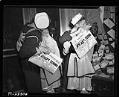
Sailors kissing girls on V-J Day, Seattle, August 14, 1945
Just after midnight on August 14, 1945, the Seattle Post-Intelligencer hit the streets with the news that the Japanese would accept the allied peace terms. Sirens blared, car horns honked, church bells rang and people danced in the streets to celebrate the end of World War II. The day of the victory over Japan came to be known as V-J…
ID Number:PI28300
Date:1945
Photograph
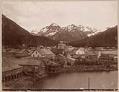
Sitka, Alaska, June 1897
Some of the shipping companies which carried gold seekers to Skagway and Dyea had already been carrying visitors to Sitka and other southeastern Alaskan ports. Sitka was settled by Russians in 1802 and was the center of their American fur trade. The city overlooks a sheltered harbor on the west shore of Baranof Island, nearly 1,000 miles northwest of Seattle.This…
ID Number:SHS29
Date:1897
Photograph
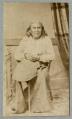
Chief Si'ahl (Chief Seattle), 1864
Chief Si'ahl, known to settlers as Chief Seattle, became the leader of the Suquamish and Duwamish peoples sometime around 1810. When settlers started moving to the Elliott Bay area in the 1850s, Chief Si'ahl stayed friendly to the newcomers and urged his people to do the same. The city of Seattle was named for him.This 1864 portrait of Chief Si'ahl…
ID Number:SHS67
Date:1864
Photograph
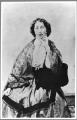
Elizabeth M. Ordway, circa 1865
A shortage of women in Seattle in the 1860s inspired Asa Mercer to travel to the east coast to find women who might want to resettle in the new city. Elizabeth M. Ordway, nicknamed Lizzie, was a native of Lowell, Massachusetts. She arrived in Seattle in 1864, along with ten other so-called "Mercer Girls." Miss Ordway had a long career…
ID Number:SHS126
Date:Circa 1865