1344 results for: Seattle Center
Photograph
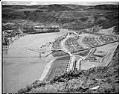
Engineers Town near site of Grand Coulee dam, circa 1937
Thousands of workers from all over the United States poured into the central Washington to work on the Grand Coulee Dam. Whether they were engineers, office workers or unskilled labor, all of these people and their families needed places to live. In December 1933, at the start of the dam project, workers graded the land for Engineers Town. Six months…
ID Number:PI22025
Date:Circa 1937
Photograph
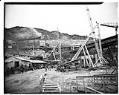
Change of shift at dam construction site, circa 1937
Work started on the Grand Coulee Dam in the fall of 1933 and was finished ten years later. Workers used a system of cranes, trestles, and conveyor belts to move the concrete and other construction materials into place. The men labored in shifts around the clock in winter and summer to build the dam on the Columbia River.This photo, taken…
ID Number:PI22031
Date:Circa 1937
Photograph
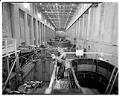
Inside a powerhouse at Grand Coulee Dam, August 1941
When Grand Coulee Dam was completed in 1943, its huge generators were the largest in the world, and the dam itself was one of the world's largest power plants. During World War II, the cheap electric power from Grand Coulee and Bonneville Dams stimulated the growth of the Pacific Northwest's aluminum, aircraft and shipbuilding industries and lit the homes of…
ID Number:PI22065
Date:1941
Photograph
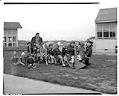
Child care center at High Point housing project, April 1942
Many people came to the Seattle area during World War II to work in the shipyards and other war industries. Some of these men and women lived at the High Point housing project in West Seattle. Child care was a problem for working mothers. Many of High Point's young children were looked after at the community's child care center.This April…
ID Number:PI23697
Date:1942
Photograph
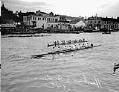
Husky crew and Indigenous canoe race, La Conner, November 29, 1941
In 1941, Swinomish leader Tandy Wilbur arranged a competition between two Indigenous racing canoes and two shells crewed by the University of Washington Huskies. Wilbur had recently become chairman of the Swinomish Tribal Community, and he intended the race to help form bonds among the several different tribal groups living together on the Swinomish reservation. He also wanted to use…
ID Number:PI23850
Date:1941
Photograph
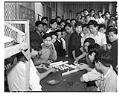
INS detainees playing mah jong at Immigration Station, Seattle, November 15, 1938
The United States Immigration Station and Assay Office was built for the Immigration and Naturalization Service in 1932, and served as the entry and exit point for immigrants arriving in Seattle. The bulk of the operation was dedicated to enforcing the Chinese Exclusion Act of 1882, which placed a moratorium on labor immigration for people of Chinese ethnicity. As such,…
ID Number:PI24516
Date:1938
Photograph
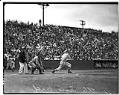
Seattle Indians batter swinging at ball, August 1934
In the 1920s and most of the 1930s, Seattle's professional baseball team, the Indians, had a long streak of bad luck. Its playing was poor and the team didn't win a Pacific Coast League pennant after 1924. Added to that, the Indians' ballfield burned in 1932 and the team had to move its games to the poorly-equipped Civic Stadium. In…
ID Number:PI26678
Date:1934
Photograph
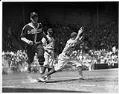
Seattle Rainiers baseball game, Seattle, 1939
Cliff Dapper of the Hollywood Stars runs to the base while Seattle Rainiers player Paul Gregory attempts to catch a ball. George Archie looks on. Handwritten on negative: Cliff Dapper - George Archie; Paul Gregory (center).Handwritten on sleeve: Dapper, Cliff, Baseball, with George Archie, Paul Gregory.Date photograph was filed at the Seattle Post-Intelligencer (date of photograph and file date may…
ID Number:PI26694
Date:1939
Photograph
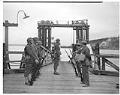
U. S. Army sentries at Winslow ferry dock, Bainbridge Island, March 25, 1942
In this image, U. S. Army soldiers guard Bainbridge Island at the Winslow ferry dock. Armed sentries were used to prevent people of Japanese descent from entering the island in violation of the Army order requiring their forced removal from the area. Civilian Exclusion Order No. 1 was issued at Bainbridge Island, ordering 227 residents of Japanese descent to leave…
ID Number:PI28036
Date:1942
Photograph
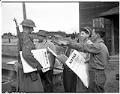
U. S. Army soldier and Japanese Americans with forced removal order, Bainbridge Island, March 25, 1942
In this image a U. S. Army soldier appears to be handing out copies of Civilian Exclusion Order No. 1 to Bainbridge Island residents of Japanese descent. 227 Japanese Americans were ordered to leave the island with six days' notice. They departed by ferry on March 30, 1942. The island had a total of 276 Japanese American residents at the…
ID Number:PI28038
Date:1942