1344 results for: Seattle Center
Photograph
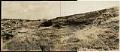
Beacon Hill regrading, Seattle, July 2, 1923
This photograph shows the north end of Beacon Hill facing north. Dearborn Street is visible coming from the left center edge of the frame, between Beacon Hill and what will later be the Chinatown - International District of Seattle. Advertisement billboards visible in the image are for Wrigley's Gum and Wing Foot Tires. This area south of downtown Seattle was…
ID Number:Lib1988.13.7.2.58
Date:1923
Photograph
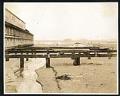
Land fill and tidal flats south of downtown Seattle, November 27, 1923
This photograph shows the land fill and tidal flats of the area south of downtown Seattle. Visible at about the center of the right edge of the frame are men working on a new property by digging canals and deposing the soil to make new land. The building will likely be eventually connected to those around it via plank roads…
ID Number:Lib1988.13.7.2.118
Date:1923
Photograph
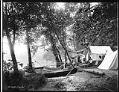
Campers at Lake Washington, 1900
Some of the parks on Seattle's Lake Washington provided platforms for tent camping. City dwellers could escape to the woods and spend the warm summer days and nights by the lakeshore.This photo, taken by Anders Wilse for the Seattle Photo Company, shows a shady campsite by the shores of Lake Washington. A canoe and several other small boats are hauled…
ID Number:Lib1988.33.100
Date:1900
Photograph
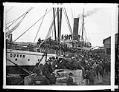
Steamer "Queen" about to depart Seattle for Alaska, March 6, 1898
During the spring and summer of 1898, the steamer "Queen," was very busy carrying people between Seattle and southeastern Alaska. The ship passage was only the first part of the long voyage to the Klondike gold fields.In this photo, a crowd made up almost entirely of men waits at a Seattle pier to board the "Queen" or another Alaska-bound steamer.…
ID Number:Lib1988.33.116
Date:1898
Photograph
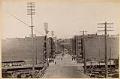
Facing north on Commercial Street, Seattle, circa 1895
This image, taken facing north along Commercial Street (now First Avenue South), shows Seattle's central business district, likely a few years after the Great Fire of 1889. The street in the foreground crossing the frame from left to right is likely Jackson Street, visibly raised above ground level like many streets were after the fire. The brick building in the…
ID Number:Lib1991.5.26
Date:Circa 1895
Photograph
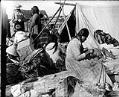
Group of Indigenous people at Port Townsend, August 30, 1899
Port Townsend, site of a S'Klallam village prior to the arrival of settlers in the mid-1800s, became an important trading center by the end of the 19th century. Indigenous peoples from Canada and the tribes of Puget Sound and the Olympic Peninsula gathered along the shores of Port Townsend Bay to trade and socialize. Many also stopped here on their…
ID Number:Lib1993.1.723
Date:1899
Photograph
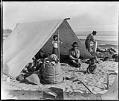
Group of Makah people under a fly tent at Port Townsend, August 30, 1899
The Makah people of the northwest tip of the Olympic Peninsula refer to themselves as Kwih-dich-chuh-ahtx, which translates roughly to "the people who live by the rocks and seagulls." The early Makah were skilled mariners, using several types of canoes which they carved from western red cedar for various purposes - war, whaling, fishing, sealing, carrying cargo, and long voyages.…
ID Number:Lib1993.1.724
Date:1899
Photograph
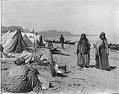
Indigenous people on the beach at Port Townsend, September 2, 1899
Port Townsend, site of a S'Klallam village prior to the arrival of settlers in the mid-1800s, became an important trading center by the end of the 19th century. Indigenous peoples from Canada and the tribes of Puget Sound and the Olympic Peninsula gathered along the shores of Port Townsend Bay to trade and socialize. Many also stopped here on their…
ID Number:Lib1993.1.754
Date:1899
Photograph
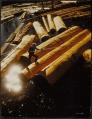
Log pond at Weyerhaeuser mill, Snoqualmie, 1950
Lumber was one of the Puget Sound's main exports in the 1890s. In 1899, 200,000 board feet of milled lumber left Seattle every day by rail or ship for the eastern United States and various Pacific ports. Snoqualmie Falls Lumber Company began operations in 1917. The company, starting with some houses and a mill store, built a small community atop…
ID Number:Lib1993.20.62
Date:1950
Photograph
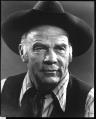
Cowboy artist Fred Oldfield, Seattle, 1969
Fred Oldfield (1918-2017) was a painter known for his painting of Western "cowboy" scenes. His parents leased land on the Yakama Indian Reservation at the time of his birth, and he often included Native subjects in his paintings of Central and Eastern Washington. He became active in the Washington State Fair and the Fred Oldfield Western Heritage and Art Center…
ID Number:Lib1993.20.264
Date:1969