120 results for: Mining
Photograph
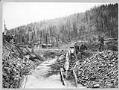
Men and sluice at Hunker Creek, circa 1898
Like Bonanza Creek, Hunker Creek flows into the Klondike River, Yukon Territory. During the season of 1898-99, $1.5 million of gold was mined at Hunker Creek. By 1899, the day of small scale mining had passed, and industrial mining had already begun.This photo of a group of miners working on a sluice at Hunker Creek was taken by Hegg &…
ID Number:SHS7302
Date:Circa 1898
Photograph
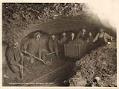
Down in a Nome gold mine, circa 1903
In Alaska and the Yukon, placer gold was found along ancient stream beds, some of which were underground. This often required much digging and long hours in the cold and dark. Candles were scarce and expensive at a dollar apiece.This photo, taken in Nome sometime between 1899 and 1906, shows a group of people working 110 feet underground for the…
ID Number:SHS7980
Date:Circa 1903
Photograph
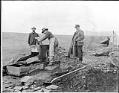
Three men and a rocker in the Nome gold fields, circa 1905
Many gold miners used rockers (also called cradles) to remove gold from pay dirt. They shoveled the dirt and gravel into a tray at the top of the rocker, and they shook the rocker back and forth as they poured water on the tray. Finer pieces of gold and dirt washed through holes in the tray into the box beneath.…
ID Number:SHS7986
Date:Circa 1905
Photograph
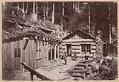
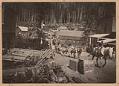
Consolidated Mining Company headquarters, Silverton, Washington, circa 1895
In 1891, a group of Snohomish County, Washington, miners named their town Silverton for its veins of silver-bearing ore. Silverton and nearby mining areas also yielded gold, copper and lead. This 1890s photo, identified as the the headquarters of the 45 Consolidated Mining Company at the Magus Mine, near Silverton. Note the large logs in the walls of the rear…
ID Number:SHS9428
Date:Circa 1895
Photograph
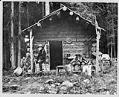
Packtrain in Silverton, Washington, circa 1895
In 1891, a group of Snohomish County, Washington, miners named their new town Silverton for its veins of silver-bearing ore. This and nearby mining areas also yielded gold, copper, and lead. In the early days, the mining companies packed supplies in and out of the district by horse and mule trains. This 1890s photo shows Johnny Jones' packtrain leaving the…
ID Number:SHS9429
Date:Circa 1895
Photograph
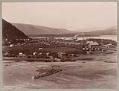
David Denny at log cabin near Lake Keechelus, 1899
During the summer of 1899, Seattle pioneer David Denny supervised the improvement of 27 miles of wagon road through Snoqualmie Pass, from North Bend, Washington, to the south end of Lake Keechelus. Between the beginning of June and the end of September, workers blasted and moved rocks, built bridges, resurfaced parts of the old road with logs, and relocated the…
ID Number:SHS9441
Date:1899
Photograph
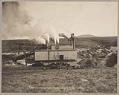
View of Klondike City, circa 1898
On July 8, 1897, an unidentified Dawson woman was quoted in The Seattle Times. She said, "There is a new mining district just discovered, fifty miles up the Yukon from here. It is turning out to be a great thing. There are over 600 claims already staked and a new town started up called Klondike..."This photo shows the town of…
ID Number:SHS9537
Date:Circa 1898
Photograph
Dredge at Solomon River, Alaska, circa 1900
By 1901, many of Alaska's small scale mining operations had been replaced by large industrial mining companies. Many of these companies used large steam-powered dredges to scoop up the gravel from creekbeds. This photo, taken around 1900, shows a dredge belonging to the Three Friends Mining Co. working the Solomon River, Alaska. Original title: Three Friends Mining Co. dredge Solomon…
ID Number:SHS9546
Date:Circa 1900
Photograph
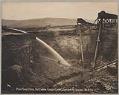
Hydraulic mining at Glacier Creek, near Nome, Alaska, circa 1904
By 1904, many of the gold mining claims around Nome, Alaska, were owned and operated by large mining companies. That year, the Miocene Ditch Company used hydraulic mining techniques at Price Bros. claim No. 2 below the original strike on Glacier Creek.This photo shows the Miocene Ditch Company's hydraulic mining operations at Glacier Creek, near Nome. A high powered stream…
ID Number:SHS9547
Date:Circa 1904
Photograph
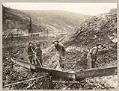
Manning a sluice at Bonanza Creek, circa 1898
Miners used water running through sluice boxes to wash the gold out of the pay dirt. Lumber for the sluice boxes was cut from nearby hills and finished in a nearby sawmill. As the hills were cleared, lumber became even more expensive. A typical two-man sluice was fifty feet long, ten inches tall, and twelve to fourteen inches across, with…
ID Number:SHS9548
Date:Circa 1898