450 results for: Military
Photograph
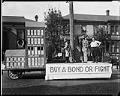
Float at Labor Day parade, Seattle, September 2, 1918
For many years, Seattle's industries closed on Labor Day, and trade union members marched in the annual Labor Day parade. In 1918, the United States' armed forces were still fighting in Europe. Union members serving at forts and naval stations in the Seattle area marched in the parade in uniform. The Seattle Times reported that 50,000 union members took part…
ID Number:1983.10.10777.1
Date:1918
Photograph
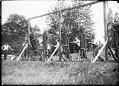
Bayonet drill, University of Washington, 1918
When the United States entered World War I in 1918, many students, faculty, and staff members left the University of Washington to serve in the military. The university expanded its military science programs, and the Reserve Officer's Training Corps organized ten units. Students in the ROTC program drilled for eight hours each week.This photo shows students at the University of…
ID Number:1983.10.10783
Date:1918
Photograph
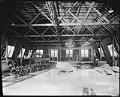
Navy pilots attending training class on UW campus, Seattle, 1918
During World War I the U. S. Navy established a temporary Naval Training Station in Seattle, on the University of Washington campus, near where the university's health sciences center is now located. The training camp was active from 1917-1919, during which time over 5,000 mostly college students were trained for both naval and naval aviation units. In this image, 11…
ID Number:1983.10.10784
Date:1918
Photograph
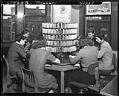
Women working in Northern Pacific office, Seattle, 1945
Northern Pacific Railroad's traffic department had its offices on the second floor of the Smith Tower. These women appear to be taking reservations by phone from that office. Trains were heavily used during the war years for moving military personnel as well as ordinary citizens. Handwritten on sleeve: Strang & Prosser.Webster & Stevens number: 45-337
ID Number:1983.10.15348.1
Date:1945
Photograph
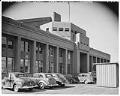
North face of US Naval Reserve Armory, Lake Union, August 22, 1942
Built on the former site of a Duwamish village, the Naval Reserve Armory was announced in 1937 but trouble with funding delayed completion of the project for several years. The Armory was designed by B. Marcus Priteca, a well-known theater architect, and William R. Grant. The Works Progress Administration, one of the New Deal agencies, constructed the building. Groundbreaking occurred…
ID Number:1983.10.17273.1
Date:1942
Photograph
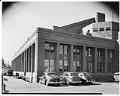
Northeastern corner of US Naval Reserve Armory, Lake Union, August 22, 1942
Built on the former site of a Duwamish village, the Naval Reserve Armory was announced in 1937 but trouble with funding delayed completion of the project for several years. The Armory was designed by well-known theater architect B. Marcus Priteca and William R. Grant. The Works Progress Administration, one of the New Deal agencies, constructed the building. Groundbreaking occurred in…
ID Number:1983.10.17273.2
Date:1942
Photograph
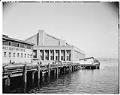
South side of US Naval Reserve Armory, Lake Union, August 22, 1942
Built on the former site of a Duwamish village, the Naval Reserve Armory was announced in 1937 but trouble with funding delayed completion of the project for several years. The Armory was designed by well-known theater architect B. Marcus Priteca and William R. Grant. The Works Progress Administration, one of the New Deal agencies, constructed the building. Groundbreaking occurred in…
ID Number:1983.10.17273.3
Date:1942
Photograph
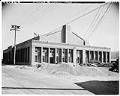
South side of US Naval Reserve Armory, Lake Union, August 22, 1942
Built on the former site of a Duwamish village, the Naval Reserve Armory was announced in 1937 but trouble with funding delayed completion of the project for several years. The Armory was designed by well-known theater architect B. Marcus Priteca and William R. Grant. The Works Progress Administration, one of the New Deal agencies, constructed the building. Groundbreaking occurred in…
ID Number:1983.10.17273.4
Date:1942
Photograph
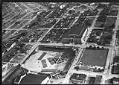
Aerial of National Guard Armory, Seattle, June 29, 1939
This aerial view looks south and west on what would later become the World's Fairgrounds, with the the Civic Auditorium and field in the foreground and the Armory (now the Center House) in the center. Handwritten on sleeve: 6-29-39 National Guard Armory.Photographer's number: T-921
ID Number:1983.10.17888
Date:1939
Photograph
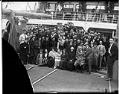
Group portrait of Russian immigrants arriving on President Jackson, Seattle, July 7, 1923
By early 1924, there were about 5000 Russians living in Seattle, most of whom arrived as refugees fleeing the Russian Revolution and Civil War of 1917-1922. Many were well-educated, including professionals, former government and military officers, or former aristocrats. The Russian community in Seattle centered on the Orthodox church on Lakeview Boulevard, which hosted classes on citizenship and the English…
ID Number:1983.10.18266
Date:1923