27 results for: Alaska Natives
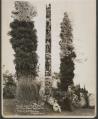
Postcard
J.E. Standley and young girl in front of a totem pole, Seattle, circa 1925
Ohio-born curio collector Joseph Edward "Daddy" Standley (1854-1940) came to Seattle in 1899 and opened Ye Olde Curiosity Shop on Second Avenue and Pike Street. He moved the shop to the Colman Dock on the waterfront in 1904, and since 1988 the shop has been located at Pier 54. Still a family-run business after five generations, the store attracts about…
ID Number:1980.6877.4.85
Date:Circa 1925
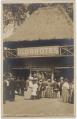
Postcard
Entrance to Igorrote Village, Pay Streak at Alaska-Yukon-Pacific Exposition, Seattle, 1909
The Alaska-Yukon-Pacific Exposition (AYPE) was a world's fair held in Seattle in 1909, publicizing the development of the Pacific Northwest. The fairgrounds became the campus of the University of Washington. One of the most popular attractions at the AYPE was the "Igorrote Village," a simulated village of the Igorot (previously spelled Igorrote), a diverse group of Indigenous Peoples living in…
ID Number:1980.7177.5.37
Date:1909
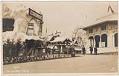
Postcard
On the Pay Streak, Alaska-Yukon-Pacific Exposition, Seattle, 1909
The Alaska-Yukon-Pacific Exposition (AYPE) was a world's fair held in Seattle in 1909, publicizing the development of the Pacific Northwest. The fairgrounds became the campus of the University of Washington. The AYPE included a constructed "Eskimo Village," which exhibited Indigenous people as attractions for the fair's visitors. This postcard shows the "Eskimo Village" with the Ferris wheel visible in background.…
ID Number:1980.7177.5.38
Date:1909
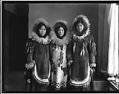
Photograph
Inuit or Alaska Native women in furs, Seattle, 1911
This image shows three Indigenous women, probably Inuit or Alaska Native, wearing traditional furs. Handwritten on sleeve: Eskimo - 1911.Webster & Stevens number: 8199
ID Number:1983.10.7961
Date:1911
Photograph
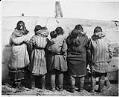
Native Alaskan women and children, 1905
In the early years of the 20th century, Frank H. Nowell, a Seattle photographer, spent several years in the area around Nome, Alaska. He took many photographs of the region and its native inhabitants and sold the photos to tourists and residents alike.In this photo, taken on a summer day in 1905, a group of Alaska Native, likely Inupiat, women…
ID Number:1983.10.13110
Date:1905
Photograph
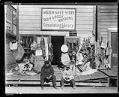
Golden Gate Store and Circulating Library, Alaska, 1905
In Alaska, many general stores still carry a little bit of everything, from thread and canned goods to boots and library books.This 1905 photo, taken during the Nome gold rush, shows an Alaskan Native man and boy sitting on the wooden sidewalk outside the Golden Gate Store. Baskets, furs, dolls, and other souvenirs cover the outside of the building. Even…
ID Number:1983.10.13147
Date:1905
Photograph
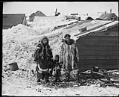
Angokwakzhuk and family, Nome, Alaska, 1905
In this 1905 photo, the Inupiat carver Angokwakzhuk (known as Happy Jack) stands next to his wife, Assongoyi, and daughter, Rose Ann Omelak, near a wooden building in Nome, Alaska. All three wear traditional fur parkas with fur-rimmed hoods.During the Nome gold rush, in the early years of the 20th century, Frank H. Nowell, a Seattle photographer, spent several years…
ID Number:1983.10.13161
Date:1905
Photograph
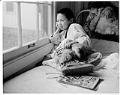
Young patient looking out of window at Firland Sanatorium, Seattle, December 1, 1954
Firland Sanatorium, Seattle’s municipal tuberculosis hospital, opened on May 2, 1911, to help combat what was at the time Seattle’s leading cause of death. Firland was located north of Seattle, on land donated by railroad magnate Horace C. Henry (1844-1928), whose son Walter had died of TB. The hospital served there until its move in 1947 to a former Naval…
ID Number:1986.5.9391.1
Date:1954
Photograph
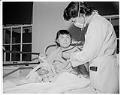
Doctor examining young patient at Firland Sanatorium, Seattle, December 1, 1954
Firland Sanatorium, Seattle’s municipal tuberculosis hospital, opened on May 2, 1911, to help combat what was at the time Seattle’s leading cause of death. Firland was located north of Seattle, on land donated by railroad magnate Horace C. Henry (1844-1928), whose son Walter had died of TB. The hospital sered there until its move in 1947 to a former Naval…
ID Number:1986.5.9391.2
Date:1954
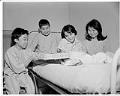
Photograph
Young patient giving another a gift at Firland Sanatorium, Seattle, December 1, 1954
Firland Sanatorium, Seattle’s municipal tuberculosis hospital, opened on May 2, 1911, to help combat what was at the time Seattle’s leading cause of death. Firland was located north of Seattle, on land donated by railroad magnate Horace C. Henry (1844-1928), whose son Walter had died of TB. The hospital served there until its move in 1947 to a former Naval…
ID Number:1986.5.9391.3
Date:1954