130 results for: Indigenous Peoples
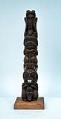
Model totem pole made by Ralph Bennett, ca. 1980
Ralph Alfred Bennett, Goo la'Slacoon, (b.1949) is a local carver and his name translated means "Abalone Fingers." He is fifth generation woodcarver from the Haida tribe in British Columbia. The eagle, bear, and beaver featured in this model totem pole are representative of Bennett's Haida heritage.
ID Number:1980.7110.1
Date:Circa 1980
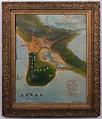
Painted map made by Adolph P. Wagner circa 1900-1920 and featuring an aerial view of Seattle in 1855-1856
On the morning of January 26, 1856, the "Battle of Seattle" began when Native Americans raided the white settlement in what is now known as Seattle. Previously warned of the attack, most settlers had barricaded themselves in a blockhouse. The attackers were driven off by artillery fire. The battle was the penultimate event in a series of armed conflicts, known…
ID Number:1981.7184.1
Date:Circa 1900-1920
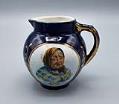
Cream pitcher with image of Kikisoblu (Princess Angeline), 1909
The image of Kikisoblu (Princess Angeline) was replicated on many souvenir items that sold in Seattle. This creamer was most likely purchased at the Alaska-Yukon-Pacific Exposition held in 1909. Kikisoblu (Princess Angeline), also known in Lushootseed as Kikisoblu, Kick-is-om-lo, or Wewick, was the eldest daughter of Chief Si'ahl (Chief Seattle). She was born around 1820 and lived until she was…
ID Number:1981.7249.1
Date:1909
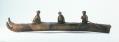
Model kayak made by native Alaskan artist, ca. 1900
This model kayak, made of leather from a seal or other marine animal, is part of a large collection of native American and native Alaskan materials collected by Fred Anhalt and donated to MOHAI. Frederick Anhalt (1896-1996) was a Seattle builder who constructed more than forty buildings in this city between 1925 and 1942. Three of Anhalt's buildings were given…
ID Number:1981.7357.77
Date:Circa 1900

Igorot spear from the Alaska-Yukon-Pacific Exposition (AYPE) replica village, 1909
The Igorot (meaning "people of the mountains") are indigenous, Austronesian-speaking ethnic groups that live in the Cordillera Mountains of Northern Luzon, Philippines. A group of Igorot people lived in a village on the Pay Streak at the Alaska-Yukon-Pacific Exposition (AYPE), held in Seattle in 1909. During the 1899 Philippine-American War, the Igorot were allied first with the independence fighters and…
ID Number:1983.47.1
Date:1909
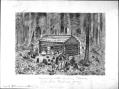
Watercolor drawing, "Bargaining with Indian Traders (at Alki Point in 1851)," by Emily Inez Denny, ca. 1870-1915
The daughter of one of Seattle’s founding families, Emily Inez Denny (1853 – 1918) was both a painter and writer. Greatly influenced by seeing the drawings of Sarah Willoughby as a student at the Washington Territorial University, she took on painting as a life-long pursuit. This scene was created by the artist based on stories told to her by her…
ID Number:1984.74.1
Date:Circa 1870-1915
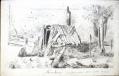
Pencil drawing, "Forsaken (Camp on West Shore of Lake Union)," by Emily Inez Denny, 1876
The daughter of one of Seattle’s founding families, Emily Inez Denny (1853 – 1918) was both an artist and writer. Greatly influenced by seeing the drawings of Sarah Willoughby as a student at the Washington Territorial University, she took on painting and drawing as a life-long pursuit. A woman who thrived on the creation of art, Emily constantly traveled with…
ID Number:1984.74.3
Date:1876
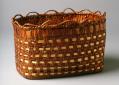
Quileute or Makah twined basket, ca. 1900
This basket is part of a large assortment of Indigenous baskets collected by Clara Young (1890-1983). Young was a schoolteacher in the early part of the 20th century and, from 1914-1915, she taught at a small schoolhouse located on the outer Washington coast near LaPush and Mora. This particular collection represents a time in Northwest Coast basketry when styles changed…
ID Number:1985.40.36
Date:Circa 1900
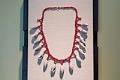
Makah, Quileute or Quinault necklace from the Clara Young collection, 1915
This necklace featuring Olivella shells found on Washington's coast is part of a large assortment of Indigenous materials collected by Clara Young (1890-1983) when she visited with the local tribes in that area. Young was a schoolteacher in the early part of the 20th century and, from 1914-1915, she taught at a small schoolhouse located on the outer Washington coast…
ID Number:1985.40.44
Date:1915
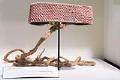
Tumpline, Salish, from the Clara Young collection, ca. 1890
When local Native people had to carry heavy loads like a canoe or bundle of wood, they’d use a tumpline strap to redistribute the weight. The strings tie around the load, and the band goes across the forehead or chest. This tumpline was collected by Clara Young (1890-1983). Young was a schoolteacher in the early part of the 20th century…
ID Number:1985.40.46
Date:Circa 1890