171 results for: Education
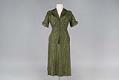
Green skirt suit with gold stripes, ca. 1950
This suit belonged to University of Washington Professor Blanche Payne (1897-1972). Payne was born in 1897 in Thayer, Kansas, and taught costume and design at the UW starting in 1927. She travelled through Central Europe and the Balkans surveying folk costume in the former Czechoslovakia, Hungary, Romania, Bulgaria, Turkey, Greece, Albania, and the former Yugoslavia. She collected original costumes, textiles,…
ID Number:1971.5263.442C1709
Date:Circa 1950
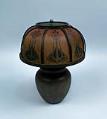
Electric table lamp that belonged to Grace McGrew Smith, Seattle teacher, ca. 1916
This lamp, an example of the Mission style, was purchased from David L. Russell who owned a Third Avenue art shop in the 1910s.
ID Number:1972.5416.2
Date:Circa 1916
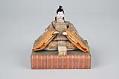
Japanese emperor doll from a Girls' Day set, ca. 1930-1940
Girls’ Day (Hinamatsuri) is traditionally celebrated with a display of decorative dolls representing the Imperial Court. The dolls are arranged on a series of platforms, draped in red cloth. At the top of the display are the Emperor and Empress. In 1942, the majority of the student body of the Bailey Gatzert Elementary School was of Japanese descent and all…
ID Number:1973.5711.1
Date:1930-1940
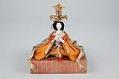
Japanese empress doll from a Girls' Day set, ca. 1930-1940
Girls’ Day (Hinamatsuri) is traditionally celebrated with a display of decorative dolls representing the Imperial Court. The dolls are arranged on a series of platforms, draped in red cloth. At the top of the display are the Emperor and Empress. In 1942, the majority of the student body of the Bailey Gatzert Elementary School was of Japanese descent and all…
ID Number:1973.5711.2
Date:1930-1940
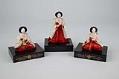
Three dolls, high servants to the empress, from a Girls’ Day set, ca. 1930-1940
Girls’ Day (Hinamatsuri) is traditionally celebrated with a display of decorative dolls representing the Imperial Court. The dolls are arranged on a series of platforms, draped in red cloth. These three court ladies are known as Sannin Kanjo. They serve the empress and manage ceremonial sake.In 1942, the majority of the student body of the Bailey Gatzert Elementary School was…
ID Number:1973.5711.3
Date:1930-1940
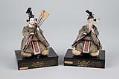
Two dolls, high servants to the emperor, from a Girls’ Day set, ca. 1930-1940
Girls’ Day (Hinamatsuri) is traditionally celebrated with a display of decorative dolls representing the Imperial Court. The dolls are arranged on a series of platforms, draped in red cloth. These figures are high servants to the emperor, possibly the minister positions known as Sadaijin and Udaijin. In 1942, the majority of the student body of the Bailey Gatzert Elementary School…
ID Number:1973.5711.4
Date:1930-1940
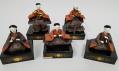
Five musicians (Gonin Bayashi) from a Girls’ Day set, ca. 1930-1940
Girls’ Day (Hinamatsuri) is traditionally celebrated with a display of decorative dolls representing the Imperial Court. The dolls are arranged on a series of platforms, draped in red cloth. This group of musicians is known as Gonin Bayashi. In 1942, the majority of the student body of the Bailey Gatzert Elementary School was of Japanese descent and all of these…
ID Number:1973.5711.5
Date:1930-1940
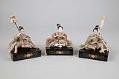
Three low servants from a Girls’ Day set, ca. 1930-1940
Girls’ Day (Hinamatsuri) is traditionally celebrated with a display of decorative dolls representing the Imperial Court. The dolls are arranged on a series of platforms, draped in red cloth. These three are low servants (sannin-jougo) helpers or protectors displaying angry, merry and sad faces. Also interpreted humorously as the three kinds of drunkards (sanshiki jogo, sannin jogo, or sannin namayoi):…
ID Number:1973.5711.6
Date:1930-1940
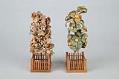
Cherry tree and citrus tree from a Girls’ Day set, ca. 1930-1940
Girls’ Day (Hinamatsuri) is traditionally celebrated with a display of decorative dolls representing the Imperial Court. The dolls and accessories are arranged on a series of platforms, draped in red cloth. It was traditional outside the imperial palace to have a cherry tree on the left and a citrus tree on the right (from the perspective of the emperor). These…
ID Number:1973.5711.7
Date:1930-1940
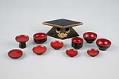
Dishes and mochi platform from a Girls’ Day set, ca. 1930-1940
Girls’ Day (Hinamatsuri) is traditionally celebrated with a display of decorative dolls representing the Imperial Court. The dolls and accessories are arranged on a series of platforms, draped in red cloth. This set of dishes includes a diamond-shaped platform for displaying colorful mochi. In 1942, the majority of the student body of the Bailey Gatzert Elementary School was of Japanese…
ID Number:1973.5711.8
Date:1930-1940