60 results for: Military
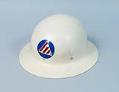
Civil Defense helmet, ca. 1940
Civil defense refers to the organized non-military effort to prepare Americans for military attack. During World War II, the Civil Defense Corps, organized approximately 10 million volunteers who were trained to fight fires, decontaminate after chemical weapon attacks, provide first aid, and other duties. This helmet would have been worn by one of these volunteersl. In recent decades, civil defense…
ID Number:1980.6924.16
Date:Circa 1940
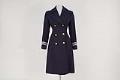
U.S. Navy WAVE uniform, worn by Jane Blogg, 1942
During World War II, the Women’s division of the United States Naval Reserve was known as the WAVES (Women Accepted for Volunteer Emergency Service). WAVES filled a variety of roles, including rigging parachutes, guiding planes in the control tower, work as metalsmiths, and more. WAVES were in high demand and received equal pay to their male counterparts of the same…
ID Number:1980.6961.1C2449
Date:1942
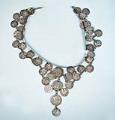
Coin necklace made by officers under the command of Governor Isaac Stevens, 1885
Isaac Ingalls Stevens (1818-1862) was the first Governor of Washington Territory, serving from 1853 to 1857. He also served as a US Congressman, and a Brigadier General in the Union Army during the Civil War until his death at the Battle of Chantilly. He was appointed posthumously to the grade of Major General of volunteers. This necklace was made by…
ID Number:1991.31.2
Date:1885
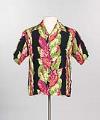
Hawaiian sport shirt worn by Admiral Ira E. Eskridge, 1948
Aloha, or Hawaiian, shirts were first created in Hawaii in the 1930s. They reflect island motifs and can be worn for a variety of occasions. The shirts became particularly popular stateside after World War II, when members of the military, such as Admiral Eskridge, brought the style home. On the mainland, the look was co-opted and reproduced as something kitschy…
ID Number:1992.39.1
Date:1948
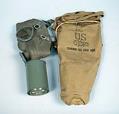
Gas mask with canvas carrying bag used for Civil Defense training, 1946
This mask was used locally for civil defense training. Civil defense refers to the organized non-military effort to prepare Americans for military attack. During World War II, the Civil Defense Corps, organized approximately 10 million volunteers who were trained to fight fires, decontaminate after chemical weapon attacks, provide first aid, and other duties. This helmet would have been worn by…
ID Number:1996.43.3
Date:1946
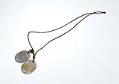
United States Navy WAVE dogtags, ca. 1944
These dog tags belonged to Harriet Airey Ross, who was a Seattle native and 1929 graduate of the University of Washington. During World War II, she was a Lieutenant in the WAVES and retired from the United States Naval Reserve as a Lieutenant Commander.
ID Number:2006.62.5
Date:Circa 1944

United States Navy nameplate, 1943-1969
Harriet Airey Ross was a Seattle native and 1929 graduate of the University of Washington. During World War II, she was a Lieutenant in the WAVES and retired from the United States Naval Reserve as a Lieutenant Commander.
ID Number:2006.62.16
Date:1943-1969
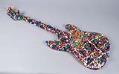
War protest art assemblage, guitar covered with paint and army toys, 2004
This guitar assemblage was made by local Seattle artist Scott MacIntire in 2004 in protest of the US-led invasion of Iraq, and subsequent Iraq War. The piece was created in conjunction with a 2004 fundraiser for the Hope Heart Institute, for which Art Institute of Seattle students and faculty embellished 30 electric guitars with various messages. The invasion and war…
ID Number:2009.7.1
Date:2004

Five gold stars from the Washington War Memorial, 1951
The Washington War Memorial was dedicated on January 7, 1951 at what used to be the Public Safety Building. These stars were mounted on the exterior of the building. The Memorial was decommissioned on January 5, 2005, when the building was demolished. The stars were symbolic of and intended to honor the Gold Star Mothers who had family members in…
ID Number:2009.11.1
Date:Circa 1951
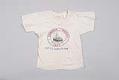
Child's "Dominion Monarch" T-shirt from the Century 21 Exposition, 1962
The ship the Dominion Monarch was commissioned in 1939 and worked the UK to Australia route via the Suez Canal. After only six months of that route she was drafted and repainted for use as a WWII troop transport. Later she became a "diaper ship," carrying military wives and families home. After the war she worked again as a liner…
ID Number:2009.22.5
Date:1962