60 results for: Military
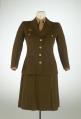
WAC uniform worn by Alice Holcomb (Sheldon) during WWII, ca. 1943
Over 150,000 women served in the Women’s Auxiliary Army Corps (WAAC) during World War II. Recruits had to be between 21 and 45, at least five feet tall, weigh over 100 lbs and have no dependents. At home and overseas, WAACs made weather forecasts, rigged parachutes, drove jeeps, analyzed aerial photos and did many other tasks that left the men…
ID Number:1952.117.1C681
Date:Circa 1943
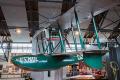
Boeing B-1 flying boat airplane, ca. 1919
The B-1 was the first aircraft designed and assembled entirely by the Boeing Airplane Company for commercial rather than military purposes. The hull was made using laminated wood veneer, and the wings were framed with Washington-grown spruce. Beginning in 1920, the plane was used on the first regularly scheduled international airmail route between Seattle and Victoria. The B-1 could carry…
ID Number:1952.552.1
Date:1919
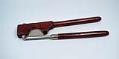
Docker from Seattle's first veterinary hospital, ca. 1900
This instrument was used at Seattle's first veterinary hospital by Captain Harry C. Fullington of the Veterinary Corps of the Washington State National Guard. These clippers "dock" or cut horses' tails to give them an upright brush-like appearance. The practice was outlawed in the early 20th century.
ID Number:1953.295
Date:Circa 1900
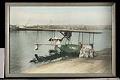
Colorized photograph of Boeing B-1 mail plane on Lake Union, 1919
The B-1 was the first aircraft designed and assembled entirely by the Boeing Airplane Company for commercial rather than military purposes. The hull was made using laminated wood veneer, and the wings were framed with Washington-grown spruce. Eddie Hubbard is best known as the pilot who inaugurated international airmail service between Seattle, Washington to Victoria, British Columbia. Beginning in 1920,…
ID Number:1953.345.b.2
Date:1919
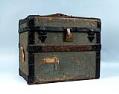
Mess chest, ca. 1859
This mess chest was used in a border dispute between the United States and British armies in the "Pig War" of 1859. It held the gold paid to soldiers of the British Army when the northwest boundary line between the original Oregon Territory and Canada was being settled. The slogan was "Fifty-Four-Forty or Fight," which represented the latitude boundary line…
ID Number:1957.1238.2
Date:Circa 1859
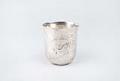
Silver cup engraved with the name "Major Granville Owen Haller," ca. 1860
Granville Owen Haller (1819-1897) was a US Army military officer who became a wealthy and prominent Seattle businessman. In 1852, G.O. Haller was promoted to Major and was transferred from service in the Mexican-American War to the Washington Territory. During his service in the Civil War he was dismissed in 1863. In 1883, he returned to the Seattle area and…
ID Number:1957.1333.1
Date:Circa 1860
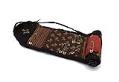
Roll-up style needle case, 1861
George C. Gleason carried this needle case while he was a Civil War soldier. It was made by his daughter and is a rare example of Civil War history within the MOHAI collection, 1861.
ID Number:1958.1508.3
Date:1861
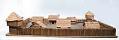
Model of Fort Nisqually, ca. 1910-1930
The artifact donor made this model when he was 11 years old. It represents the Hudson's Bay Company fur trading and farming post located in what is now Dupont, Washington. Nisqually was chosen for its ideal ship anchorage location and, in 1832, the first structure, the Nisqually House, was built, with more buildings added thereafter.
ID Number:1958.1563
Date:Circa 1910-1930
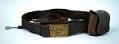
Uniform belt from the Civil War period, ca. 1860s
W.R. Davis wore this belt as part of his uniform for the Home Guard in Junction City, Oregon, during the Civil War period. The extra straps are made to go over the wearer's shoulders and the attached leather pocket would hold ammunition or sundries.
ID Number:1959.1606.1
Date:Circa 1860
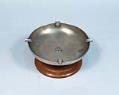
Ashtray made from the engine room bell of the USS OREGON, ca. 1893
The USS OREGON battleship launched in 1893 for the United States Navy and served during the Spanish-American War (1898), the Philippine-American War (1899-1902), and WWI before she was decommissioned in 1919. In 1925, she was lent to the state of Oregon to serve as a floating monument and museum in Portland. Her stripped hulk was later used as an ammunition…
ID Number:1959.1816.3
Date:Circa 1893