40 results for: Construction and Urban Planning
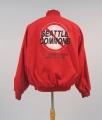
Red "No Seattle Commons" jacket, 1995-1996
The Seattle Commons was a proposal to build a massive park between Denny Way and the southern end of Lake Union. This jacket from the “no” campaign argues for saving the neighborhood of industrial warehouses and affordable housing. Voters rejected the Seattle Commons twice—in 1995 and 1996. Sweeping redevelopment soon transformed the South Lake Union area anyway.
ID Number:2017.40.1
Date:1995-1996
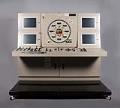
Central control panel from "Bertha," the Seattle Tunnel Boring Machine, ca. 2012
The Seattle Tunnel Boring Machine (TBM), nicknamed "Bertha" after the city's first female mayor Bertha Knight Landes, was the largest TBM ever built at the time in 2012. For over 4 years, Bertha dug a nearly 2-mile long tunnel along the city's waterfront, completing it's underground journey in 2019. The control panel was the heart of the machine where the…
ID Number:2017.42.1.1
Date:Circa 2012
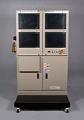
Additional cabinet for the central control panel from "Bertha," the Seattle Tunnel Boring Machine, ca. 2012
The Seattle Tunnel Boring Machine (TBM), nicknamed "Bertha" after the city's first female mayor Bertha Knight Landes, was the largest TBM ever built at the time in 2012. For over 4 years, Bertha dug a nearly 2-mile long tunnel along the city's waterfront, completing it's underground journey in 2019. The control panel was the heart of the machine where the…
ID Number:2017.42.1.2
Date:Circa 2012
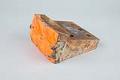
Cutter bit or tooth from the cutter head of the Seattle Tunnel Boring Machine, ca. 2012
The Seattle Tunnel Boring Machine (TBM), nicknamed "Bertha" after the city's first female mayor Bertha Knight Landes, was the largest TBM ever built at the time in 2012. For over 4 years, Bertha dug a nearly 2-mile long tunnel along the city's waterfront, completing it's underground journey in 2019. Bertha's cutter head consisted of eight 24-foot long spokes, and along…
ID Number:2017.42.3.1
Date:Circa 2012
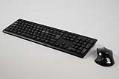
Japanese & English computer keyboard and mouse associated with the Seattle Tunnel Boring Machine computer mainframe, ca. 2012
The Seattle Tunnel Boring Machine (TBM), nicknamed "Bertha" after the city's first female mayor Bertha Knight Landes, was the largest TBM ever built at the time. It was made by Hitachi Zosen Sakai Works in Osaka, Japan, and assembly completed in Seattle in 2013. For over four years, Bertha dug a nearly two-mile long tunnel along the city's waterfront, completing…
ID Number:2017.42.Ref.Keyboard
Date:Circa 2012
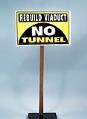
Picket sign, "Rebuild Viaduct, No Tunnel," ca. 2007
Although everyone agreed that the aging Alaskan Way Viaduct needed to be torn down, not everyone supported the Seattle Tunnel Boring project. There was a large contingent of people who wanted to rebuild the Alaskan Way Viaduct, led by the Citizens for an Elevated Solution. In 2007, a vote of preference was put before the citizens of Seattle and King…
ID Number:2017.64.1
Date:Circa 2007
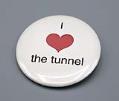
Pin, "I (heart) the tunnel," ca. 2007
The Seattle Tunnel Boring Machine (TBM), nicknamed "Bertha" after the city's first female mayor Bertha Knight Landes, was the largest TBM ever built at the time in 2012. For over 4 years, Bertha dug a nearly 2-mile long tunnel along the city's waterfront, completing it's underground journey in 2019. This pin was worn by a supporter of the tunnel project…
ID Number:2017.64.2
Date:Circa 2007
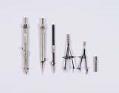
Set of surveying tools used by James Casey Embree, ca. 1903-1939
James Casey Embree (1881-1940) was an early Seattle civil engineer. He was responsible for surveying various Seattle neighborhoods and, from 1906-1924, he worked on the Alaskan Engineering Commission that would provide railroads to parts of Alaska following the Gold Rush of 1897.
ID Number:2018.54.1
Date:Circa 1900
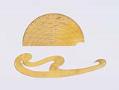
Protractor measuring tool used by James Casey Embree, ca. 1903-1939
James Casey Embree (1881-1940) was an early Seattle civil engineer. He was responsible for surveying various Seattle neighborhoods and, from 1906-1924, he worked on the Alaskan Engineering Commission that would provide railroads to parts of Alaska following the Gold Rush of 1897.
ID Number:2018.54.2
Date:1877
Surveying stencil tool used by James Casey Embree, ca. 1903-1939
James Casey Embree (1881-1940) was an early Seattle civil engineer. He was responsible for surveying various Seattle neighborhoods and, from 1906-1924, he worked on the Alaskan Engineering Commission that would provide railroads to parts of Alaska following the Gold Rush of 1897.
ID Number:2018.54.3
Date:1877