58 results for: Coast Salish Peoples
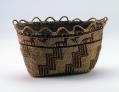
Skokomish twined basket, ca. 1900
The Skokomish Tribe was originally primarily composed of Twana Indians, a Salishan people from the Hood Canal drainage basin in western Washington State. The Twana subsisted on hunting, fishing and gathering activities, moving around in warmer weather and settling on more permanent sites during colder climes. Twana descendants live on the Skokomish Reservation, and all have become known as the…
ID Number:1965.3775.8
Date:Circa 1900
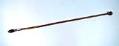
Noisemaker cane, ca. 1911-1941
During the early Seattle Potlatches, many of these canes were used by the celebrants. A tablet the size of an aspirin made of a strong explosive was put in the iron slot at the bottom and when it was thumped on the sidewalk, a very loud explosion occurred. These noisemakers unfortunately burned women's ankles from the flash so they were…
ID Number:1966.3878.63
Date:Circa 1911-1941
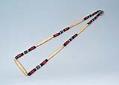
Trade bead necklace, ca. 1910
This necklace was collected by Aubrey Archer in the early part of the 20th century. His father, Finch R. Archer, was the Alotting Agent for the Quinault, Queets, and Hoh tribes from 1906 to 1912. He was in charge of alotting these government land to these tribes. Aubrey worked with his father during school vacations.
ID Number:1970.4971.2
Date:Circa 1910
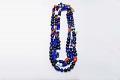
Trade bead necklaces, ca. 1850
Strings of beads and dentalium were often used for trade or sale between the Native community and the early European settlers.
ID Number:1971.5263.69
Date:Circa 1850
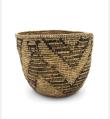
Coiled cedar basket, Skokomish, ca. 1900
This basket, although highly decorated, was well used for activities such as berry picking or food storage. It is made from cedar bark, cedar root, horsetail root, and beargrass.
ID Number:1972.5396
Date:Circa 1900
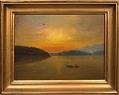
Painting of Indigenous person paddling a canoe on Lake Union, ca. 1900
Anna L. Fonda (1863-1917) was born in New York and settled in the Tacoma/Seattle area around 1892. She is best known for her landscapes and still-life works.
ID Number:1973.5723
Date:Circa 1900
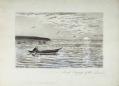
Watercolor painting, "Last Voyage of the Lumei," by Emily Inez Denny, ca. 1870-1915
The daughter of one of Seattle’s founding families, Emily Inez Denny (1853 – 1918) was both a painter and writer. Greatly influenced by seeing the drawings of Sarah Willoughby as a student at the Washington Territorial University, she took on painting as a life-long pursuit. Emily’s father, David Denny, supported her artistic aspirations and frequently brought home printing paper from…
ID Number:1974.5903.44
Date:Circa 1870-1915
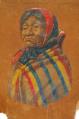
Hide painting of Kikisoblu (Princess Angeline) by Carrie Monroe (C.M.) Gilbert, ca. 1900-1915
Kikisoblu (Princess Angeline), also known in Lushootseed as Kikisoblu, Kick-is-om-lo, or Wewick, was the eldest daughter of Chief Si'ahl (Chief Seattle). She was born around 1820 and lived until she was in her mid-seventies. This portrait is reproduced from a photograph. The artist, Carrie Monroe Gilbert (1871-1956), lived in Oregon and was known for her portraits of Indigenous people of…
ID Number:1980.6980.1
Date:Circa 1900-1915
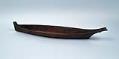
Model canoe carving given as gift to donor's father from Chief Si'ahl (Chief Seattle), 1891
This model canoe was made by either Chief Si'ahl (Chief Seattle) or a member of his tribe and bears the insignia of the family on the bow and stern. When Marian Engle Cummings, donor of this model, was born, her father was gifted with the canoe to signify that his newborn child was an honorary member of the tribe. Prior…
ID Number:1980.7084.1
Date:Circa 1891
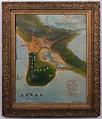
Painted map made by Adolph P. Wagner circa 1900-1920 and featuring an aerial view of Seattle in 1855-1856
On the morning of January 26, 1856, the "Battle of Seattle" began when Native Americans raided the white settlement in what is now known as Seattle. Previously warned of the attack, most settlers had barricaded themselves in a blockhouse. The attackers were driven off by artillery fire. The battle was the penultimate event in a series of armed conflicts, known…
ID Number:1981.7184.1
Date:Circa 1900-1920