58 results for: Coast Salish Peoples
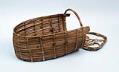
Cradle basket given to Gilbert Norris Turner by members of the Tulalip tribe in the early 1910s
This cradle basket was given to the donor's family as a gift from the Tulalip people. The family fished with their Tulalip neighbors at their summer home in Snohomish.
ID Number:2015.95.1
Date:Circa 1910
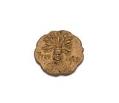
Token coin, "Tyee 1913 Klahowya! Potlatch, Seattle" made by Mayer Bros. Makers
This token is from the Seattle "Potlatch" of 1913 and made by the Mayer Bros., prominent Seattle jewelry maker. "Klahowya" means "Welcome" in Chinook jargon and “Tyee” means chief or an important person. The name "Golden Potlatch" appropriates a Chinook Jargon word describing a Native ceremony celebration and gift giving. It also reflects the importance of the Klondike Gold Rush…
ID Number:2016.34.1
Date:1913
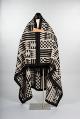
Salish pattern Honor blanket, designed by Louie Gong of Eighth Generation, 2018
Eighth Generation is taking back the wool blanket market and empowering Indigenous artists along the way. In 2015, they became the first Indigenous-owned company to offer wool blankets. They stand as an ethical alternative to companies that profit from designs that are “Native-inspired.” This particular design references Coast Salish weaving patterns that stretch back thousands of years. While these blankets…
ID Number:2018.72.1
Date:2018
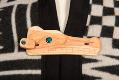
Blanket pin made by Peter Gong, 2018
Carver Peter Gong (Squamish) made the custom yew wood wolf pin closure. Peter is uncle to Louie Gong, founder of Eighth Generation, a Seattle-based and Indigenous-owned wool blanket company. This pin was made to fasten the Salish blanket when worn around the shoulders. Eighth Generation strengthens the Indigenous artist community by contracting directly with cultural artists from around the country.
ID Number:2018.72.2
Date:2018
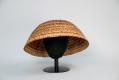
Woven cedar bark Chief Si'ahl (Chief Seattle) style hat made by DeAnn Jacobson, 2019
Native American weaver DeAnn Jacobson (Duwamish, Suquamish), a direct descendant of Chief Si'ahl (Chief Seattle), wove this hat from cedar bark. Coast Salish tribes have used locally sourced materials like cedar bark to make weatherproof clothing for millennia. Such garments range in style from functional to decorative.
ID Number:2019.15.1
Date:2019

Contemporary art paddle commemorating the opening of the Seattle Duwamish Longhouse and Cultural Center, 2009
Contemporary art paddle commemorating the opening of the Seattle Duwamish Longhouse and Cultural Center in 2009.
ID Number:2019.60.1
Date:2009
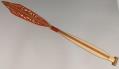
Canoe Journeys paddle made by Keith Stevenson, Muckleshoot, ca. 2020
Tribal Canoe Journeys is a celebrated event for the Indigenous peoples of the Pacific Northwest Coast. Participants travel and visit neighboring Nations in ocean-going canoes, usually made of traditional cedar material, but other materials and more modern techniques may be applied as well. Justice Bill (Muckleshoot/Tlingit) stated: “Canoe Journeys have revitalized our nations through travel by oceangoing canoes and the…
ID Number:2021.76.1
Date:Circa 2020
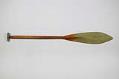
Canoe paddle carved by Emmett Oliver (Swinomish), 1934
This canoe paddle was carved by Emmett Oliver of the Swinomish Tribe. He raced in the Lone Eagle dugout canoe during the annual Canoe Race of 1934. The Lone Eagle would be the same boat that raced against the UW crew in the 1941 Great Race. Long before white settlers introduced rowing to this region, Coast Salish tribes paddled the…
ID Number:2024.55.1
Date:1934