137 results for: Toys
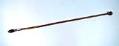
Noisemaker cane, ca. 1911-1941
During the early Seattle Potlatches, many of these canes were used by the celebrants. A tablet the size of an aspirin made of a strong explosive was put in the iron slot at the bottom and when it was thumped on the sidewalk, a very loud explosion occurred. These noisemakers unfortunately burned women's ankles from the flash so they were…
ID Number:1966.3878.63
Date:Circa 1911-1941
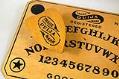
Ouija board with pointer, ca. 1917
The Ouija Board, or talking board, has long been a popular recreational activity at gatherings. It features a series of letters and numbers, and is considered to be a conduit to communicating with the spirit world. Participants place their hands on the planchette, or pointer, and ask questions. The planchette moves around the board, seemingly without urging from the participants,…
ID Number:1966.3924.1
Date:Circa 1917
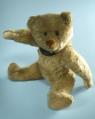
Teddy bear, ca. 1906
This cuddly children’s toy, was invented almost simultaneously in the United States and Germany, but the United States undoubtedly gave it its name. In November 1902, President Theodore ‘Teddy’ Roosevelt was hunting in Mississippi. He failed to make a kill so his hosts caught and tethered a bear, presenting it to the President as a sitting target. Naturally the President…
ID Number:1966.3969.3
Date:Circa 1906
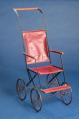
Doll carriage, ca. 1900
This collapsible doll carriage was a favorite toy of the donor, Blanche Erickson, when she was a child.
ID Number:1969.4777.2
Date:Circa 1900
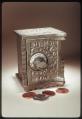
Coin bank in the shape of a floor safe, ca. 1900
This is a promotional item from Union Bank made by Kenton Hardware Manufacturing Company in Ohio. Kenton produced cast iron toys, stoves, and miniature banks and distributed them across the US. These toy banks were very popular in the late 19th and early 20th centuries.
ID Number:1970.4869.7
Date:Circa 1900
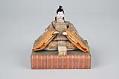
Japanese emperor doll from a Girls' Day set, ca. 1930-1940
Girls’ Day (Hinamatsuri) is traditionally celebrated with a display of decorative dolls representing the Imperial Court. The dolls are arranged on a series of platforms, draped in red cloth. At the top of the display are the Emperor and Empress. In 1942, the majority of the student body of the Bailey Gatzert Elementary School was of Japanese descent and all…
ID Number:1973.5711.1
Date:1930-1940
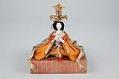
Japanese empress doll from a Girls' Day set, ca. 1930-1940
Girls’ Day (Hinamatsuri) is traditionally celebrated with a display of decorative dolls representing the Imperial Court. The dolls are arranged on a series of platforms, draped in red cloth. At the top of the display are the Emperor and Empress. In 1942, the majority of the student body of the Bailey Gatzert Elementary School was of Japanese descent and all…
ID Number:1973.5711.2
Date:1930-1940
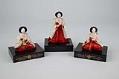
Three dolls, high servants to the empress, from a Girls’ Day set, ca. 1930-1940
Girls’ Day (Hinamatsuri) is traditionally celebrated with a display of decorative dolls representing the Imperial Court. The dolls are arranged on a series of platforms, draped in red cloth. These three court ladies are known as Sannin Kanjo. They serve the empress and manage ceremonial sake.In 1942, the majority of the student body of the Bailey Gatzert Elementary School was…
ID Number:1973.5711.3
Date:1930-1940
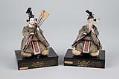
Two dolls, high servants to the emperor, from a Girls’ Day set, ca. 1930-1940
Girls’ Day (Hinamatsuri) is traditionally celebrated with a display of decorative dolls representing the Imperial Court. The dolls are arranged on a series of platforms, draped in red cloth. These figures are high servants to the emperor, possibly the minister positions known as Sadaijin and Udaijin. In 1942, the majority of the student body of the Bailey Gatzert Elementary School…
ID Number:1973.5711.4
Date:1930-1940
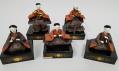
Five musicians (Gonin Bayashi) from a Girls’ Day set, ca. 1930-1940
Girls’ Day (Hinamatsuri) is traditionally celebrated with a display of decorative dolls representing the Imperial Court. The dolls are arranged on a series of platforms, draped in red cloth. This group of musicians is known as Gonin Bayashi. In 1942, the majority of the student body of the Bailey Gatzert Elementary School was of Japanese descent and all of these…
ID Number:1973.5711.5
Date:1930-1940